Home
» Today
»
Winter Weather Advisory Explained: What U.S. Alert Levels Mean for Canadian Readers
Winter Weather Advisory Explained: What U.S. Alert Levels Mean for Canadian Readers
Information checked: November 15, 2026, 8:03 p.m. UTC. “Winter Weather Advisory” is the National Weather Service (NWS) term used in the United States. In Canada, Environment and Climate Change Canada (ECCC) uses a different set of alert names and a color-coded impact system. For Canadian readers, the practical question is less “Which U.S. level applies?” and more “What hazard is forecast for my location, how serious are its expected effects, and when should I act?”
This is a guide to interpreting alert language, not a report of a specific storm or a check of active alerts in any particular community. Winter alerts are local and can change as forecasts are updated.
Destaques
In the U.S. system, an advisory signals impactful winter conditions below local warning criteria; a watch means a significant storm is possible; a warning calls for action.
Canada’s ECCC uses Warnings, Advisories, and Watches too, but the color banner and impact level add separate information.
Read the location, timing, forecast confidence, expected impacts, and safety steps in the full alert—not just its headline or color.
A lower-severity label does not mean risk-free: snow, ice, blowing snow, or extreme cold can still make a particular trip dangerous.
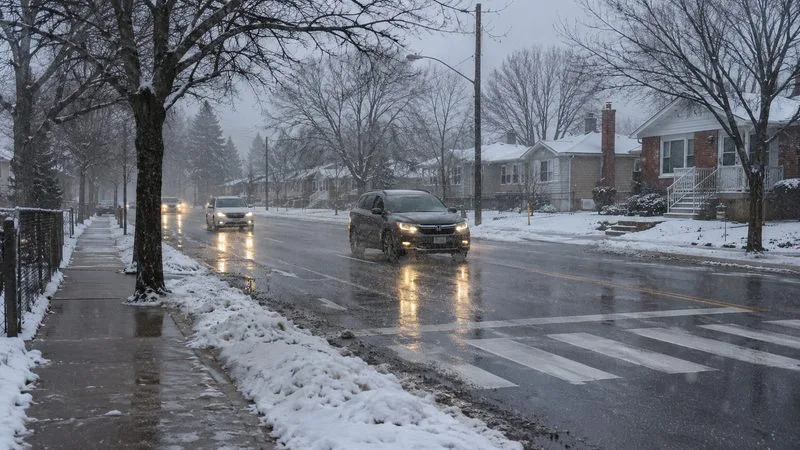
Winter precipitation can make roads slick and reduce visibility even when conditions do not meet the highest alert threshold. (Illustrative image.)
What does a U.S. Winter Weather Advisory mean?
The NWS issues a Winter Weather Advisory when snow, blowing snow, sleet, ice, or a combination is expected to cause inconvenience and possible travel difficulty, but is forecast to remain below the local criteria for a warning. The agency advises people to be aware, use caution, and prepare for winter driving conditions. The advisory is not a promise that roads will be safe or that impacts will be minor for every person.
There is no single nationwide snowfall amount that defines every advisory. NWS offices use criteria suited to their local climate and terrain: an amount that is unusual or disruptive in one region may be common in another. Ice, wind, visibility, timing, and the combination of hazards can matter as much as the snow total. An advisory can also cover freezing rain or sleet, so check the hazard details instead of assuming it means snow alone.
How do watches, advisories, and warnings differ?
Watch — be prepared. A significant winter storm is possible, but its track, timing, or intensity may still be uncertain. Use the lead time to review plans and get ready for likely disruptions.
Advisory — be aware and use caution. Winter conditions are expected to create meaningful inconvenience or hazards, often including difficult travel, but they do not meet the local warning threshold.
Warning — take action. A significant or dangerous winter event is expected or underway. Follow the alert’s safety advice, reconsider travel, and prepare for serious effects such as closures or outages.
These are general descriptions, not a universal severity scale based on a fixed number of centimetres or inches. For example, an ice storm or a short, intense snow squall can create dangerous conditions without a large seasonal snowfall total.
How does Canada’s alert system work?
For people in Canada, ECCC’s official products are the relevant source. The system includes Warnings, Advisories, and Watches. A Warning means severe weather is happening or expected and people should act to protect themselves. An Advisory calls for action for significant but less severe weather; ECCC lists hazards such as blowing snow, fog, freezing drizzle, and frost. A Watch means conditions are favorable for severe weather to develop, so get ready and keep monitoring for a possible upgrade.
Canada’s newer alert banners use yellow, orange, or red to communicate severity. Those colors do not replace the alert type: the banner can say, for example, “Orange Warning — Blizzard.” The detailed message may also give an impact level—moderate, high, or extreme—and a forecast-confidence level. These are related but distinct signals. The impact guide describes expected effects on daily routines, travel, utilities, property, and health; forecast confidence tells you how certain forecasters are that the event will occur. ECCC cautions that weather can have serious consequences at any impact level.
Canadian winter alerts can be hazard-specific: snowfall, snow squall, freezing rain or freezing drizzle, winter storm, flash freeze, extreme cold, blizzard, or blowing snow. A blizzard alert focuses on wind-driven snow and poor visibility; a flash-freeze alert concerns a rapid temperature drop that can turn wet roads and sidewalks icy. The headline tells you the alert type and hazard, while the body tells you what is expected in the affected area.
What should you check before deciding what to do?
Open the full alert from ECCC’s weather map or WeatherCAN app, or from your local NWS office if you are in the United States. Confirm that your community is inside the listed area and note when conditions are expected to begin and end. Look for the specific hazard, forecast confidence, expected impacts, and recommended actions. Then check the forecast again before leaving: conditions and alert boundaries can change, and a narrow band of snow or freezing precipitation may affect nearby places differently.
For a commute, consider visibility, road icing, and timing—not only accumulation. For an outdoor event, think about exposure to wind chill and whether travel routes could become difficult. If officials advise avoiding travel, take that guidance seriously. If you must go, use current road and transit information, allow extra time, and tell someone your route. These are general precautions; the alert’s location-specific instructions should guide decisions during an active event.
Is a Winter Weather Advisory the same as a Warning?
No. In U.S. terminology, an advisory is for impactful winter conditions below local warning criteria; a warning signals a more significant or dangerous event and calls for action. Local criteria vary.
Does a yellow Canadian alert mean it is safe to travel?
No. Color communicates severity, not a safety guarantee. Read the hazard, impact, timing, confidence, and instructions for your area before deciding.
Can an alert change after it is issued?
Yes. A Watch can be upgraded to a Warning as confidence or expected severity increases, and alert details can be revised. Recheck official forecasts and alerts as conditions approach.