Home
» Today
»
W5 Airport Baggage-Tag Scam Report: Key Findings and What Canada Is Changing | Nov. 15, 2026
W5 Airport Baggage-Tag Scam Report: Key Findings and What Canada Is Changing | Nov. 15, 2026
Updated: November 15, 2026, 3:02 p.m. Toronto time (EST, UTC−05:00); 8:02 p.m. UTC.
CTV’s W5 has expanded its investigation into airport baggage-tag switching with a new five-part series, reporting more than two dozen Canadian cases and renewed calls for stronger airport controls. The alleged scheme is more serious than ordinary baggage theft: a traveler’s airline tag can be moved to a separate suitcase containing drugs, leaving the innocent passenger’s name attached to contraband found overseas. The cases remain individual allegations and investigations; a tag match by itself does not establish who packed or owned a bag.
The latest reporting also complicates the advice to photograph checked luggage. Images and a tracking device may help establish what a traveler’s own suitcase looked like or where it went, but W5’s November coverage describes a Toronto traveler whose documentation initially drew suspicion from authorities in Albania. Canada is considering broader security-clearance rules for transportation workers, but the relevant legislation has not passed and existing screening rules remain in force.
Destaques
W5’s November reporting broadened its count to more than two dozen Canadian cases; the earlier May investigation had identified at least 17 passengers detained abroad over the preceding year.
W5 reported that RCMP figures included 16 Pearson employees arrested over five years, at least five in connection with tag-switching cases.
Bill C-39 is still under House committee consideration; no proposed clearance reform has taken effect.
Photographing a bag and its tag may preserve useful evidence, but it cannot guarantee protection or prevent a foreign criminal investigation.
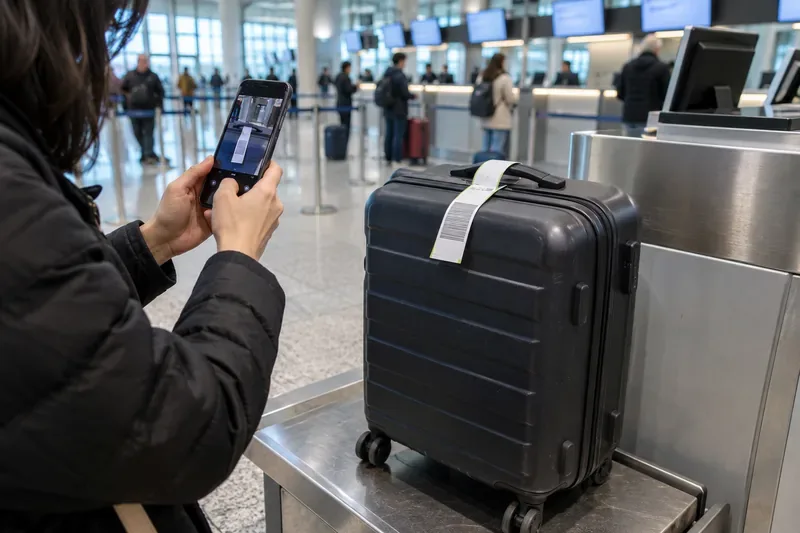
Illustrative image: a traveler documenting a suitcase at check-in; it does not depict a specific airport or incident.
What did W5 find about airport baggage-tag switching?
In its May investigation, W5 said it had identified at least 17 passengers who departed from Canada and were detained on drug-smuggling suspicions after their baggage tags were allegedly transferred to suitcases carrying drugs. The reported cases involved destinations including the Dominican Republic, France, Germany, Morocco, Bermuda, the Philippines and South Korea. The network described by W5 depends on an insider changing the link between a passenger and a bag: the passenger checks a legitimate suitcase, but its tag is allegedly attached to another suitcase that travels under the passenger’s booking details.
The November series widened the reported picture to more than two dozen cases involving Canadians, most connected to departures from Toronto Pearson, and covered people still facing consequences abroad. W5 also reported that the RCMP said 16 Pearson workers had been arrested over the prior five years, with at least five arrests connected to tag-switching schemes. These are not interchangeable totals: the May figure concerned passengers detained over a one-year period, while the later reporting discussed a broader set of cases and employee arrests over five years. An arrest is not a conviction, and the cases do not prove that every airport worker or airline is involved.
The RCMP has publicly documented a separate, earlier case that demonstrates how the alleged method can work. In July 2025, it announced charges against two baggage-handling employees after a passenger arriving in Paris was detained and then released without charges. Police said about 21 kilograms of cannabis had been transported to France using a switched tag. Those allegations were charges announced by police, not findings of guilt. The RCMP release is a documented example, not evidence that the same facts apply to every W5 case.
What changed in the latest W5 report?
The key development is the move from an initial tally of affected passengers to a wider examination of recurring cases, accountability and government action. The November installments follow travelers who say they were detained abroad after contraband bags carried their baggage tags. W5’s latest traveler-safety segment revisits government advice to photograph luggage and tags, but reports that such evidence may not be interpreted the same way by every foreign investigator. A photograph can show the appearance of a bag at a moment in time; it does not by itself prove who handled it afterward or what was inside.
The report also raises practical questions about who is responsible for baggage after check-in. Airlines, airport authorities, ground-handling companies, screening agencies and police have different roles. Air Canada has said it is cooperating with law enforcement and working with airport and other stakeholders on security measures, according to reporting on the investigation. W5’s cases underscore how difficult it can be for a passenger to get prompt answers when several organizations touch a checked bag.
What is Canada changing at airports?
Transport Canada’s official discussion paper says the current Transportation Security Clearance program is focused mainly on transportation-specific risks and has limits in considering links to organized crime or patterns of suspicious activity. The department proposed a broader, risk-based framework that could consider those factors and extend clearance requirements to additional roles connected to cargo, logistics and transportation systems. Its published “What We Heard” report says participants supported addressing insider threats but also urged proportional screening, clear criteria, adequate resources and attention to worker rights and regional realities.
The government is pursuing legislative changes through Bill C-39, the Building Canada Strong Act. Parliament’s LEGISinfo page lists the bill as under consideration in a House of Commons committee, with the latest recorded House stage being referral to committee on October 8, 2026. The committee has held meetings, but report stage and third reading have not been reached. The bill is therefore a proposal, not a new rule already applied to airport employees. Transport Canada likewise says the current clearance program remains in place until changes are approved and implemented.
A separate written question in the House of Commons asks the government for five years of data on tag-switching cases, affected bags, charges, drugs moved and safeguards at Canadian airports. The question page still lists the response as pending. That means W5’s reporting provides important case-based evidence, while a complete official national count and a full public account of preventive procedures remain unavailable in the material reviewed.
How can Canadian travelers document checked luggage?
Travelers can take a clear photo or short video of the outside of each bag at the airline counter, with its airline-issued tag visible, and keep the baggage receipt and claim stub until the bag is returned. A photo that shows the bag on the scale can help record its appearance and approximate check-in weight. A luggage tracker may provide another clue about a bag’s location, but its data is not a substitute for police or airline records. Keep valuables, medication, travel documents and essential electronics in carry-on baggage where permitted.
These precautions are documentation, not a guarantee against theft, tampering or mistaken suspicion. Do not attach another person’s tag, accept a bag to carry for someone else, or leave checked luggage unattended before handoff. If a bag appears missing, altered or unexpectedly tracked elsewhere, contact the airline immediately and ask that the report be recorded; if there is a suspected crime or an urgent safety concern, contact airport police or local authorities. On international trips, travelers should also review the destination’s laws and Canadian government travel advice.
What happens next?
The next measurable step is legislative and administrative: whether Bill C-39 advances, what changes Parliament ultimately approves, and how Transport Canada turns any new authority into regulations and screening practices. Parliamentary status and the department’s own consultation report show that work is ongoing; they do not establish a timetable for a finished policy. The pending government response to the House question could also clarify how many incidents authorities have formally recorded and what controls already exist.
For now, travelers should treat bag photos and tags as one layer of record-keeping, not as proof that a bag cannot be switched. The broader policy issue is whether airport access controls, worker screening, camera coverage, baggage reconciliation and law-enforcement coordination can close the gaps identified by investigators while protecting fair treatment for workers and passengers.
FAQ
Is baggage-tag switching the same as ordinary luggage theft?
No. The reported scheme involves allegedly moving a passenger’s airline tag onto a different bag, sometimes one containing drugs. The passenger may still receive their own suitcase or may be detained when the tagged bag is discovered elsewhere.
Does photographing a checked bag guarantee protection?
No. Photos may help document a bag’s appearance and tag at check-in, but they cannot prove every later handling step or prevent an investigation abroad.
Have Canada’s airport security-clearance changes taken effect?
No. As of November 15, 2026, Bill C-39 remains in committee, and Transport Canada says the current clearance program remains in place until any amendments are approved and implemented.