Home
» Today
»
National Weather Service Alerts: How Warnings Work During Outages | Nov. 14, 2026
National Weather Service Alerts: How Warnings Work During Outages | Nov. 14, 2026
Information checked: November 14, 2026, 1:05 a.m. UTC (November 13, 2026, 8:05 p.m. Eastern Standard Time, UTC−05:00). This is the time of this review, not the time of an NWS service incident.
The National Weather Service (NWS) does not rely on a single website, radar map, or smartphone app to warn the public. Its forecasts and warnings travel through a network of government communications systems, broadcasters, cellular alerts, NOAA Weather Radio, and commercial services. If one website or feed stops responding, other pathways may still work—but no individual channel is guaranteed to remain available during every failure.
The distinction matters after November 13 reports raised questions about a possible nationwide NWS disruption. Reporting on an NWS Central Operations administrative message issued November 13 at 23:01 UTC (6:01 p.m. Eastern Standard Time, UTC−05:00) said radar data systems and network communications were operating normally, with no widespread NWS information technology or network outage. The live public archive accessible in this review did not display that message, so its wording is attributed to contemporary reporting rather than presented as independently retrieved. A problem loading a radar page should not be treated as proof that radar equipment, warnings, and emergency broadcasts have all stopped.
Destaques
NWS warnings reach the public through separate, sometimes interconnected channels—not only weather.gov.
Wireless Emergency Alerts (WEA), NOAA Weather Radio, television, radio, and weather apps have different technical dependencies and limitations.
A broken website or unavailable map does not, by itself, establish a nationwide radar or warning-system outage.
For life-threatening weather, use multiple sources and follow any valid warning immediately instead of waiting for a preferred app to recover.
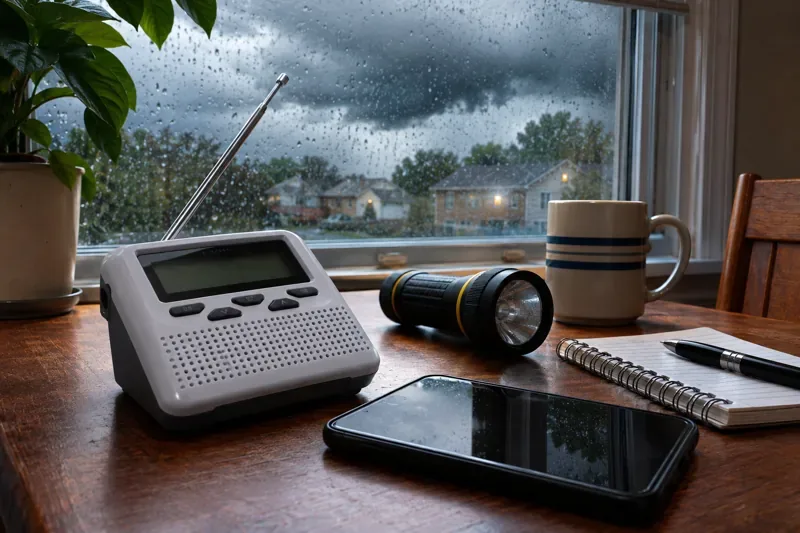
Illustrative scene of a home weather-safety setup with a weather radio, flashlight, and phone. This is not a photograph of an NWS outage or a live alert screen.
How does the National Weather Service issue and distribute weather warnings?
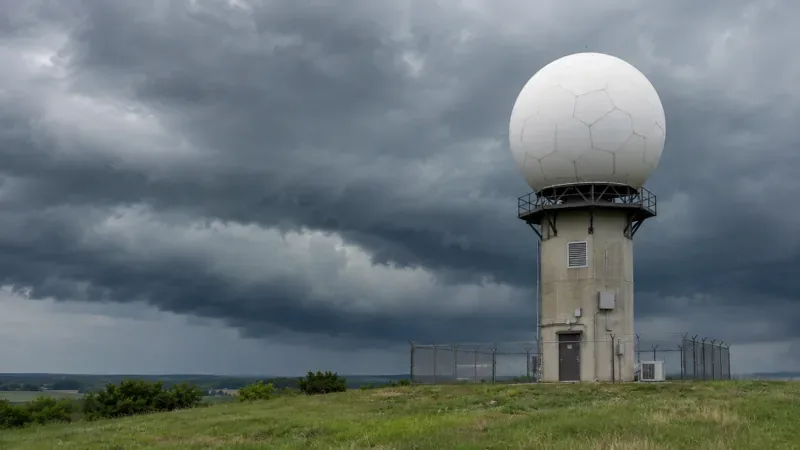
Local NWS Weather Forecast Offices and national centers monitor conditions using observations, Doppler weather radar, satellite data, and other tools. Meteorologists assess the hazard, determine the warning area and timing, and issue products such as tornado warnings, severe thunderstorm warnings, and flash flood warnings. The warning then enters dissemination systems used by emergency managers, broadcasters, websites, and third-party alert providers.
The NWS Office of Dissemination identifies several distinct delivery methods. NOAA Weather Wire Service (NWWS) sends text warnings to broadcasters and emergency-response partners using Internet and satellite distribution. NOAA Weather Radio (NWR) broadcasts weather information and alerts over dedicated radio frequencies. Additional government and commercial systems take NWS data and display it through maps, APIs, television graphics, radio broadcasts, and mobile applications.
Not every alert is sent as a loud notification to every phone. Whether a message activates a wireless alert, local broadcast, or radio alarm depends on the warning type, affected area, technical rules, equipment, and the delivery network.
What happens if weather.gov or the NWS API goes down?
The website is a public access point, not the entire warning infrastructure. The NWS API supplies forecasts, alerts, and observations for applications and websites. If the API becomes unavailable or returns stale data, an app that depends on it can fail to refresh—even when other alert-delivery routes are still operating.
Likewise, a radar image that will not load can reflect an issue with a map interface, distribution server, internet connection, or a particular radar site. Radar is a detection and observation resource; a radar display is not itself the official warning message. To judge a disruption, identify which service failed, where it failed, and whether the NWS has issued a system notice. Do not infer that every nationwide alert channel is down merely because one screen is blank.
Is the NOAA Weather Wire Service designed for interruptions?
Yes, but redundancy is not immunity. NWS describes NWWS as a rapid text-warning feed with both Internet and satellite sources. Its technical guidance recommends using both paths for stronger availability and explicitly acknowledges planned and unplanned interruptions to the Internet-based interface. Those dual paths are especially relevant to broadcasters and emergency managers with properly configured receiving equipment; ordinary households do not automatically receive the satellite feed.
Will Wireless Emergency Alerts still arrive during an outage?
Wireless Emergency Alerts are short, geographically targeted emergency notifications sent through participating cellular networks to compatible phones. FEMA's Integrated Public Alert and Warning System (IPAWS) helps authenticated alerting authorities distribute eligible emergency messages to participating channels, including WEA and the Emergency Alert System (EAS). The NWS wireless-alert guidance explains how urgent weather warnings can reach people on the move.
A WEA may still arrive when a public weather webpage cannot be reached, because the phone alert is not simply a push notification from that webpage. But that is conditional: message origination, alerting-system gateways, carrier infrastructure, cellular coverage, and phone settings can each affect delivery. Some warnings are not WEA-eligible. Never assume silence means there is no danger.
How is NOAA Weather Radio different from a phone app?
NOAA Weather Radio All Hazards uses dedicated VHF radio transmitters instead of requiring a household broadband connection. Properly programmed receivers with alert capability can sound for covered local hazards. This makes a battery-powered weather radio a useful backup when home power, broadband, or mobile-data service fails.
However, a local transmitter can itself be degraded or off the air, and reception depends on location, terrain, antenna, receiver settings, and power. NOAA Weather Radio is therefore a complementary route, not an absolute guarantee. NWS maintains transmitter-status information, which can help distinguish a local radio problem from a wider disruption.
What should you do if a weather alert or radar feed stops working?
Act on the hazard first. If you see a tornado, dangerous flooding, or other immediate threat, take appropriate protective action without waiting for a web service to reload.
Check an independent channel. Try NOAA Weather Radio, a trusted local television or radio broadcaster, or local emergency-management announcements.
Verify your phone. Confirm emergency alerts are enabled and assess whether the device has cellular signal. A third-party app's failure is not necessarily a WEA failure.
Prepare before the next storm. Keep a charged power bank, battery-operated weather radio, flashlight, and locally relevant shelter plan.
What does redundancy mean for future NWS interruptions?
Redundancy reduces dependence on one network or product, but it does not eliminate shared points of failure. The NWS dissemination architecture intentionally offers different transport methods, while FEMA's IPAWS framework distributes authenticated alerts through multiple public-facing channels. Both designs help explain why a web or API interruption can have different consequences from a failure in message origination or cellular broadcasting.
The exact effect of any future incident will depend on which component is affected and how long the failure lasts. Before describing an outage as nationwide, look for a time-stamped NWS operational notice identifying the actual impaired services. Meanwhile, keeping two or more genuinely different ways to receive warnings is more useful than installing several apps that all depend on the same upstream feed.
If the NWS website is down, are tornado warnings still issued?
They may still be issued and distributed through other channels. A website problem alone does not establish whether the warning-origination systems are affected.
Do Wireless Emergency Alerts require a weather app or Wi-Fi?
No. WEA uses participating cellular networks and compatible phones, rather than a downloaded weather app or home Wi-Fi. Coverage and other delivery conditions still matter.
What is the best backup when mobile data fails?
A battery-powered, properly programmed NOAA Weather Radio is a strong complementary source, alongside local broadcast outlets and emergency-management guidance. No channel is failproof.