Home
» Today
»
Senate Blocks Fast-Track Data Center Bill: What It Could Mean for AI and Cloud Infrastructure
Senate Blocks Fast-Track Data Center Bill: What It Could Mean for AI and Cloud Infrastructure
The headline “Senate blocks data center bill” needs one important qualification. On September 17, 2026, Sen. Jon Husted of Ohio asked the Senate to pass the House-approved Ratepayer Protection Act by unanimous consent. Sen. Martin Heinrich of New Mexico objected. That stopped the fast-track request, but it did not amount to a final Senate vote rejecting the bill, and it does not prevent the measure from being considered again through the normal legislative process.
The House had passed H.R. 9340 one day earlier, 417-3. The proposal targets a narrow but increasingly important question: when a very large data center needs new generation, transmission, or distribution infrastructure, who should pay for those upgrades? The bill would require state utility regulators and certain nonregulated utilities to consider a federal standard under which qualifying data-center customers cover the full incremental cost of the grid upgrades needed to serve them, along with financial assurances or contributions before construction begins.
For AI and cloud infrastructure, the immediate effect is limited because the bill is not law. The more useful question is what would change if a similar policy eventually takes effect, and what signals operators, utilities, investors, and customers should watch in the meantime.
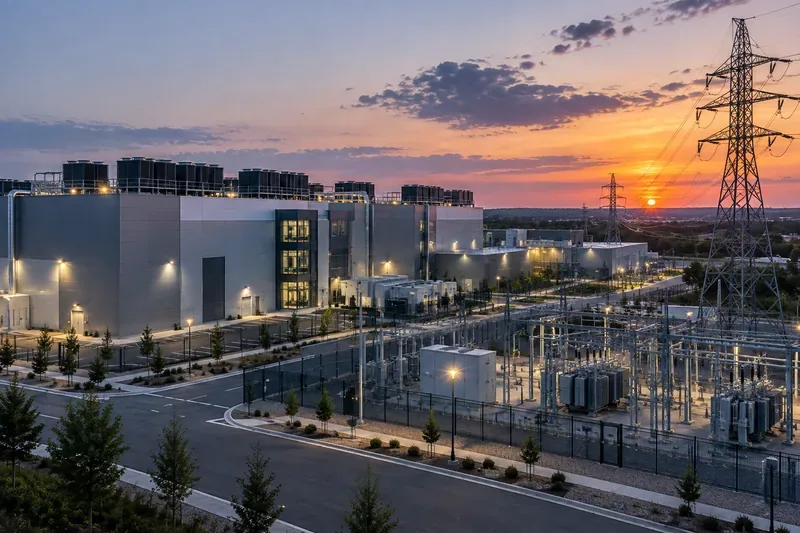
A hyperscale-style data center next to grid infrastructure illustrates the core policy question: how the cost of new power capacity and network upgrades should be allocated.
What happened in the Senate
The Ratepayer Protection Act moved unusually far with bipartisan support in the House. The House Energy and Commerce Committee says H.R. 9340 passed the chamber 417-3 on September 16.
On September 17, Husted sought unanimous consent in the Senate to pass the bill quickly. Under that procedure, a single senator can object and stop immediate passage. Heinrich objected and instead sought passage of his GRID Savings Act. A Republican senator objected to that request as well. The competing actions are documented in statements from Husted’s Senate office and Heinrich’s Senate office.
The disagreement is partly about how binding federal policy should be. Husted describes the Ratepayer Protection Act as a practical bipartisan way to protect households and small businesses from infrastructure costs associated with new data centers. Heinrich argues that its “consider” framework is too weak and prefers a more mandatory approach. Those are policy positions advanced by the senators; the current legislative fact is simpler: neither proposal cleared the Senate through unanimous consent on September 17.
What the Ratepayer Protection Act would actually do
The Congressional Budget Office describes H.R. 9340 as a requirement for state regulatory commissions to consider whether to adopt standards for certain large-load customers. The covered customer is a nonresidential electricity user operating a data center with peak demand of at least 100 megawatts at a single facility.
The proposed standard focuses on two financial protections. First, rates would be designed to recover the full incremental cost of generation, transmission, or distribution upgrades necessary to serve the qualifying data center. Second, the utility would obtain financial assurances or contributions associated with those upgrades. The intent is to reduce the risk that infrastructure built for a very large customer later becomes a cost borne by other customers if the project shrinks, changes plans, or leaves.
That distinction matters. The bill would not create a national electricity price cap, ban new data centers, or directly order every state to adopt one uniform rate. CBO says commissions would have to consider the federal standard, but under current law they could adopt or reject it. That makes the potential effect more dependent on state utility proceedings than the bill’s name alone may suggest.
Why AI and cloud operators care about grid-cost allocation
Modern AI infrastructure is power intensive, and the scale of new campuses makes utility planning a first-order business issue. The U.S. Energy Information Administration says data-center development is a major driver of rising electricity demand. In its September 2026 Short-Term Energy Outlook, EIA forecasts U.S. electricity sales of 4,135 billion kilowatthours in 2026 and 4,211 billion kilowatthours in 2027, with data centers and manufacturing contributing heavily to the increase. See the EIA electricity outlook.
Lawrence Berkeley National Laboratory’s 2025 update projects that U.S. data centers could account for 9.5% to 15.3% of total U.S. electricity use by 2030 across its modeled scenarios, with a reference estimate of 11.8%. The range is wide because future server shipments, AI-chip utilization, efficiency, and facility design remain uncertain. The LBNL report is useful precisely because it presents a range rather than a single guaranteed outcome.
When a proposed campus needs hundreds of megawatts, the cost is not just the electricity it consumes. New substations, transmission capacity, feeder upgrades, generation contracts, or storage may also be needed. A policy that places more of those incremental costs directly on the data-center customer could affect site economics even if it does not change the underlying demand for compute.
Potential effect on AI infrastructure: higher upfront certainty, possibly higher project costs
If states adopt a stronger “large load pays” framework, developers could face larger deposits, longer financial commitments, or special tariffs tied to the specific infrastructure their projects require. That may raise the upfront cost of some campuses, especially those in regions where the grid needs substantial expansion.
At the same time, clearer cost-allocation rules can reduce another kind of risk: uncertainty. A developer deciding between several states wants to know not only the power price but also the interconnection timeline, required security, stranded-cost exposure, and the terms that apply if projected load does not materialize. Lawrence Berkeley National Laboratory’s 2026 work on rate designs for large loads notes that utilities and regulators are increasingly using specialized tariffs and electric-service agreements to manage these risks.
The quality outcome to look for is not simply “cheaper data centers.” A more useful measure is whether a project receives a transparent price for the grid capacity it needs, whether other customers are protected from identifiable stranded costs, and whether the rules are stable enough for long-lived infrastructure planning.
Potential effect on cloud capacity: likely uneven by region
A federal “must consider” framework would still leave meaningful authority with states and utility commissions. That means the impact could differ substantially by market. A data-center proposal in a region with spare transmission capacity and abundant generation might face a modest incremental bill. The same project in a constrained region could require much more expensive upgrades.
For cloud providers, that could reinforce an existing trend toward geographic diversification. Capacity decisions may increasingly balance latency, fiber availability, land, tax incentives, water constraints, generation supply, and large-load tariff structure rather than treating electricity as a simple cents-per-kilowatthour comparison.
One sign of a good outcome would be fewer surprises after a project is announced: a clear queue position, a credible power-delivery date, and documented responsibility for upgrade costs. A warning sign would be repeated revisions to required grid investments or long delays between a data-center announcement and firm power availability.
Potential effect on consumers: protection depends on implementation
The bill is framed around ratepayer protection, but its mechanism is indirect. It would ask state regulators to consider a cost-allocation standard; it would not itself calculate a household bill or guarantee a specific reduction. Electricity rates are shaped by many factors, including fuel costs, generation investment, transmission, distribution, weather, and state regulatory decisions.
For consumers, the most relevant test is therefore whether state regulators can identify data-center-related upgrades and assign the associated incremental costs consistently. Another useful measure is whether utilities disclose the assumptions behind new large-load forecasts. If large projects are delayed or canceled after infrastructure is built, regulators also need a way to determine who is responsible for the remaining fixed costs.
Does the Senate action slow the AI buildout right now?
Not by itself. The September 17 objection did not impose a construction moratorium, change existing utility tariffs, cancel interconnection agreements, or restrict cloud providers from adding servers. Companies still operate under state utility rules, local permitting requirements, grid-operator processes, private power contracts, and existing federal law.
The more immediate constraint is physical and commercial: whether enough generation and grid capacity can be delivered on the schedule a data-center project requires. EIA has repeatedly identified data centers as a major source of near-term load growth, especially in regions such as ERCOT and PJM. When demand grows faster than supply or network capacity, the effects can show up in interconnection delays, infrastructure spending, wholesale prices, and negotiations over special large-load rates.
That is why the Senate episode matters even without a new law. It shows that federal lawmakers are actively debating who should bear the cost of grid expansion tied to large computing loads.
What to watch next
Signal
Why it matters
What would change the outlook
Senate scheduling
Unanimous consent failed, but the bill can still move through normal Senate procedure.
A committee action, floor agreement, amendment, or formal vote would be more consequential than the September 17 objection alone.
State utility tariffs
States already regulate many large-load cost issues.
New minimum-demand charges, longer contract terms, deposits, or exit-fee structures could affect data-center economics before Congress acts.
Interconnection timelines
Power availability can determine when AI capacity goes live.
Shorter queues or firm transmission commitments would ease a major bottleneck; persistent delays would increase siting pressure elsewhere.
Utility load forecasts
Forecast accuracy affects how much infrastructure utilities build.
Large downward revisions to expected data-center demand would reduce some investment needs; sustained upward revisions would strengthen the case for more capacity.
Power-price and rate cases
These proceedings determine who pays for new infrastructure.
Regulators adopting clear data-center-specific cost allocation would make project economics more predictable.
Bottom line
The Senate did not hold a final up-or-down vote rejecting the Ratepayer Protection Act. A senator objected to an attempt to pass it by unanimous consent on September 17, leaving the House-passed bill stalled rather than dead.
For AI and cloud infrastructure, the near-term practical effect is minimal because no new federal standard took effect. The longer-term significance lies in the policy question the bill puts at the center of the data-center boom: how much of the grid expansion required by 100-megawatt-plus facilities should be paid directly by those facilities, and how much risk should remain with utilities and other ratepayers?
The strongest way to evaluate what happens next is to watch measurable outcomes rather than headlines: Senate legislative action, state tariff decisions, interconnection lead times, required financial assurances, and whether utilities can add capacity without shifting identifiable project-specific costs to customers who did not cause them. Those indicators will tell operators and consumers more about the real infrastructure impact than the failure of one fast-track vote.