Would Europe Be Drawn into a Hypothetical U.S.-Israel-Iran Nuclear War? NATO Rules Explained

A guide to NATO Articles 4 and 5, UN self-defense rules, and why consultation does not mean automatic European entry into war.
AMD's latest CPUs — the Ryzen 9000-Series — launched in August 2024 and were heavily criticized for their poor performance.
Now, AMD has responded to the issues with its underperforming flagship CPU line with a new update that could deliver a few more frames per second.
AMD Releases New BIOS Update to Speed Up 9000-Series
AMD has released a new BIOS version in direct response to performance issues discovered during the launch of the Ryzen 9000-Series and subsequent reviews.
Update for AMD 5-socket AMD motherboards with AMD Ryzen 600 or 870X chipsets can now be upgraded to a new version of AMD's BIOS, bringing performance boosts for Ryzen 9600X and 9700X CPUs, improved inter-core latency for all other Ryzen 9 9000-Series CPUs.
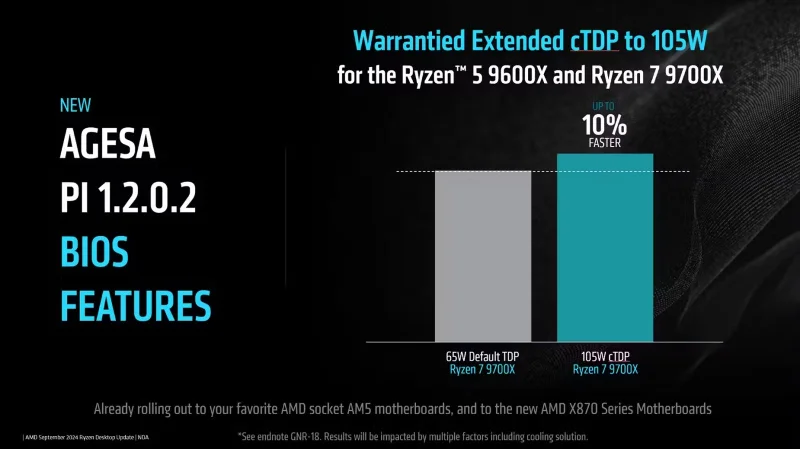
AMD's official blog claims that its new BIOS can increase the chip's TDP (thermal design power) by up to 10%, up from the default TDP of 65W to 105W.
The extra power delivers what all Ryzen 9000-Series users want: More performance.
Interestingly, the update also improves inter-core latency, where information is shared between CPU cores to speed up processing. Previously, AMD found that this process required two interactions to read and write data.
But now, the AMD BIOS update 1.2.02 has cut the number of transactions in half, significantly reducing the latency between these data transfers.
AMD BIOS update brings PCIe 5.0 support
Now, eagle-eyed folks may have spotted something else this BIOS update brings: AMD's Ryzen 9000-Series CPUs will support PCIe 5.0.
Why is this important?
It's rumored that Nvidia's next-generation 5000-Series GPUs will use PCIe 5.0, which means that if you want the most powerful consumer GPUs, you'll need a motherboard and CPU that support PCIe 5.0.
Update your AMD motherboard BIOS now!
Anyone with an AMD Ryzen 9000-Series CPU should update their BIOS to the latest version right now. Updating the BIOS is a relatively simple process, plus updating the BIOS can bring a number of benefits, not just the performance boost mentioned above.
A guide to NATO Articles 4 and 5, UN self-defense rules, and why consultation does not mean automatic European entry into war.
Assess claims about Iran in six steps, distinguishing uranium enrichment, weapons development and verified possession.
Understand nuclear decision authority in six steps, including US civilian control and the limits of public information about Israel.
A guide to official 2026 evidence on Hormuz shipping disruption, Iran-related claims, confirmed incidents, and what remains uncertain.
A source-based guide to nuclear escalation risks, UN Charter rules and NATO Article 5 in a strictly hypothetical Iran scenario.
Use five steps to prepare for an outage; nuclear and EMP scenarios are hypothetical, and official shelter instructions come first.
Use 5 defensive steps to verify a cyber disruption, protect household accounts, and avoid mistaking an outage for war.
Use these 5 steps to assess climate effects from a hypothetical Iran strike, compare model assumptions, and avoid unsupported predictions.
Explore six steps for reading research on climate, food and ecosystem recovery after a hypothetical nuclear conflict.
Build a practical fallout preparedness kit in six steps, with sealed food and water, a radio, medical supplies and shelter guidance.