Home
» Technology
»
Blockchain in Global Trade: What It Can—and Cannot—Do for Transparency and Traceability
Blockchain in Global Trade: What It Can—and Cannot—Do for Transparency and Traceability
Blockchain can improve transparency and traceability in global trade when several independent parties need to share and verify the history of the same shipment, document, or product without relying entirely on one party's database. It is much less compelling when a trusted operator already controls the workflow, counterparties do not agree on common data standards, or the information entering the system cannot be verified.
That distinction should come before any technology decision. Global trade is already difficult because a shipment can involve exporters, importers, carriers, freight forwarders, ports, customs authorities, banks, insurers, inspection bodies, and other participants. A shared ledger may reduce reconciliation between those parties, but it does not automatically make physical-world data true, make electronic trade documents legally valid, or make competing systems interoperable.
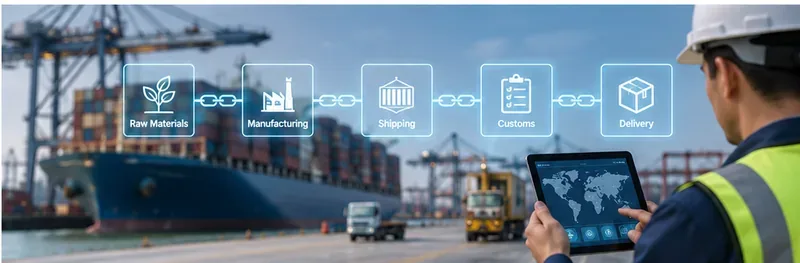
A global trade flow spans multiple organizations and handoffs. Blockchain can provide a shared record of those events, but useful traceability still depends on trusted data, common standards, legal recognition, and participation across the network.
What problem are you actually trying to solve?
Start by naming the failure in the current process. If the problem is that several companies maintain separate records of the same trade event and spend time reconciling mismatches, a distributed ledger may help. If the problem is that a supplier enters inaccurate origin data, blockchain alone does not solve it. If the problem is that a customs authority will not legally accept an electronic document, the priority is legal and standards work rather than ledger architecture.
The World Trade Organization describes blockchain as a decentralized distributed ledger whose records are difficult to alter and highlights its potential for secure, transparent, and verifiable recordkeeping in trade. The WTO also treats blockchain as one part of a wider digital-trade toolkit that includes paperless trade, standards, digital identity, data governance, and other technologies. See the WTO's Digital Technologies and Trade resources.
A practical decision therefore begins with the business process, not with the word “blockchain.” Ask which parties disagree about the state of a transaction, which records are duplicated, which events need a durable audit trail, and which organization currently bears the cost of resolving disputes.
What does blockchain make more transparent?
Blockchain is strongest at making a shared sequence of recorded events easier for authorized participants to verify. Examples can include the creation of a shipping document, a custody handoff, an inspection result, a customs status update, or the transfer of control over an electronic trade record.
In a permissioned trade network, transparency does not have to mean publishing commercially sensitive information to the public. Participants can be given different access rights while the system preserves a common history of authorized events. The design question is therefore not “public or private?” but “who needs to see what, who can write which events, and how are those permissions governed?”
For product provenance, the ledger may link events such as production, certification, shipment, border clearance, and receipt. For trade finance, it may help counterparties establish that the same electronic record has not been inconsistently presented across disconnected systems. For customs collaboration, it may provide an auditable data-sharing layer when authorities and private actors have agreed on the information to exchange.
Can blockchain prove that a product really came from where the ledger says it did?
Not by itself. Blockchain can make a recorded claim difficult to alter later; it cannot independently verify that the original claim was true. This is the central limit of blockchain-based traceability.
Suppose a coffee exporter records that a shipment came from a certified farm. The ledger can preserve the record and its history. It still needs a trustworthy link between the physical coffee and the digital identity: reliable supplier controls, inspections, certificates, tamper-resistant identifiers, IoT sensors, or other verification mechanisms. If someone enters false data before the blockchain record is created, immutability preserves the false statement just as effectively as a true one.
This is why traceability projects increasingly combine data standards, identity, sensors, certification systems, and governance rather than treating blockchain as a stand-alone truth machine. UNECE's UN/CEFACT work on trade facilitation and sustainable value-chain traceability similarly emphasizes interoperable information and verifiable disclosures. Its Trade Facilitation Recommendations include Recommendation No. 49 on trustworthy, interoperable sustainability information across value chains.
When is blockchain better than a conventional database?
Decision criterion
Blockchain/DLT is more attractive when...
A conventional shared database may be simpler when...
Number of organizations
Several independent parties need to write or verify records.
One trusted organization controls the workflow.
Trust model
No participant should have unilateral power to rewrite history.
Participants already accept one operator as the system of record.
Auditability
A tamper-evident sequence of cross-company events has business or compliance value.
Ordinary database logs satisfy audit needs.
Data sharing
Partners are willing to use common identities, permissions, and data definitions.
Partners will not contribute usable data regardless of technology.
Interoperability
The ledger fits established standards and can exchange data with outside systems.
The proposed blockchain would create another closed data island.
Governance
Participants can agree on validation, onboarding, dispute, correction, and exit rules.
No credible multi-party governance model exists.
The table explains why a blockchain proof of concept can work technically but fail commercially. The difficult part is often not consensus software; it is consensus among companies.
What did TradeLens teach the industry?
TradeLens is an important caution because it was a real blockchain-enabled global trade platform, not merely a laboratory experiment. Maersk and IBM announced in November 2022 that they would discontinue it. Maersk said the platform itself was viable, but the level of global industry collaboration needed for commercial viability had not been achieved. The platform was scheduled to go offline by the end of the first quarter of 2023. The original announcement remains available from A.P. Moller - Maersk.
The lesson is not that blockchain cannot work in trade. It is that network value depends on participation, neutrality, incentives, integration cost, and governance. A technically sound ledger with insufficient ecosystem adoption can still lose to less sophisticated infrastructure that more partners are prepared to use.
Before funding a new network, identify who must join for the system to become useful, what each participant gains, who pays, how competitors are governed, and how organizations can leave without losing access to legally or operationally important records.
Do electronic trade documents need blockchain to be legally valid?
No. This is one of the most important distinctions in digital trade.
The United Nations Commission on International Trade Law adopted the Model Law on Electronic Transferable Records (MLETR) in 2017. MLETR is technology neutral. It can accommodate registries, tokens, distributed ledgers, and other technical models as long as the required legal functions are satisfied.
For an electronic transferable record to be functionally equivalent to a paper transferable document or instrument under the MLETR framework, reliable methods are needed to identify the record, preserve its integrity, and establish control. Bills of lading, bills of exchange, promissory notes, and warehouse receipts are among the kinds of instruments relevant to the model law.
Therefore, choosing blockchain does not by itself establish legal equivalence. A company also needs to check the laws applicable to the transaction, the jurisdictions involved, contractual arrangements, and whether the relevant electronic record system meets applicable reliability requirements.
Why do standards matter more than the choice of ledger?
A blockchain network that records proprietary field names and identifiers may be internally consistent yet still fail to communicate with carriers, banks, customs platforms, or other trade networks. Interoperability requires shared semantics: parties need to mean the same thing when they exchange a container identifier, legal entity, port location, shipment status, or document field.
The WTO and ICC jointly published the Standards Toolkit for Cross-border Paperless Trade to map widely used foundational, identifier, commercial, transport, logistics, regulatory, and interoperability standards. The toolkit emphasizes that limited adoption and fragmentation of data standards restrict seamless information flow across the supply chain.
The ICC Digital Standards Initiative currently focuses on the same problem: globally interoperable digital trade rather than a single required technology. Its Digital Standards work covers identifiers, commercial transactions, logistics, official-control documents, interoperable frameworks, and electronic transferable records.
Recommendation: choose identifiers, document standards, APIs, and data models before choosing a ledger implementation. A blockchain should consume and produce interoperable trade data, not become a reason to invent another private vocabulary.
Where do electronic bills of lading fit?
An electronic bill of lading, or eBL, is a digital form of a bill of lading that can perform the legal and commercial functions required of that document when the relevant legal and technical conditions are met. An eBL may use blockchain, another type of distributed ledger, or a different reliable system. Treating “eBL” and “blockchain bill of lading” as synonyms is incorrect.
Momentum around eBLs is nevertheless useful evidence that trade digitization is progressing. As accessed in September 2026, the ICC Digital Standards Initiative homepage reports an eBL adoption rate of 12.8%, up from 5% in 2024. That is an eBL adoption figure, not a blockchain adoption figure. DCSA member carriers have separately committed to 100% eBL adoption by 2030 based on standardized digital processes. See the ICC Digital Standards Initiative and Digital Container Shipping Association.
For a blockchain strategy, the implication is clear: connect to the growing ecosystem of electronic trade documents rather than requiring every participant to adopt one ledger.
Can blockchain help customs and regulatory agencies?
Potentially, especially where customs administrations need trustworthy data from several private-sector sources. The World Customs Organization and WTO have examined blockchain/DLT alongside IoT, big data, analytics, artificial intelligence, and machine learning in cross-border trade. Their work documents both implementation examples and challenges rather than presenting blockchain as a universal solution.
In practice, the strongest customs use case is not “put customs on a blockchain.” It is a narrower question: which declarations, certificates, inspection results, identities, or supply-chain events would become easier to verify if authorized participants shared a tamper-evident record?
How should commercially sensitive data be handled?
Global trade requires transparency, but not every participant should see every commercial detail. Prices, supplier relationships, financing terms, customer identities, routes, and inventory data can be competitively sensitive. A blockchain architecture therefore needs privacy design from the start.
Common design options include permissioned participation, selective disclosure, keeping sensitive content off-chain while anchoring proofs on-chain, and separating business channels or data domains. The right design depends on who needs to verify a fact and what they actually need to learn.
Do not store information permanently on a shared ledger merely because the platform makes it technically possible. Retention rules, privacy law, trade secrecy, sanctions compliance, cybersecurity, and contractual confidentiality may all influence what should be stored, hashed, referenced, or kept outside the ledger.
What governance questions should be answered before implementation?
Who can join? Define identity verification and onboarding for exporters, carriers, banks, customs agencies, and service providers.
Who can write each event? A carrier may confirm loading, but it should not necessarily attest to a supplier's production certificate.
How are mistakes corrected? An immutable history still needs a governed method for appending corrections and explaining disputed records.
Who changes the rules? Define voting or governance for protocol upgrades, data models, fees, and access policies.
Who is liable? Technology does not eliminate responsibility for inaccurate documents, unavailable systems, or unauthorized actions.
Can participants exit? Organizations need continuity, export, and archival arrangements if a provider, consortium, or network closes.
The WTO, ESCAP, and UNCITRAL Cross-border Paperless Trade Toolkit identifies legal recognition, trust services, data governance, liability, digital identity, data models, communication protocols, security, connectivity, and stakeholder governance as key elements of interoperable paperless trade. Those requirements remain relevant whether or not blockchain is used.
How should a company measure whether blockchain is working?
A successful pilot should be judged against an existing process, not against a demo. Good metrics are operational:
time spent reconciling records between organizations;
time needed to verify origin, custody, or document status;
number of manual re-entry steps and data mismatches;
time to trace an affected batch or shipment;
dispute frequency and average resolution time;
cost of integrating each new participant;
percentage of required partners actually using the network;
availability, incident rate, and recovery performance;
cost of maintaining governance, nodes, APIs, identity, and security.
If a pilot improves ledger throughput but does not reduce reconciliation or attract participants, it has not solved the trade problem. Likewise, a centralized system that reaches more partners with lower integration cost may produce greater real-world transparency than a more sophisticated blockchain with limited adoption.
Which use cases are the best candidates?
Use case
Why blockchain may help
What must also be in place
Multi-tier product provenance
Multiple organizations can contribute a durable chain of custody or certification events.
Participants can verify the latest authorized event without reconciling separate ledgers.
Legal recognition, document standards, identity and permission rules.
Trade finance coordination
Shared status can reduce inconsistent views among counterparties.
Bank participation, compliance controls, legally reliable electronic records.
Customs data sharing
Authorities can verify selected events from authorized supply-chain sources.
Government acceptance, security, data standards, liability and governance.
When should you not use blockchain?
A blockchain is probably unnecessary when one organization is already accepted as the authoritative system owner; the workflow is internal rather than cross-company; the data does not need a shared tamper-evident history; transaction confidentiality is difficult to reconcile with the network design; or the main problem is simply poor master data.
It is also a weak choice when the required ecosystem partners have no incentive to join. TradeLens demonstrates why this matters. Network infrastructure creates value only when enough of the network is actually present.
Finally, do not use blockchain to avoid standards work. If two systems cannot agree on what a shipment, document, organization, or status code means, distributing the disagreement across more computers does not create interoperability.
What should decision-makers do first?
For a company evaluating blockchain in global trade, the most practical sequence is:
Choose one cross-company problem with measurable reconciliation, fraud, provenance, or traceability cost.
Map every participant that must contribute or verify information.
Adopt existing trade identifiers and data standards wherever possible.
Check whether electronic records have the necessary legal recognition in relevant jurisdictions.
Define who owns input accuracy, correction, privacy, security, and dispute resolution.
Compare a blockchain architecture with a conventional shared platform using the same business requirements.
Pilot on a limited trade lane, product category, or document flow and measure operational results.
Scale only if ecosystem participation and integration economics improve with growth.
Transparency comes from the system, not the ledger alone
Blockchain can strengthen global trade when it gives independent participants a shared, tamper-evident history that is difficult to achieve efficiently with isolated databases. It can support provenance, traceability, document exchange, regulatory visibility, and multi-party reconciliation.
But transparency is a property of the whole system. Accurate source data, digital identity, legal recognition, interoperable standards, privacy controls, cybersecurity, governance, and incentives determine whether the ledger is useful. The most durable strategy is therefore not “put trade on blockchain.” It is “make trade data trustworthy and interoperable, then use blockchain where distributed governance genuinely improves the result.”