Home
» Technology
»
Solid-State and Beyond: A Practical Guide to the Race for Next-Generation Energy Storage
Solid-State and Beyond: A Practical Guide to the Race for Next-Generation Energy Storage
Next-generation energy storage is not a single race with one finish line. The technology that makes sense for a premium electric vehicle may be a poor fit for a 100-hour grid backup project, while a chemistry that looks unimpressive on energy density can still be compelling if it uses abundant materials, lasts for years, and stores electricity cheaply.
As of September 2026, lithium-ion remains the commercial benchmark, but the field around it is widening. Solid-state batteries are moving from laboratory cells toward pilot and early production programs. Sodium-ion is entering larger-scale manufacturing. Flow batteries and iron-air systems are targeting longer-duration grid needs. Lithium-sulfur and lithium-air remain attractive for applications where very high specific energy could justify more technical risk. The practical question is therefore not “Which battery wins?” but “Which storage architecture best matches the job?”
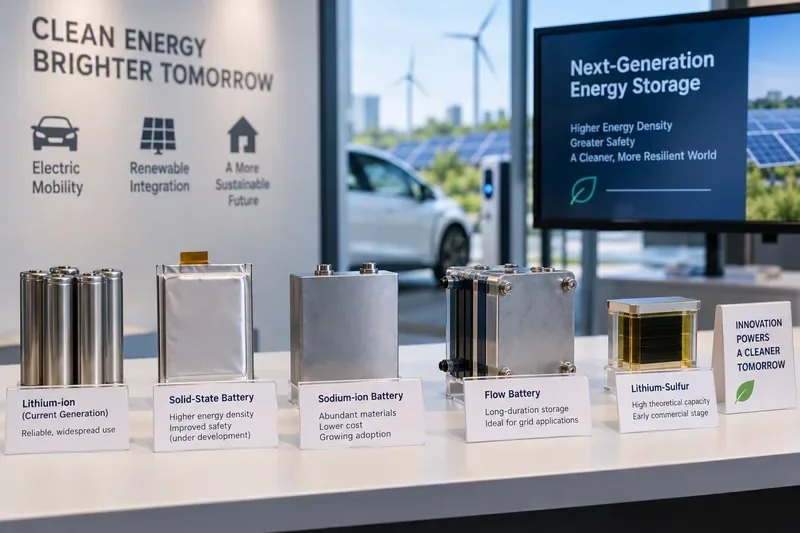
A representative display of several next-generation storage approaches. The physical form and performance of real systems vary widely by manufacturer, chemistry and application.
The five terms that make battery comparisons useful
Before comparing technologies, it helps to separate a few measurements that are often blended together in headlines.
Energy density describes how much energy can be stored in a given mass or volume. It matters greatly in cars, aircraft and portable devices, but much less in a utility project with ample land.
Power density describes how quickly energy can be delivered. A high-power battery may accelerate a vehicle well or stabilize the grid quickly even if it does not store energy for many hours.
Cycle life is the number of charge-discharge cycles a battery can complete before reaching a defined capacity or performance threshold. The test temperature, charge rate and depth of discharge matter as much as the headline cycle count.
Round-trip efficiency is the fraction of electricity recovered after charging and later discharging a storage system. It is especially important when a system cycles frequently.
Storage duration is how long a system can discharge at its rated power. The U.S. Department of Energy generally treats long-duration energy storage, or LDES, as systems capable of delivering electricity for 10 hours or more. See the DOE Long-Duration Energy Storage program.
A sixth metric, levelized cost of storage, attempts to spread capital cost, operating cost, efficiency losses and useful lifetime over the electricity a system actually delivers. It is often more informative for grid projects than a cell price quoted in dollars per kilowatt-hour.
Quick reference: where the leading technologies stand in 2026
Technology
2026 maturity
Best-fit use cases
Main advantage
Main challenge
Lithium-ion
Mass commercial
EVs, electronics, short-duration grid storage
Established manufacturing, high efficiency, strong power and energy performance
Thermal management, material supply, degradation and cost trade-offs
All-solid-state
Pilot / precommercial scale-up
Future premium EVs and other weight- or space-sensitive applications
Potential for higher energy density, fast charging and improved safety architecture
Interfaces, durability, manufacturing yield, pressure control and cost at scale
Sodium-ion
Early commercial and scaling
Stationary storage, selected EVs, cold-climate and cost-sensitive applications
Less dependence on lithium and use of widely available sodium resources
Lower energy density than leading lithium-ion cells and a younger supply chain
Flow battery
Commercial niche plus expanding demonstrations
Grid storage from several hours into long-duration ranges
Energy capacity can be increased by enlarging electrolyte storage tanks
Large physical footprint, pumps and balance-of-plant complexity
Iron-air / metal-air
Commercial demonstration and project scale-up
Multi-day grid resilience
Very long duration using abundant active materials
Large stationary systems and a limited long-term commercial operating record
Lithium-sulfur
Development and early commercialization efforts
Aviation, drones and other weight-sensitive systems
High theoretical specific energy and sulfur availability
Cycle life, electrolyte management and sulfur-related side reactions
The maturity labels above are deliberately broad. A laboratory cell, a certified automotive pack and a bankable utility project are very different milestones. The IEA's Global EV Outlook 2025 battery analysis similarly treats solid-state, sodium-ion, lithium-sulfur, iron-air and redox-flow batteries as distinct technologies with different application targets rather than interchangeable successors to lithium-ion.
Solid-state batteries: the premium-performance contender
A conventional lithium-ion cell normally uses a liquid electrolyte to carry lithium ions between the cathode and anode. An all-solid-state battery replaces that liquid with a solid electrolyte. In principle, this can enable different electrode designs, including lithium-metal anodes, while reducing reliance on flammable liquid electrolyte.
The appeal is easy to understand: higher energy density could mean more driving range for the same pack mass, or a smaller pack for the same range. Faster charging and better high-temperature tolerance are also major development goals. But those are potential system-level benefits, not automatic properties of every solid-state cell.
The hard part is manufacturing. Solid materials must maintain intimate contact while a battery repeatedly expands, contracts, charges and discharges. Cracks, interfacial resistance, lithium dendrites, required stack pressure and production yield can all undermine laboratory performance when cells are made larger and faster.
The commercialization timeline is becoming more concrete but is still a timeline, not proof of mass-market readiness. Toyota and Sumitomo Metal Mining said in October 2025 that they were developing mass-production cathode materials and that Toyota was targeting BEVs using all-solid-state batteries in 2027-2028. The announcement is useful evidence of industrial progress, but it should still be read as a company target. See Toyota's October 2025 solid-state battery materials announcement.
What to ask when evaluating a solid-state claim
Is the number measured at the cell level or the complete pack level?
Is the battery truly all-solid-state, or does it still contain gel or liquid components?
How much external pressure is required during operation?
What cycle life was demonstrated, at what temperature and charge rate?
Was the result produced in a coin cell, pouch cell, automotive-size cell or production-intent line?
Has performance been independently validated under standardized conditions?
Sodium-ion: the resource-diversification play that is moving into production
Sodium-ion batteries work on a similar basic shuttle-ion principle to lithium-ion batteries, but sodium replaces lithium as the charge-carrying ion. Sodium is abundant and geographically widespread, which makes the chemistry attractive for supply-chain diversification and stationary storage.
The main compromise is energy density. Sodium ions are heavier and larger than lithium ions, and today's sodium-ion products generally do not match the best lithium-ion chemistries on energy stored per kilogram. That matters in long-range vehicles. It matters much less in a stationary cabinet or container where land and weight are secondary concerns.
What changed in 2026 is that sodium-ion moved beyond being only a pilot-line story. CATL said in April 2026 that its Naxtra sodium-ion platform had reached GWh-scale industrialization and was scheduled for full-scale mass production by the end of 2026. In June, the company announced a sodium-ion energy-storage system and said domestic deliveries would begin in September 2026, with international deliveries planned for 2027. Those are manufacturer statements rather than an industry-wide independent benchmark, but they are significant evidence of supply-chain scaling. See CATL's April 2026 technology update and CATL's June 2026 sodium-ion storage announcement.
For buyers, the key question is not whether sodium-ion can “replace lithium.” It is whether lower material concentration risk, cold-weather behavior, expected cycle life and delivered system cost outweigh lower energy density for a specific project.
Flow batteries: when duration matters more than compactness
A redox-flow battery stores active materials in liquid electrolytes held in external tanks. Pumps circulate those liquids through an electrochemical cell stack. The architecture separates the component that determines power—the cell stack—from much of the component that determines stored energy—the electrolyte volume.
That makes flow batteries particularly interesting for stationary projects that need many hours of storage and frequent cycling. Increasing storage duration can often be done by adding more electrolyte and larger tanks rather than proportionally enlarging the entire power-conversion system.
The trade-off is physical complexity. Tanks, pumps, piping and electrolyte management make flow batteries much less attractive for mobile applications. The DOE continues to treat flow batteries as a major long-duration research, demonstration and validation pathway. Its Storage Innovations 2030 program evaluates flow, sodium, zinc, lithium-ion, thermal, mechanical and other storage families against long-duration cost and performance needs.
Iron-air and other metal-air systems: built for multi-day storage
Metal-air batteries use a metal as one active material and oxygen from air in the electrochemical reaction. The attraction for grid storage is not high power-to-weight performance; it is the possibility of storing large amounts of energy for long periods using inexpensive, abundant materials.
Iron-air illustrates the distinction between mobile and stationary design priorities. A system that is too bulky for a car can still be attractive beside a substation if it can economically cover multi-day gaps in renewable generation or provide resilience during prolonged grid stress.
Commercial evidence is beginning to accumulate, but this category remains far less mature than lithium-ion. Form Energy says its first commercial iron-air product is designed for up to 100 hours of storage and reports that a first commercial demonstration system was deployed in 2025, with larger projects progressing in 2026. Those are vendor-reported milestones, so project planners should still ask for operating data, warranties and independent validation. See Form Energy's project and technology timeline.
Lithium-sulfur and lithium-air: the high-specific-energy frontier
Lithium-sulfur is attractive because sulfur is light, abundant and capable of storing a large amount of charge relative to its mass. This makes the chemistry especially interesting for drones, aviation and other applications where every kilogram matters. The familiar challenge is maintaining stable cycling while controlling sulfur species that can migrate through the electrolyte and reduce capacity over time.
Lithium-air reaches even further. Instead of carrying all active cathode material inside the cell, it uses oxygen from the surrounding environment as part of the reaction. That creates exceptional theoretical specific-energy potential, but also difficult problems involving air purity, reaction products, reversibility and cycle life.
In 2025, the U.S. Department of Energy highlighted an Argonne-led solid-electrolyte lithium-air design that demonstrated at least 1,000 charge-discharge cycles in laboratory work and projected very high future specific energy. That is scientifically important, but it is still research—not a production battery you can order for a vehicle or grid project. See the DOE summary of the lithium-air research.
Choose the chemistry by use case, not by headline specification
For electric vehicles
Start with pack-level energy density, fast-charge performance, low-temperature performance, cycle degradation, thermal behavior, warranty and manufacturing cost. Solid-state becomes attractive if its cell-level advantages survive pack integration and mass production. Sodium-ion can be compelling where cost, cold weather or resource diversification matters more than maximum range.
For four-hour grid storage
Lithium-ion, especially LFP, has the advantage of enormous manufacturing scale and established project experience. A new chemistry must beat not only the cell but also the mature ecosystem of inverters, controls, safety codes, warranties, financing and service.
For 10- to 24-hour storage
Compare flow batteries, sodium-based systems, zinc systems, thermal storage and other LDES options on delivered cost, cycle profile, efficiency, footprint and project life. The DOE's 10-hour threshold is useful because it marks a point where simply adding more lithium-ion energy capacity may not always be the most economical architecture.
For multi-day resilience
Iron-air, other metal-air systems, hydrogen hybrids and certain thermal or mechanical storage approaches deserve attention. Here, low cost per stored kilowatt-hour and long discharge duration can matter more than compactness or peak round-trip efficiency.
For aviation and extreme weight sensitivity
Specific energy becomes dominant. Lithium-sulfur and advanced solid-state designs may have a better strategic fit than stationary chemistries, but aviation also imposes severe requirements for safety, reliability, certification and repeatable performance.
A practical checklist for separating progress from hype
Identify the scale. Coin cell, pouch cell, module, pack and complete storage plant are not equivalent.
Check the denominator. Wh/kg at the active-material level can look much better than Wh/kg at the pack level.
Ask what “commercial” means. A pilot line, customer sample, demonstration project, limited production and mass production are separate milestones.
Look for operating conditions. Cycle life without temperature, charge rate, depth of discharge and end-of-life threshold is incomplete information.
Separate safety potential from certification. A nonflammable electrolyte does not make a full battery system automatically safe.
Compare total systems. For grid storage, include pumps, tanks, thermal controls, inverters, construction, land, augmentation and maintenance—not just cell cost.
Check the supply chain. Abundant raw material does not automatically mean mature refining, precursor, cell-manufacturing or recycling capacity.
Demand bankable evidence. Warranties, standardized testing, field data, insurance acceptance and credible service networks matter once a project leaves the laboratory.
Common mistakes to avoid
Assuming higher energy density is always better. It is crucial in aircraft and valuable in vehicles, but a grid project may care far more about lifetime cost and discharge duration.
Treating a target date as a shipment. A company can be technically on track while still facing yield, qualification or supply-chain delays. Distinguish “aiming for 2027” from “customer systems delivered in 2027.”
Comparing cell cost with project cost. A cheap cell can become an expensive project if it needs heavy cooling, frequent replacement or costly balance-of-system equipment.
Calling every new chemistry a lithium-ion replacement. The likely future is a portfolio. The IEA's battery work and DOE's storage programs both point toward multiple chemistries serving different transport, grid and resilience needs rather than one universal design.
What to watch from 2026 through 2030
Three developments will matter more than laboratory records alone.
Manufacturing yield. Solid-state batteries need repeatable, high-throughput production with acceptable defect rates and limited process complexity.
Field data. Sodium-ion, iron-air, flow and other emerging systems need years of operating evidence across climates and duty cycles.
System economics. The winner in a given market will be the technology that delivers the required service at the best risk-adjusted lifetime cost, not necessarily the one with the most impressive single specification.
The DOE's current storage strategy explicitly emphasizes safe deployment, validation and application-specific decision-making rather than a single technology path. Its Energy Storage Strategy and Roadmap is a useful reference for understanding how research, validation, commercialization and grid deployment fit together.
Bottom line
Solid-state batteries remain one of the most important next-generation candidates for high-performance mobility, but they are only one part of the storage transition. Sodium-ion is becoming a real manufacturing alternative where resource diversity and cost matter. Flow batteries are designed around long stationary duty cycles. Iron-air targets multi-day grid resilience. Lithium-sulfur and lithium-air push toward much higher specific energy for applications where weight dominates.
The most reliable way to follow the race is to stop asking which chemistry is “best” and instead compare maturity, system-level performance, lifetime cost, safety evidence and fit for a specific job. By that standard, the next generation of energy storage will probably be plural: different technologies winning different parts of a much larger market.