Home
» Technology
»
Wearable Health Monitoring: How Smart Medical Devices Can Help Prevent Critical Illness
Wearable Health Monitoring: How Smart Medical Devices Can Help Prevent Critical Illness
The most important thing to know is that wearable health monitors do not prevent critical illness by themselves. Their value is in shortening the time between a meaningful change in the body and the action that follows. A wearable may detect an irregular rhythm, a falling glucose level, rising ketones, or a concerning oxygen trend before a person would otherwise notice it. But the benefit appears only when the signal is reliable, the user understands what it means, and there is a clear plan for confirmation or medical follow-up.
That distinction matters because the category now spans everything from general-fitness watches to FDA-authorized medical sensors. The U.S. Food and Drug Administration (FDA) describes digital health broadly enough to include wearable devices, software, sensors, telehealth, and connected medical systems, while also distinguishing low-risk wellness products from devices intended for diagnosis, monitoring, prevention, or treatment. See the FDA overview of digital health and its January 2026 general-wellness guidance.
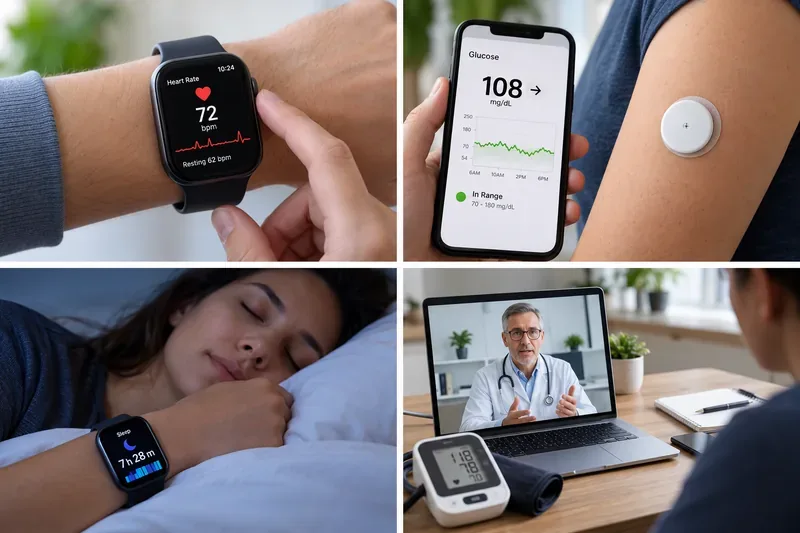
Smartwatch sensing, continuous glucose monitoring, sleep tracking, and clinician-connected home measurements show how wearable data can support earlier review of changing health trends.
First, understand what a wearable is actually measuring
A wearable health monitor is a body-worn sensor that collects physiologic or behavioral data over time. Some are regulated medical devices; others are consumer wellness products. A beginner should start with the health question, not with the gadget.
Signal
What it can help reveal
Important limitation
Heart rate or rhythm
Unexpected rate changes or possible irregular rhythms such as atrial fibrillation
A notification is not a diagnosis, and no alert does not rule out disease
Continuous glucose
High, low, or rapidly changing glucose trends
Different CGMs are cleared for different populations and purposes
Ketones
Rising ketone levels in people with diabetes when using a device specifically authorized for that purpose
This capability is not present in ordinary smartwatches or standard glucose-only sensors
Oxygen saturation (SpO₂)
Estimated blood oxygen trends
Readings can be inaccurate and must be interpreted with symptoms and clinical context
Sleep, activity, temperature, recovery
Changes from a person's usual pattern
These trends are generally less specific and may reflect many benign or medical causes
ECG means electrocardiogram, an electrical recording of the heart's activity. Some watches can record a single-lead ECG. PPG, or photoplethysmography, uses light to detect changes in blood volume at the skin and can be used to estimate pulse rate or identify patterns that may suggest an irregular rhythm. CGM means continuous glucose monitor, a wearable sensor that measures glucose in interstitial fluid just under the skin and sends repeated readings to a receiver or phone.
Why early detection can matter
The practical pathway is simple: detect a change, interpret it correctly, confirm it when needed, and act early. Each part matters. If any link fails, the wearable may create reassurance without safety or alarms without useful action.
Irregular heart rhythm: useful screening, not automatic diagnosis
Atrial fibrillation (AFib) is an irregular heart rhythm associated with increased stroke risk. The Centers for Disease Control and Prevention (CDC) notes that AFib is associated with a markedly higher risk of ischemic stroke and that treatment may include medicines to control rhythm or rate and, for some patients, blood-thinning medication to reduce clot-related stroke risk.
Wearables can help bring previously unnoticed rhythm changes to attention. In the original Apple Heart Study published in the New England Journal of Medicine, 419,297 participants were monitored. Only 0.52% received an irregular-pulse notification; among participants who returned analyzable ECG patches after notification, AFib was found in 34%. When a later irregular-pulse notification occurred at the same time as ECG monitoring, the positive predictive value for AFib was 0.84.
Those numbers show both the promise and the limit. A watch can surface a signal worth evaluating, but it does not turn every alert into confirmed AFib. FDA-cleared irregular-rhythm software is also explicitly designed as a screening aid rather than a replacement for diagnosis. For example, the FDA record for Fitbit Irregular Rhythm Notifications identifies the software as an over-the-counter Class II medical device; its cleared use does not mean it captures every AFib episode.
Glucose: trend alerts can create time to respond
For people with diabetes, continuous glucose monitoring can provide one of the clearest examples of how a wearable can reduce the chance that a deteriorating trend goes unnoticed. The CDC's CGM guidance, updated September 30, 2025, explains that CGMs update glucose readings repeatedly and many systems can alert users when glucose is rising or falling quickly. The CDC also notes that a CGM may alert a person to low glucose during sleep.
This is important because severe hypoglycemia can lead to confusion, seizures, loss of consciousness, or a need for help from another person. Monitoring does not eliminate that risk, but it can provide earlier information for a person and their care team to follow an established treatment plan.
A newer example is the FDA authorization announced August 25, 2026 for the Libre Duo 10 Day Continuous Dual Glucose Ketone Monitoring System. The FDA says the device continuously monitors both glucose and ketones for people with diabetes age 2 years and older and can help detect warning signs of diabetic ketoacidosis before the situation becomes a medical emergency. This is a specific authorized capability, not a feature that should be assumed for other wearables.
SpO₂ is an estimate of the percentage of hemoglobin carrying oxygen. Home oxygen readings may help identify a worsening trend, but they are especially vulnerable to misuse if a single number is treated as a diagnosis.
The FDA's pulse-oximeter guidance says users should not rely on pulse oximetry alone and should also pay attention to symptoms and how they feel. The agency lists factors that can affect accuracy, including poor circulation, skin pigmentation, skin thickness, skin temperature, tobacco use, and fingernail polish. In January 2025, the FDA also issued draft recommendations intended to improve evaluation of medical-purpose pulse oximeters across the range of skin pigmentation.
Before buying or activating a device, prepare these four things
1. Define the problem you want to monitor
A device is more useful when there is a specific question. “I want better health data” is vague. “My clinician wants to review intermittent palpitations,” “I use insulin and need low-glucose alerts,” or “we are monitoring oxygen during recovery from a respiratory illness” are more actionable goals.
2. Check whether the product is a medical device for your intended use
Do not assume that a watch, ring, patch, or app has been evaluated for medical decision-making just because it displays health numbers. The FDA's sensor-based digital health technology list, updated periodically, includes authorized wearable devices such as watches, rings, patches, and bands intended for health monitoring in non-clinical settings.
Also read the exact indications for use. Age limits, whether a person already has a diagnosis, whether a device is intended for screening or treatment decisions, and whether it provides alerts can all change whether the product is appropriate.
3. Decide what each alert will trigger
An alert without a response plan is just an interruption. Before relying on a monitor, ask: Should this warning be repeated after rest? Confirmed with another approved device? Sent to a clinician? Treated according to an existing diabetes plan? Or considered an emergency when paired with specific symptoms?
For people with chronic disease, this is where clinician guidance adds the most value. A care team can define which data matter, what trend is meaningful, and when medication or testing should be reviewed. Do not change prescription doses solely because a consumer wearable reports an unusual value unless your treatment plan specifically instructs you to do so.
4. Review privacy and sharing settings
Connected wearables often send data to a phone app or cloud account. Health information in a consumer app is not automatically protected in the same way as a hospital medical record. The U.S. Department of Health and Human Services explains that HIPAA generally does not protect health information stored in personal apps unless the app is being used by a HIPAA-covered entity or its business associate. Review permissions, account security, data-sharing defaults, and whether family members or clinicians actually need continuous access.
How to use wearable monitoring without becoming overwhelmed
Once the device is appropriate for the goal, focus on consistency rather than constant checking.
Wear it as instructed. Sensor placement, skin contact, charging, replacement intervals, and app connectivity affect data quality.
Learn your baseline. A baseline is your usual range or pattern when you are stable. Trends away from that pattern may be more informative than one isolated reading.
Use alerts selectively. Enable clinically relevant notifications and avoid stacking unnecessary wellness alerts that can cause alarm fatigue.
Record context. Exercise, fever, stress, poor sleep, dehydration, medication timing, meals, and sensor problems can explain sudden changes.
Share summaries, not every number. Trend reports are usually more useful to a clinician than screenshots of dozens of individual readings.
Confirm unexpected values when the device instructions call for it. Some measurements require a second method before treatment decisions are made.
Common mistakes that can turn useful monitoring into bad decision-making
Mistake 1: treating a wellness device as if it were a diagnostic device
FDA guidance makes a clear distinction between low-risk general wellness products and functions intended for medical purposes. If a product is sold for fitness or wellness, do not assume it has been reviewed for diagnosing disease.
Mistake 2: trusting a “noninvasive glucose” claim from a watch or ring
This is a particularly important red flag. In a February 21, 2024 safety communication, the FDA warned consumers not to use smartwatches or smart rings that claim to measure or estimate blood glucose on their own without piercing the skin. The agency stated that it had not authorized, cleared, or approved any such smartwatch or smart ring for that purpose. That warning is different from a watch or phone displaying readings from an authorized CGM sensor that does penetrate the skin.
Mistake 3: assuming “no alert” means “no disease”
Wearable algorithms may sample only under certain conditions, may miss intermittent events, or may not be designed for a particular age or diagnosis. A normal-looking device screen should never overrule serious symptoms.
Mistake 4: reacting to every outlier
Motion, poor contact, temperature, circulation, sensor aging, signal noise, and software limitations can create unusual readings. Look for persistent or repeated patterns, follow the device's instructions, and use confirmatory measurements when appropriate.
Mistake 5: confusing more data with better prevention
Monitoring works best when it changes a decision. Collecting months of sleep scores, heart-rate graphs, and oxygen estimates without knowing what would prompt action can produce anxiety instead of prevention. Choose a small number of metrics tied to a specific health goal.
When a wearable should not slow down urgent care
Do not wait for a wearable to confirm an emergency. Severe chest pain, severe shortness of breath, fainting, signs of stroke, a seizure, major confusion, or other rapidly worsening symptoms require urgent medical evaluation according to local emergency guidance. The same applies when a person with diabetes has symptoms consistent with severe hypoglycemia or diabetic ketoacidosis.
A wearable can contribute useful information—such as the time an abnormal rhythm began or the direction of a glucose trend—but it should not become a gatekeeper that decides whether severe symptoms are “real.”
What success looks like for a beginner
A good wearable health-monitoring setup is not the one with the most sensors. It is the one where you can answer five questions clearly: What is being measured? How accurate is this feature for my intended use? What is normal for me? What will I do when the device alerts me? Who receives the data if follow-up is needed?
That is how smart medical devices can help reduce the chance that a dangerous trend goes unnoticed. Their strongest role is often early warning and continuity: capturing data between clinic visits, surfacing changes that deserve attention, and giving patients and clinicians more time to respond. The technology is most protective when it is paired with an appropriate medical plan rather than treated as a substitute for one.