Home
» Technology
»
Grid-Scale Battery Storage: The Missing Piece in the Renewable Energy Transition
Grid-Scale Battery Storage: The Missing Piece in the Renewable Energy Transition
Grid-scale battery storage is one of the most important missing pieces in the renewable energy transition—but it is not the only one. Batteries solve a specific and increasingly urgent problem: solar and wind generation do not always line up with the hours when electricity demand is highest. A battery can absorb electricity when supply is abundant, then return it to the grid minutes or hours later when it is more valuable.
That capability is already moving from niche service to mainstream grid infrastructure. The International Energy Agency (IEA) reported in its 2026 Global Energy Review that 108 GW of new battery storage capacity was deployed worldwide in 2025, about 40% more than in 2024. Roughly 80% of those additions were utility-scale. The same IEA analysis says lithium iron phosphate, or LFP, batteries accounted for around 90% of deployments in 2025. See the IEA's 2026 battery storage assessment.
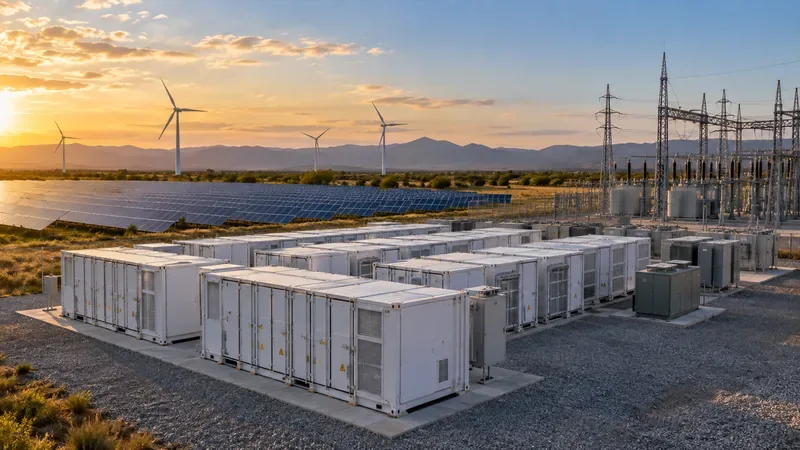
Utility-scale battery enclosures sit alongside solar generation, wind turbines, and grid infrastructure, illustrating how storage connects variable renewable power with the transmission system.
Why batteries matter more as solar and wind grow
A power system must balance supply and demand continuously. Conventional generators can often be scheduled to follow demand, but wind and solar output depends on weather and time of day. That does not make renewables unreliable by definition; it means the rest of the power system needs enough flexibility to manage their variability.
Battery storage is unusually good at providing that flexibility because it can react quickly. The IEA's 2026 Electricity report describes utility-scale batteries as one of the most versatile tools for short-term flexibility: they can balance the system, provide grid support services, shift renewable output to higher-demand periods, contribute to capacity adequacy, and sometimes reduce or defer network upgrades. The full discussion is in the IEA Electricity 2026 flexibility chapter.
Consider a solar-heavy grid. Solar output may peak around midday, while residential electricity demand can remain high into the evening after the sun falls. A four-hour battery can charge during the solar-rich hours and discharge across the evening ramp. That is a better match for the problem than building a resource that only produces more electricity at noon.
What grid-scale batteries actually do
1. Shift renewable energy from one part of the day to another
This is the use case most people associate with battery storage. The U.S. Energy Information Administration (EIA) explains that batteries with four-to-eight-hour durations are commonly used for load shifting: they charge when demand is lower or renewable output is plentiful, then discharge when demand is higher. In solar-rich regions, that often means moving midday solar generation into the evening. The EIA's explanation of battery duration is available in its utility-scale battery duration analysis.
2. Stabilize the grid in seconds or minutes
Batteries can change output very quickly, which makes them useful for frequency response and other grid services that may require fast corrections rather than hours of continuous energy. A battery does not need a huge energy reservoir to be valuable in this role; it needs enough power capacity and control capability to respond when the grid needs it.
3. Reduce renewable curtailment when there is somewhere useful to send the energy later
Curtailment occurs when available generation is deliberately reduced because the system cannot use or transport all of it at that moment. Storage can absorb some of that otherwise-curtailed energy, but only if the battery has available charging capacity and a later discharge opportunity. This is why storage economics depend on local price patterns, congestion, renewable output, and market rules—not simply on how many solar panels or wind turbines are nearby.
4. Provide capacity during peak demand
A battery that is adequately charged before a predictable peak can contribute dependable power during that period. This can reduce reliance on generators that run only during a small number of high-demand hours. The value is highly location-specific: a four-hour system may be well suited to one evening peak but insufficient for a longer heat-wave event or a multi-day supply shortfall.
The scale-up is already visible
The United States provides a useful real-world example. According to the EIA's August 7, 2026 update, U.S. operational utility-scale battery storage reached 43.6 GW by the end of 2025 and nearly 52 GW by the end of June 2026 after another 8.3 GW was added in the first half of the year. Operators reported plans for another 54 GW over the following two and a half years, although planned projects are not guaranteed to enter service on schedule. See the EIA's August 2026 battery capacity update.
Globally, the direction is similar. The IEA says battery storage was the fastest-growing power technology in 2025. That growth matters because renewable capacity is also expanding quickly. In its 2024 batteries report, the IEA estimated that global energy storage capacity would need to rise to 1,500 GW by 2030 in its Net Zero Emissions scenario, with batteries supplying most of the increase. That figure is a scenario requirement, not a forecast of what will definitely happen. The distinction is important. The source is the IEA's Batteries and Secure Energy Transitions outlook.
Where lithium-ion batteries fit best
For today's grid, lithium-ion batteries are strongest when the problem is intra-day rather than seasonal. The IEA has described battery storage as well suited to short-term flexibility across roughly one to eight hours. That aligns with the way many utility projects are designed today.
National laboratory cost models also commonly evaluate four-hour systems because that duration has become a major reference point for utility-scale storage. The National Laboratory of the Rockies' 2024 Annual Technology Baseline, formerly published under the NREL name, models utility-scale battery storage using cost components for four-hour systems and allows costs to be evaluated across different durations. See the 2024 utility-scale battery storage ATB methodology.
Grid need
Typical battery fit
Main limitation
Frequency and fast grid response
Excellent
Requires suitable controls, market access, and interconnection
Shift midday solar into evening
Strong for several-hour systems
Value falls if price spreads are small or charging energy is scarce
Peak capacity for a few hours
Strong when the peak is predictable and short enough
Long peaks may exceed battery duration
Relieve local congestion
Potentially strong at the right grid node
Cannot replace every transmission upgrade
Multi-day wind or solar shortfall
Limited for conventional short-duration lithium-ion systems
Energy capacity becomes expensive as required duration grows
Seasonal energy shifting
Generally poor fit for today's lithium-ion fleet
Requires much longer-duration or different storage approaches
Why batteries are not the whole answer
Calling storage the “missing piece” can become misleading if it suggests that batteries eliminate the need for power lines, flexible demand, dispatchable generation, or other storage technologies. In reality, they work as part of a portfolio.
Transmission and distribution still matter
A battery cannot charge from renewable generation it cannot access, and it cannot discharge to a load that is isolated by network constraints. The IEA's Electricity 2026 report says grid capacity itself is becoming a bottleneck in many regions, with connection queues and congestion slowing new supply, demand, and storage projects. Storage can reduce some congestion, but it is not a substitute for every needed line, substation, transformer, or interconnection upgrade. See the IEA's 2026 analysis of grid bottlenecks.
Long-duration shortages need a different toolset
Most battery projects today cluster around a few hours of duration. That is enough to reshape a daily solar profile, but not necessarily enough to bridge a multi-day weather event. The U.S. Department of Energy defines long-duration energy storage as systems capable of delivering electricity for 10 hours or more and is supporting development of non-lithium and other technologies for these longer needs. See the DOE Long-Duration Energy Storage program.
Longer-duration options can include electrochemical systems beyond conventional lithium-ion, pumped hydropower, thermal storage, compressed-air concepts, and chemical storage pathways. Which technology makes sense depends on geography, duration, cycling frequency, efficiency, capital cost, safety requirements, and how often the resource is expected to operate.
Demand flexibility can be cheaper than storing every surplus kilowatt-hour
Sometimes the best response to abundant midday electricity is not to store it, but to move consumption into that period. Smart EV charging, industrial load scheduling, thermal storage in buildings, and other forms of demand response can absorb low-cost electricity directly. Batteries are especially valuable when demand cannot move enough or when the grid needs fast, dispatchable power.
How to tell whether grid-scale storage is the right solution
The best storage projects start with a grid problem, not with a battery chemistry. A utility, developer, regulator, or large energy user should be able to answer a few practical questions before deciding on a system:
What exact problem needs to be solved? Evening peak, frequency response, curtailment, congestion, backup, capacity adequacy, or something else?
How long must the system discharge? A two-hour service and a 12-hour reliability requirement are fundamentally different designs.
How often will it cycle? Daily energy shifting places different economic and degradation demands on a battery than occasional emergency use.
Where should it connect? Location determines congestion value, interconnection cost, access to renewable charging energy, and market revenue.
What is the alternative? Compare storage with transmission upgrades, demand response, flexible generation, curtailment, or a hybrid portfolio.
How will safety, permitting, augmentation, and end-of-life management be handled? These are project design requirements, not afterthoughts.
A battery is a strong candidate when the need is fast, repeatable, and measured in minutes to several hours. It becomes less obviously optimal as the required discharge duration stretches into multi-day or seasonal territory, unless the project uses a technology specifically designed for that role.
Costs are falling, but project economics still depend on the market
Battery hardware costs have declined sharply over the past decade, and the IEA reported that battery storage project costs fell by about 40% in 2024 to around $150 per kilowatt-hour in its cross-market assessment. But a lower battery price does not automatically produce a profitable project. Revenue can come from energy arbitrage, capacity payments, ancillary services, congestion relief, or contracts with utilities and renewable generators. Rules differ widely by region, and some markets still do not compensate storage for every service it provides.
Developers also face costs that are not captured by the cell price alone: inverters, transformers, controls, site work, interconnection equipment, land, fire protection, permitting, financing, augmentation, and eventually decommissioning or recycling. The National Laboratory of the Rockies' utility-scale battery cost methodology explicitly treats the battery pack as only one portion of the full battery energy storage system.
The real missing piece is flexibility
The renewable transition does not require batteries everywhere. It requires enough flexibility everywhere that supply and demand can keep matching as the generation mix changes. Grid-scale batteries are becoming one of the most scalable ways to provide that flexibility over short periods, particularly as solar grows and evening peaks become more pronounced.
The strongest evidence is no longer just a projection. Global deployment accelerated again in 2025, and U.S. utility-scale capacity continued climbing rapidly into 2026. At the same time, official energy agencies continue to invest in long-duration storage research and grid expansion because conventional batteries cannot solve every reliability challenge.
So the practical conclusion is straightforward: grid-scale battery storage is a missing piece, not the entire puzzle. It is especially well matched to hourly balancing, renewable energy shifting, fast grid services, and short-duration capacity. For longer gaps, constrained networks, or seasonal mismatches, the better answer is usually a portfolio that combines batteries with stronger grids, flexible demand, long-duration storage, and other dependable resources.