Home
» Technology
»
Where to Study Logistics and Drone Delivery Management: Best Degree Paths for 2026
Where to Study Logistics and Drone Delivery Management: Best Degree Paths for 2026
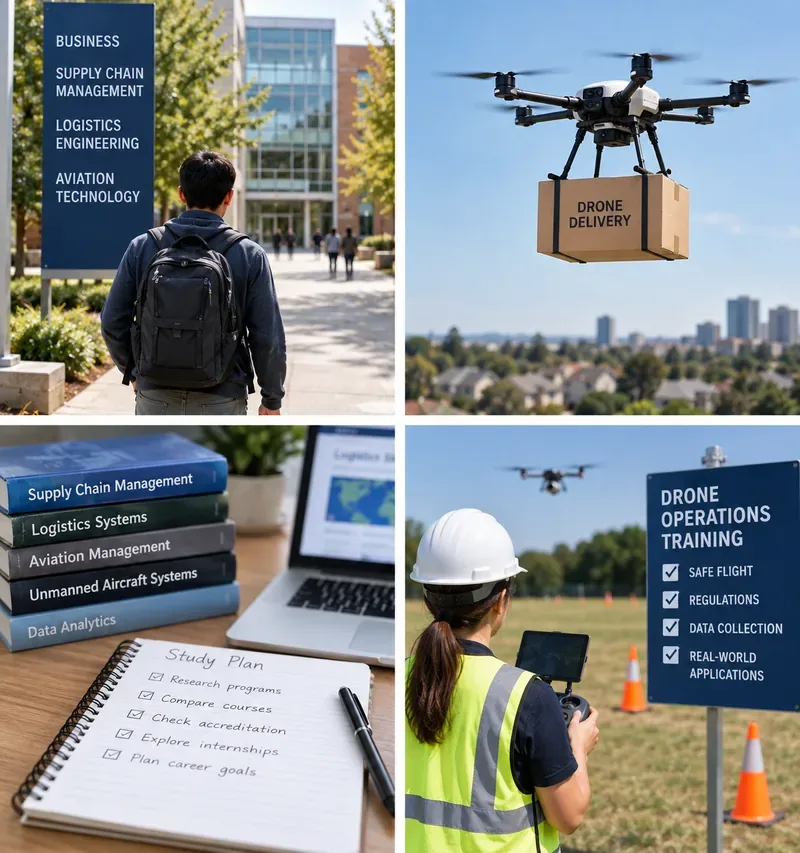
Drone delivery sits at the intersection of two disciplines that universities still usually teach separately: supply chain management and unmanned aircraft systems (UAS). If your goal is to manage drone-enabled last-mile delivery, the strongest academic plan is rarely a degree with “drone delivery management” in the title. Instead, choose the side of the operation you want to own, then add the complementary skills.
This guide is a practical reference for 2026 applicants. It focuses on current programs whose official curricula or program descriptions cover logistics, supply chain analytics, aviation, UAS operations, autonomy, or closely related management skills. The schools below are not presented as a universal ranking; they are recommended for different career goals.
Drone-delivery careers combine logistics planning, analytics, aviation regulation and hands-on UAS operations, so the best degree choice depends on which part of the system you want to manage.
Quick answer: which degree is best for drone delivery management?
Career goal
Best degree direction
Why it fits
Plan delivery networks, hubs, inventory and last-mile economics
Supply Chain Management or Logistics
Builds forecasting, procurement, transportation, operations and analytics skills.
Run drone fleets and flight operations
UAS / Uncrewed Aircraft Systems / Aviation
Emphasizes airspace, mission planning, safety, aircraft systems and regulatory operations.
Lead a drone-delivery business unit
Supply Chain or Aviation Business, plus UAS electives/certification
Combines commercial decision-making with enough aviation knowledge to manage specialized teams.
Design autonomous delivery systems
Robotics, Autonomous Systems, Aerospace or Systems Engineering
Best for autonomy, sensing, controls, systems integration and technical product roles.
Move into senior supply-chain leadership after work experience
Master's in Supply Chain Management
Adds advanced analytics, network design, strategy and leadership without requiring a second bachelor's degree.
Why logistics knowledge matters as much as drone knowledge
A delivery drone is only one node in a larger fulfillment system. A manager still has to answer conventional logistics questions: Where should a launch hub be located? Which orders are eligible for drone service? How should inventory be positioned? What happens when weather grounds the fleet? How should a drone route connect with vans, stores, warehouses and customer service?
That is why a strong logistics curriculum should include demand planning, transportation, procurement, inventory, operations management and quantitative analysis. A drone-focused curriculum should add airspace rules, mission planning, safety management, human factors, aircraft performance, autonomy and data systems.
The regulatory side is also substantial. The FAA's package-delivery guidance, last updated September 3, 2026, says U.S. operators conducting small-package delivery beyond visual line of sight currently use the Part 135 certification framework and need appropriate airspace authorization, operational approvals and safety documentation. For ordinary small-UAS operations under Part 107, the FAA's Remote Pilot Certificate guidance, updated June 9, 2026, requires remote pilots to demonstrate knowledge of regulations, airspace, weather, loading, emergency procedures and other aviation topics.
Best undergraduate programs for logistics and supply-chain leadership
Penn State — B.S. in Supply Chain and Information Systems
Penn State is a strong fit if you want to manage the digital and operational backbone behind drone delivery. The 2026–2027 Penn State Undergraduate Bulletin describes a 120-credit B.S. at University Park that combines sourcing, manufacturing and service operations, demand fulfillment, information systems and supply-chain technology.
The prescribed major courses include demand fulfillment, manufacturing and services strategies, strategic procurement, supply-chain analytics and strategic design and management of supply chains. That mix is especially useful for students aiming at logistics analyst, network-planning, fulfillment-technology or operations-management roles. You would still need to add drone-specific training through electives, extracurricular projects, internships or a Part 107 pathway.
Arizona State University — B.S. in Supply Chain Management
ASU is a practical option when you want a broad supply-chain foundation with flexibility. Its B.S. in Supply Chain Management is listed for Tempe and online study and requires 120 credit hours. The program description covers logistics, planning, procurement, operations management, negotiation and strategy, while also emphasizing quantitative methods such as forecasting, programming, optimization, data warehousing and data mining.
That analytics component matters in drone delivery because vehicle assignment, route economics, demand density and hub placement are optimization problems. ASU is therefore a good choice for a student who expects to work on the business and analytics side of autonomous delivery rather than as a flight operator.
Embry-Riddle — B.S. in Global Business & Supply Chain Management
For students who want supply chain education inside an aviation-focused university, Embry-Riddle offers an unusually relevant combination. Its B.S. in Global Business & Supply Chain Management at the Prescott, Arizona campus is a 120-credit program that covers global logistics and supply chain management alongside aviation, transportation, trade, finance and international business.
This is a particularly sensible path for future program managers who want to understand both commercial logistics and the aviation environment. The program itself is business-oriented, so students seeking hands-on drone operations should deliberately add UAS coursework or practical flight experience.
Best undergraduate programs for drone operations and autonomy
University of North Dakota — B.S. Aero in Unmanned Aircraft Systems Operations
UND is one of the clearest choices for students who want operational depth. The B.S. in Aeronautics with Unmanned Aircraft Systems Operations is a 120-credit, four-year on-campus major. UND says the curriculum includes autonomous and unmanned aircraft systems, crew resource management, aviation safety, aircraft systems and performance, and National Airspace System integration.
The program also offers a low-altitude UAS commercial applications and operations track, which aligns well with delivery concepts. One major eligibility limitation is important: UND states that the UAS Operations major requires U.S. citizenship because of export-controlled technology and curriculum, although international students may pursue a UAS Operations minor. Applicants should confirm the current requirement before applying.
Embry-Riddle — B.S. in Uncrewed and Autonomous Systems
Embry-Riddle's B.S. in Uncrewed and Autonomous Systems is a 120-credit path for students who want a broader autonomy profile. The program covers the air domain as well as autonomous robotics across ground, maritime and space applications, and the university notes that students can pursue options such as GIS and remote sensing and an FAA Remote Pilot in Command certificate.
This is a better fit than a pure logistics degree if you want to work on fleet operations, UAS program management, mission systems, geospatial workflows or autonomous-vehicle integration. To move toward delivery-network leadership, pair it with coursework in operations, business analytics or supply chain management.
Best master's routes for experienced professionals
MIT — Master of Applied Science or Master of Engineering in Supply Chain Management
MIT's Supply Chain Management master's programs are strong choices for professionals who already have a bachelor's degree and want advanced logistics and analytics. MIT offers a Master of Applied Science in Supply Chain Management and a Master of Engineering in Supply Chain Management, with residential and blended pathways.
This is not a drone degree. Its value for drone delivery is at the system level: network design, analytics, operations, research and industry problem-solving. A professional who already has aviation or UAS experience could use the degree to move toward strategy, network planning or senior operations leadership.
Loughborough University — M.Sc. in Supply Chain Management
For a UK-based option with a direct MIT connection, Loughborough Business School's Supply Chain Management M.Sc. was jointly created with MIT's Center for Transportation and Logistics. Loughborough states that the program combines data-driven theory with practical skills, a capstone project and a three-week residential at MIT's Boston-area campus.
This route makes sense for students who want international supply-chain depth and a project-based master's. As with MIT, it should be paired with UAS regulatory knowledge or industry experience if the target job is specifically drone delivery.
How to compare programs before you apply
Use this checklist when reading curricula. A strong program for drone-delivery management does not need every item, but the more boxes you can check across your degree, electives and internships, the fewer gaps you will need to fill after graduation.
Business context: finance, project management, customer experience and strategy.
What combination should you choose?
If you are starting college and want to become a logistics or network manager, choose a supply-chain B.S. first and add UAS electives, a drone club, a research project and—where appropriate—FAA Part 107 certification. Penn State and ASU are strong examples of this route.
If you want to become a drone operations or fleet manager, start with UAS or aviation. UND and Embry-Riddle provide more direct exposure to uncrewed-aircraft operations. Add accounting, operations, analytics and supply-chain electives so you can manage the economics as well as the aircraft.
If you want to become a technical product or autonomy leader, consider systems engineering, robotics, aerospace engineering or autonomous-systems programs instead of a business degree. Delivery companies need people who can design safe autonomous systems as much as they need people who can schedule them.
If you already work in logistics, aviation or technology, a specialized master's in supply chain management can be more efficient than starting over with another bachelor's degree. MIT and Loughborough are examples of advanced routes that build strategic and analytical depth while letting you add drone-specific expertise through your work, research or professional credentials.
Final decision rule
Do not choose a school because the word “drone” appears in the program title. Choose the program that matches the decisions you want to make professionally. Drone delivery needs people who can optimize a fulfillment network, people who can operate and regulate aircraft, people who can engineer autonomous systems, and people who can lead all three groups together.
For most future delivery managers, the strongest plan is a primary degree in either supply chain/logistics or UAS/aviation, plus deliberate coursework and experience in the other domain. Before enrolling, verify the current curriculum, lab access, internship opportunities, admission restrictions and aviation requirements directly with the university, because program structures and UAS regulations can change.