Home
» Technology
»
Biomanufacturing Breakthroughs: How Faster, Smarter Production Is Expanding Access to Life-Saving Therapeutics
Biomanufacturing Breakthroughs: How Faster, Smarter Production Is Expanding Access to Life-Saving Therapeutics
Biomanufacturing is changing from a sequence of large, fixed, batch-oriented operations into a more connected production system built around flexible platforms, intensified processes, real-time measurements, and faster learning. The practical goal is not simply to make a reactor run faster. It is to reduce the total time from a qualified starting material to a releasable medicine while preserving identity, purity, potency, sterility, and consistency.
That distinction matters for monoclonal antibodies, vaccines, recombinant proteins, mRNA products, viral vectors, and cell and gene therapies. A faster upstream step has limited value if purification, quality testing, comparability work, fill-finish, or supply logistics remain the true bottleneck. The most important biomanufacturing breakthroughs therefore connect process engineering with analytical science, automation, standardized platforms, and regulatory planning.
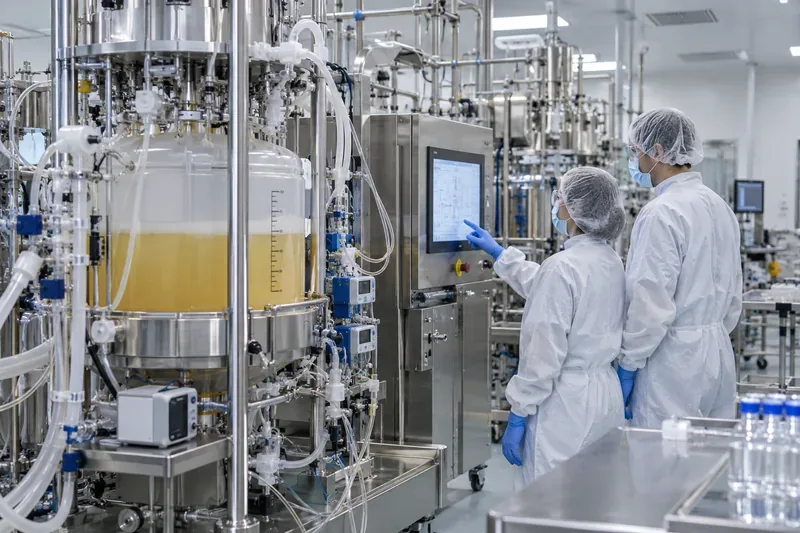
Modern biomanufacturing increasingly combines bioreactors, closed fluid paths, sensors, automation, and digital process control to shorten production cycles while maintaining quality oversight.
Quick reference: which breakthrough addresses which bottleneck?
Manufacturing approach
Primary problem it addresses
Best-fit use cases
Main caution
Continuous and intensified processing
Long cycle times, low equipment utilization, large facility footprint
Protein biologics and other processes with well-understood unit operations
Requires strong process understanding, residence-time control, automation, and contamination strategy
Perfusion and high-density cell culture
Upstream productivity limits
Monoclonal antibodies, recombinant proteins, some vector processes
Media demand, cell-retention performance, and control complexity can shift the bottleneck downstream
Platform manufacturing
Reinventing development for every new product
mRNA, related biologics, repeat product families, some gene-therapy workflows
A platform does not eliminate product-specific characterization or comparability work
PAT, automation, and digital twins
Delayed feedback and slow deviation detection
Processes with measurable critical parameters and quality attributes
Models must be validated, maintained, and governed; not every quality attribute can be measured in real time
Centralized production and long patient-specific lead times
Emerging RNA and individualized medicine models
Still developmental; quality control, validation, logistics, and regulation must scale with the network
1. Continuous and intensified bioprocessing moves the focus from batches to flow
Continuous manufacturing links unit operations so material moves through production with less waiting and fewer large intermediate holds. In biomanufacturing, the idea often appears as perfusion cell culture, continuous chromatography, continuous viral inactivation, or an integrated sequence of upstream and downstream operations.
The regulatory foundation is clearer than it was a decade ago. The U.S. Food and Drug Administration's ICH Q13 continuous manufacturing guidance, finalized in March 2023, describes scientific and lifecycle considerations for continuous drug-substance and drug-product manufacturing. It also discusses in-line and online monitoring and notes that some protein drug-substance attributes can be measured during processing, while other attributes may still require conventional release testing.
For biologics, process intensification is especially important upstream. Perfusion systems continuously add fresh medium and remove spent material while retaining productive cells, allowing high cell densities and extended operation. A current NIIMBL integrated continuous upstream project is developing a closed perfusion platform with media recycle and closed-loop control of productivity and critical quality attributes. The project is useful as a practical signal of where the field is heading, but it should not be read as evidence that every perfusion process is automatically cheaper or easier.
When continuous processing is worth considering
The product demand justifies better equipment utilization or a smaller manufacturing footprint.
The process has stable, measurable operating ranges and enough historical data to support control models.
Downstream steps can accept the upstream output rate without becoming the new capacity constraint.
The organization can maintain sensors, automation, residence-time models, and contamination-control strategies over long runs.
2. Platform technologies shorten development by reusing what is already understood
A platform is a repeatable manufacturing architecture that can support a family of products. The benefit is accumulated knowledge: common equipment, raw materials, analytics, control strategies, and operating ranges can reduce the amount of process development that must start from zero.
mRNA is a strong example. The core RNA is produced by in vitro transcription rather than by growing a production cell line to express the final RNA product. That can make sequence changes comparatively fast at the drug-substance level. But the full manufacturing chain still includes DNA-template preparation, transcription, purification, formulation—often with lipid nanoparticles—sterile processing, analytical testing, storage, and distribution. A peer-reviewed manufacturing review indexed by PubMed describes both the speed advantages of mRNA production and persistent challenges such as impurities, formulation, dose requirements, and long-term storage.
FDA has also created a formal route for recognizing advanced manufacturing methods. Its Advanced Manufacturing Technologies Designation Program guidance, finalized in December 2024, is intended to encourage technologies that can improve manufacturing reliability and robustness, improve product quality, reduce development time, or help maintain the supply of important medicines. Designation can facilitate regulatory interaction, but it does not waive the evidence needed to show that a drug is manufactured to appropriate quality standards.
3. Real-time analytics are turning process control into a manufacturing advantage
Traditional bioprocessing often relies on taking samples, sending them to a laboratory, and waiting for results. Process Analytical Technology, or PAT, moves selected measurements closer to the process through in-line, on-line, or at-line instruments. Depending on the product and unit operation, measurements may include pH, dissolved gases, cell density, metabolite concentrations, protein concentration, or selected impurity and product-quality signals.
The practical payoff is earlier detection. Operators can identify drift before a batch is lost, adjust feed or flow conditions within an approved control strategy, and build a richer data history for continuous process verification. This does not mean all release testing disappears. Potency, microbiological tests, and other complex quality attributes may still need slower or off-line methods.
Digital twins are the next layer: a synchronized computational representation of a physical process that uses real data to estimate, predict, or optimize behavior. In July 2026, NIST published a framework for integrating PAT with digital twins in biomanufacturing, including a model-based predictive-control case study. The work is important because it focuses on interoperability and operational deployment, not just simulation. It is still a technical framework and case study, however, not proof that digital twins are ready to make unsupervised release decisions across all biopharmaceutical products.
What to validate before using a model in production
Which process decision the model is allowed to influence.
Whether the training and validation data cover expected operating ranges and disturbances.
How model performance will be monitored for drift over time.
How raw sensor data, calculations, audit trails, and changes are governed.
What happens when a sensor, connection, or model fails.
4. Closed, modular, and single-use systems increase flexibility
Single-use bioreactors, disposable flow paths, preassembled tubing sets, and closed transfer systems can reduce cleaning and turnaround requirements between campaigns. They can also make it easier to add parallel production trains instead of constructing a single very large stainless-steel line. For clinical supply and multiproduct facilities, that flexibility can be more valuable than maximum vessel size.
The trade-off is that disposability changes the risk profile rather than eliminating risk. Manufacturers must manage supplier qualification, component availability, extractables and leachables, integrity testing, waste, connector compatibility, and the possibility that a specialized consumable becomes a single point of failure. For resilient operations, dual sourcing and well-defined equivalent components can be as important as the bioreactor itself.
NIST's Biomanufacturing Program highlights another requirement for flexible manufacturing: common reference materials, measurement methods, and analytical standards. Faster equipment changeovers are only useful when laboratories can still compare product quality reliably across sites, scales, and process versions.
5. Cell and gene therapy is forcing manufacturing to become more flexible without lowering quality standards
Cell and gene therapies create manufacturing problems that conventional high-volume biologics do not. Autologous cell therapies may begin with material from one patient and return a finished therapy to that same patient. Viral-vector processes can face difficult scale-up and analytical burdens. Genome-editing products may require tight control of raw materials, identity, potency, and off-target or process-related risks.
For manufacturers, the practical message is to build comparability and lifecycle change management into the process early. A process that can produce material quickly but cannot demonstrate that pre-change and post-change product remain comparable may lose the time it gained during manufacturing.
6. Distributed and on-demand manufacturing is moving from concept toward funded development
The newest frontier is to automate production so extensively that selected genetic medicines could be made closer to patients or in a distributed network. This is particularly attractive for individualized products, where centralized manufacturing and long logistics chains can dominate lead time.
On September 1, 2026, the U.S. Advanced Research Projects Agency for Health announced five teams for its GIVE program, with up to $125 million planned to develop automated, distributed manufacturing technology for individualized RNA-based genetic medicines. The important qualifier is that ARPA-H describes this as technology that does not yet exist at the intended scale and capability. It is a development program, not an available clinical manufacturing network.
Cell-free systems are another emerging path. They use biological machinery outside intact living cells to make proteins or other biomolecules, potentially simplifying certain forms of rapid, decentralized production. A 2025 proof-of-principle study indexed by PubMed demonstrated scalable cell-free production of active T7 RNA polymerase across a wide range of reaction volumes. The result is promising for decentralized biomanufacturing research, but cell-free production still faces product-specific questions about scale, cost, purification, post-translational modifications, and GMP implementation.
How should a manufacturer measure whether a "breakthrough" is actually accelerating supply?
The most useful performance measures cover the whole value stream, not just the bioreactor. A technology is valuable when it improves the rate at which conforming product reaches patients without creating a harder bottleneck elsewhere.
Metric
What it reveals
End-to-end manufacturing lead time
Whether the entire process is faster from input receipt to releasable product
Right-first-time rate
Whether speed is being achieved without more deviations, rework, or rejected lots
Release-testing cycle time
Whether analytical testing is now the limiting step
Yield per facility area or per equipment-hour
Whether process intensification is improving asset productivity
Changeover and tech-transfer time
Whether the platform can move efficiently between products, sites, or scales
Raw-material and consumable risk
Whether faster processing depends on fragile suppliers or single-source components
Comparability burden after changes
Whether process improvements can be introduced without delaying development or supply
Practical adoption checklist
Define the bottleneck first. Determine whether the constraint is upstream production, purification, analytics, fill-finish, cold-chain logistics, or regulatory comparability.
Map critical quality attributes to process controls. Know which variables must be controlled and which can only be tested later.
Choose scale-up or scale-out deliberately. A larger reactor is not always better than parallel smaller lines, especially for personalized or multiproduct manufacturing.
Plan the data architecture before adding automation. Sensors are useful only if their data are trustworthy, traceable, time-synchronized, and connected to defined decisions.
Design for closed handling where feasible. Every manual open transfer can add contamination risk and operator variability.
Stress-test the supply chain. Include media, resins, filters, single-use assemblies, plasmids, enzymes, lipids, reference standards, and fill-finish capacity.
Build comparability into change plans. Collect the analytical evidence needed to show that a faster or more automated process still produces a comparable product.
Engage regulators early for genuinely novel technologies. FDA's advanced-manufacturing programs exist in part to support earlier discussion of technologies that do not fit established manufacturing patterns.
What still limits faster production?
No single technology removes the hardest constraints in biomanufacturing. Potency assays can remain slow. Sterility assurance and microbiological methods can set minimum waiting times. Raw-material shortages can idle high-performance equipment. Highly intensified upstream processes can overload chromatography or filtration capacity. Personalized therapies can be limited by chain-of-identity logistics rather than reactor throughput.
There is also a human constraint. Advanced manufacturing requires operators, engineers, quality professionals, data scientists, automation specialists, and regulators who can work from the same process model and quality strategy. BARDA's current Pharmaceutical Countermeasures Infrastructure program explicitly treats advanced manufacturing, capacity, supply-chain resilience, and workforce readiness as linked preparedness problems rather than isolated technology purchases.
Outlook: the biggest breakthrough is integration
As of September 2026, the strongest trend is not one universal production platform. It is integration: high-productivity biology connected to closed equipment, rapid analytics, automated control, reusable process knowledge, and a regulatory strategy that anticipates manufacturing change.
Continuous processing can shorten cycle time. Platform technologies can reduce repeated development work. PAT can reveal process drift earlier. Digital twins may improve prediction and control. Modular systems can speed facility changes. Distributed manufacturing may eventually shorten the path for individualized medicines. But each technology creates value only when it improves a validated end-to-end process.
For organizations deciding what to adopt next, the best starting question is therefore practical: Which step currently prevents us from delivering a conforming therapeutic faster? Once that bottleneck is measurable, the relevant biomanufacturing breakthrough becomes much easier to identify—and much easier to evaluate against patient supply, product quality, and lifecycle risk.