Home
» Technology
»
Smart Automation in Industry 4.0: What Changed in 2026 and How to Automate with Less Intervention
Smart Automation in Industry 4.0: What Changed in 2026 and How to Automate with Less Intervention
Smart automation in Industry 4.0 is moving beyond isolated robots and dashboards toward connected systems that can sense conditions, make bounded decisions, act, verify results, and escalate exceptions. Two verified 2026 developments make that shift especially relevant now. In July 2026, NIST published its 2026 Roadmap on Artificial Intelligence and Machine Learning for Smart Manufacturing, highlighting both the growing role of AI and the unresolved challenges around industrial data, heterogeneous systems, and trustworthy operation. ISO also extended its manufacturing digital-twin framework with ISO 23247-5:2026 on the digital thread and ISO 23247-6:2026 on composing multiple digital twins.
The practical message is not that factories suddenly became autonomous in 2026. It is that the standards and research agenda are becoming more explicit about how automation must connect across equipment, software, life-cycle data, and organizational boundaries. For plant leaders, that favors architectures that are interoperable, observable, and governable rather than one-off automation islands.
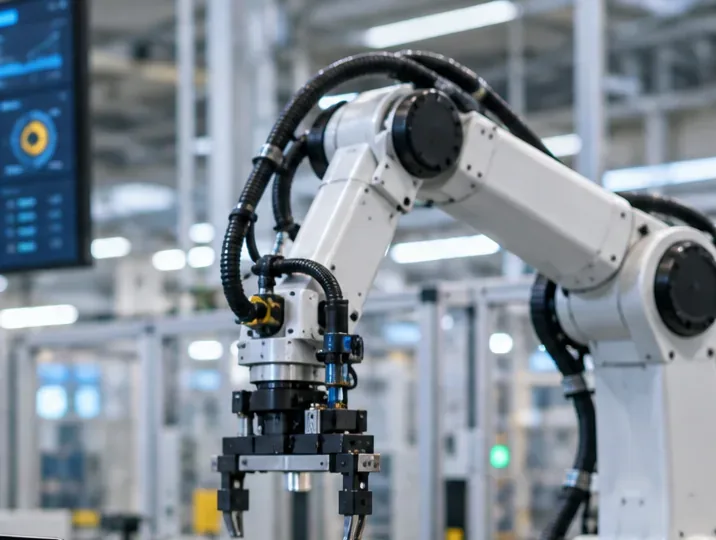
An industrial robotic arm operates inside a connected production cell, illustrating the physical automation layer of an Industry 4.0 system.
What smart automation actually means
Traditional automation usually follows predetermined logic: when condition A occurs, perform action B. Smart automation keeps that deterministic control where it is needed, then adds connected data, analytics, machine learning, digital twins, and orchestration so the system can adapt within defined limits.
A useful mental model is a closed loop with six functions: sense, interpret, decide, act, verify, and escalate. Sensors and control systems observe the process. Analytics or AI interpret the signal. A controller, workflow engine, or optimization layer chooses an allowed response. Equipment executes it. The system checks whether the expected outcome occurred. If confidence is low, risk is high, or the result falls outside limits, the case goes to a person.
What is verified: NIST's 2026 roadmap identifies AI and machine learning as increasingly important to smart manufacturing while also emphasizing reliable, explainable, and trustworthy operation in high-stakes industrial environments. What depends on context: how much authority an algorithm should receive depends on the process hazard, product risk, regulatory environment, model reliability, and quality of instrumentation. Action: define the decision boundary before selecting the AI model.
Minimal intervention does not mean zero human involvement
One common misunderstanding is that the goal of Industry 4.0 is a completely unattended factory. That may be feasible for some tightly controlled cells or time windows, but it is not a universal design target. A better objective is to remove routine intervention while preserving human authority for exceptions, safety, quality release, maintenance strategy, and unusual operating conditions.
For example, an automated inspection system can classify clear pass/fail cases and route uncertain images to a quality engineer. A scheduling optimizer can resequence jobs automatically within approved material, tooling, and delivery constraints while escalating a decision that would violate a customer commitment. A predictive-maintenance model can recommend an inspection without directly shutting down a critical asset unless the plant's safety and control design explicitly authorizes that behavior.
Action: separate decisions into three categories: fully automatic, automatic within guardrails, and human approval required. This simple classification prevents the phrase "autonomous operations" from becoming an undefined requirement.
The architecture that makes smart automation scalable
Efficiency gains are harder to sustain when every machine, dashboard, and database uses a custom integration. Industry 4.0 therefore depends as much on information architecture as on robotics or AI.
Layer
Main role
Typical examples
Design question
Physical process
Produce, move, inspect, or transform material
Motors, robots, conveyors, valves, cameras
What must remain safe if higher-level systems fail?
Control and edge
Execute low-latency logic close to equipment
PLCs, DCS, robot controllers, edge gateways
Which decisions require deterministic timing?
Operations
Coordinate production and plant workflows
SCADA, MES, quality and maintenance systems
Where is the operational source of truth?
Enterprise
Plan resources, orders, finance, and supply
ERP, planning, supply-chain applications
Which business events should change production?
Analytics and digital twin
Predict, optimize, simulate, and contextualize
AI models, historians, digital twins, optimization services
How are model decisions traced back to real assets and data?
The ISA-95 framework remains useful for clarifying these boundaries and information exchanges. In April 2025, ISA announced an updated ANSI/ISA-95.00.01-2025 Part 1 covering models and terminology for enterprise-control integration. The point is not to force every factory into a rigid pyramid; it is to make ownership, interfaces, and semantics clear enough that distributed systems can cooperate.
Action: map one production value stream from field device to ERP and identify duplicate tags, manual re-entry, conflicting identifiers, and unclear ownership before adding new AI.
Why the 2026 digital-twin updates matter
Digital twins are often described too loosely as dashboards or 3D models. In manufacturing, their value comes from maintaining a structured digital representation tied to real equipment, process state, product information, and life-cycle context. The ISO 23247 series provides a formal framework for that idea.
The 2026 additions are meaningful because they address two problems that appear after a pilot succeeds. Part 5 focuses on the digital thread that connects and maintains twin information across design, planning, production, and testing. Part 6 addresses how multiple twins can communicate, aggregate, and interoperate, including integrated, unified, and federated compositions.
What is verified: these standards were published in June and July 2026. What is not guaranteed: adopting the standards does not automatically make existing vendor systems interoperable, because real deployments still depend on supported interfaces, semantics, data quality, and implementation discipline. Action: treat a digital twin as an information contract with ownership and update rules, not as a visualization project.
Where smart automation delivers the strongest value
1. Predictive and condition-based maintenance
Connected vibration, temperature, current, pressure, or process data can help detect abnormal behavior earlier than calendar-based maintenance alone. The strongest use cases have a measurable failure mode, enough historical evidence, and a maintenance action that can actually be scheduled when risk rises. If the plant cannot act on the prediction, adding a more sophisticated model may not improve uptime.
2. Automated quality inspection with escalation
Machine vision can inspect every unit or a much larger sample than manual inspection alone. The useful pattern is not simply "AI replaces inspection." It is automatic handling of obvious cases, traceable confidence scores, drift monitoring, and human review for ambiguous or high-consequence defects.
3. Dynamic production scheduling
Scheduling systems can use order priorities, machine availability, changeover constraints, labor, tooling, and material status to adjust plans as conditions change. This works best when upstream data is timely and the optimizer is constrained by real operating rules rather than idealized assumptions.
4. Energy and resource optimization
Automation can coordinate equipment states, idle periods, heating or cooling loads, compressed air, and production timing. Savings depend heavily on the process and tariff structure, so generic percentage claims are not reliable. Measure energy per good unit, not only total facility consumption, to avoid mistaking lower output for higher efficiency.
5. Intralogistics and material flow
Automated guided vehicles, autonomous mobile robots, conveyors, and warehouse systems can reduce manual movement when routes, interfaces, traffic rules, and exception handling are designed together. Poorly synchronized automation can simply move the bottleneck from production to staging.
Use AI where it improves decisions, not where deterministic control is better
Industry 4.0 does not require machine learning in every control loop. Deterministic PLC logic remains the better choice for many safety-critical, repetitive, low-latency functions because its behavior is explicit and testable. AI is more useful where the problem involves perception, prediction, anomaly detection, optimization, or patterns that are difficult to encode as fixed rules.
This distinction also improves maintainability. A plant should be able to answer whether a production decision came from a control rule, an operator, an optimization engine, or an AI model. If that lineage is unclear, troubleshooting becomes slower precisely when automation was supposed to reduce intervention.
Action: for every automated decision, record the triggering data, decision source, allowed action range, outcome, and escalation path.
Cybersecurity becomes an operating requirement, not an IT add-on
Connecting more equipment increases the paths through which software faults, credential misuse, network problems, and cyberattacks can affect physical operations. NIST's Cybersecurity Framework 2.0 added stronger emphasis on governance and supply-chain risk, while the industrial automation community continues to use the IEC 62443 series for industrial automation and control system security.
For Industrial IoT specifically, IEC published IEC PAS 62443-1-6:2025, guidance on applying the 62443 series to IIoT. A separate NIST CSF 2.0 Manufacturing Profile revision was still listed by NIST as an initial public draft in the source checked for this article, so it should not be described as a final manufacturing standard.
Action: require asset inventory, network segmentation, identity and access control, secure remote access, backup and recovery, patch strategy, logging, supplier risk review, and incident procedures as part of the automation design—not after commissioning.
A practical way to maximize efficiency with less intervention
The most reliable automation programs scale from a clearly measured operational problem rather than from a technology shopping list. A sensible sequence is:
Baseline the process. Measure cycle time, downtime, scrap, rework, energy per good unit, maintenance burden, and manual touches.
Choose one bounded decision loop. Define what the system may sense, decide, and change.
Fix data and interfaces first. Resolve timestamp, naming, unit, synchronization, and ownership problems.
Keep hard safety constraints outside the optimization layer. Automation should never depend on an AI model to enforce a safety function unless the complete safety case explicitly supports it.
Instrument observability. Log inputs, actions, model versions, overrides, alarms, and outcomes.
Test degraded modes. Confirm what happens when sensors fail, networks drop, models are unavailable, or data becomes stale.
Scale only after the economics are repeatable. Reuse interfaces, information models, security controls, and deployment patterns across lines.
For an illustrative example, consider a packaging line with frequent short stops. A weak project starts by buying an AI platform. A stronger project first identifies the top stop categories, verifies sensor coverage, and automates only the repeatable recovery actions. AI might then rank probable causes or predict a developing jam. The result is less operator interruption without giving the model unrestricted control over the line.
How to measure whether the automation is actually smarter
Overall equipment effectiveness can be useful, but it should not be the only score. Pair production metrics with quality, reliability, human workload, and risk indicators. Useful measures include first-pass yield, mean time between failures, mean time to repair, unplanned stops, schedule adherence, energy per good unit, manual interventions per shift, alarm rate, override frequency, and the percentage of automated decisions that require later correction.
Also measure data and model health. A system can look efficient while its sensors drift or its AI silently degrades. Track missing data, stale data, model confidence, false alarms, false negatives, version changes, and the time required to investigate an automated decision.
Action: define success as a balanced scorecard before the pilot starts. If throughput rises while scrap, overrides, or recovery time worsen, the automation is not delivering the intended outcome.
The durable lesson for Industry 4.0
The strongest smart-automation strategy is not "automate everything." It is to automate repeatable decisions, connect systems through clear information models, use AI where uncertainty or complexity justifies it, and preserve human control where consequences are high. The latest 2026 work from NIST and ISO reinforces that direction: autonomy is becoming more capable, but interoperability, data management, trustworthiness, and life-cycle governance remain central engineering problems.
Organizations that get those foundations right can reduce routine intervention without making operations opaque or fragile. That is the real efficiency promise of Industry 4.0: machines handle more of the normal flow, while people spend more time on exceptions, improvement, engineering judgment, and decisions that genuinely need human context.