Home
» Technology
»
The Business of Carbon Capture in 2026: Engineering Solutions for a Net-Zero Future
The Business of Carbon Capture in 2026: Engineering Solutions for a Net-Zero Future
Carbon capture is becoming an infrastructure business, not just a technology project
The most important recent change in carbon capture is financial rather than scientific. In March 2026, the International Energy Agency reported that more than 30 carbon capture, utilization and storage (CCUS) projects had reached final investment decision in the previous two years, while annual investment had risen more than fifteenfold since 2020 to more than $5 billion in 2025. The same IEA review said more than $15 billion in commercial debt had been raised over two years, concentrated mainly in markets where governments had reduced specific project risks. See the IEA's March 2026 Financing CCUS at Scale report.
That matters because the commercial bottleneck has shifted. The core capture technologies are no longer the only question. A project must now prove that the capture plant, CO2 conditioning system, pipeline or ship, storage site, permits, monitoring program and revenue contracts will all work together for decades. The IEA's 2026 project update found operational or under-construction capture capacity more than 10% higher than in the previous annual update, while storage capacity increased by about 25%. At the same time, many planned projects slipped toward 2035, showing that a large pipeline is not the same thing as a bankable project. The underlying data are available in the IEA CCUS Projects Database, updated in March 2026.
Action for project developers: build the business case around the entire CO2 chain. A technically excellent capture unit has little value if transport starts late, storage capacity is unavailable, or the revenue contract does not cover the operating profile.
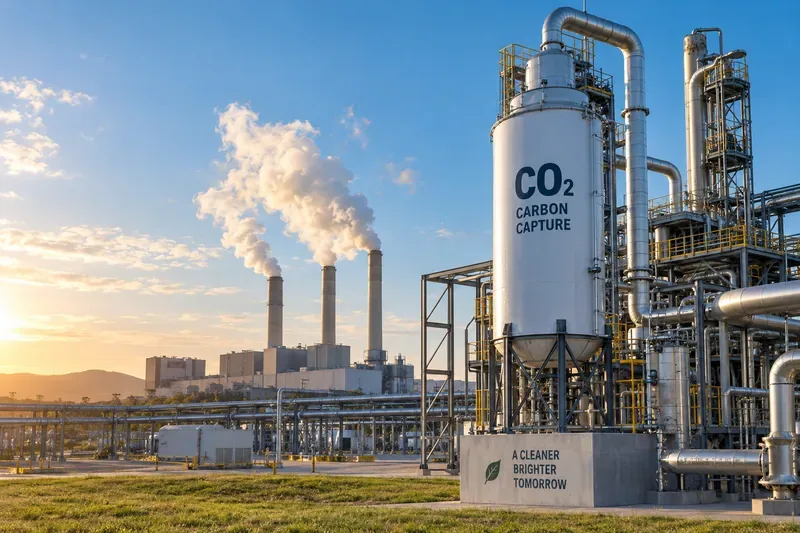
A modern carbon-capture plant is shown with large process vessels, pipework and an adjacent power facility, illustrating the physical infrastructure that must connect capture equipment with compression, transport and eventual storage.
What does a carbon-capture business actually sell?
A common misconception is that captured CO2 itself will usually pay for the project. In reality, the IEA describes CO2 as having little intrinsic market value and limited standalone demand. Most viable projects therefore monetize something else: compliance value, a tax credit, a long-term government-backed payment, a premium for lower-carbon products, a carbon-removal credit, or a transport-and-storage service fee.
Business model
What creates revenue
Typical commercial risk
Tax-credit model
A payment or credit tied to verified tonnes captured and securely stored or used in qualifying ways
Eligibility, tax capacity or transferability, performance and measurement
Contract-for-difference or long-term support
A contract that closes part of the gap between low-carbon production costs and market value
Contract duration, reference prices, availability and change-in-law risk
Transport and storage utility
Fees for moving, injecting and managing CO2 for multiple customers
Volume risk, cross-chain outages, underused infrastructure and long-term liability
Low-carbon product premium
Customers pay more for cement, steel, chemicals or fuels with lower verified lifecycle emissions
Demand depth, certification rules and willingness to pay
Carbon-removal offtake
Buyers contract for durable removals from direct air capture or bioenergy with carbon capture and storage
Credit quality, permanence, methodology and long-term buyer demand
The United States provides one clear example of a performance-based revenue stream. The IRS Section 45Q guidance describes a federal credit for qualified carbon oxide that is captured and securely stored, used in qualifying enhanced recovery, or utilized in specified ways. The IRS also states that the credit can be eligible for direct payment or transfer, subject to statutory requirements. In the United Kingdom, the government has continued to update separate commercial frameworks for industrial capture and transport and storage; its CCUS business-model collection was updated in July 2026.
Action for investors: treat the revenue mechanism as part of the engineering design basis. A plant sized for maximum capture may not be optimal if the contract rewards only certain operating hours, products, or verified storage volumes.
Engineering choices determine whether the economics can work
1. Capture: concentration, pressure and heat integration matter
Separating CO2 from a concentrated industrial stream is generally easier than extracting it from a dilute flue gas. That is why natural-gas processing, ethanol fermentation and some chemical processes have historically offered more favorable capture economics than cement kilns or power-plant exhaust. In a 2021 analysis, the IEA estimated illustrative capture costs of roughly $15-$25 per tonne for some high-purity industrial streams and $40-$120 per tonne for more dilute applications. Those are historical estimates rather than 2026 quotations, but the engineering lesson remains valid: concentration, pressure, contaminants, steam availability, energy prices and plant integration strongly affect cost. See the IEA analysis Is carbon capture too expensive?.
Post-combustion amine systems are mature and retrofit-friendly, but solvent regeneration consumes heat. Pre-combustion separation can work well where the process already creates a concentrated CO2 stream. Oxy-fuel systems change the combustion environment to produce a CO2-rich exhaust. Membranes, solid sorbents and newer solvents can be attractive in specific pressure, purity and temperature ranges.
Action for engineers: compare technologies on the same system boundary. Include steam extraction, electricity, cooling, compression, solvent replacement, water, downtime and the effect on the host plant—not just the capture skid's nameplate rate.
2. Compression and conditioning are not minor balance-of-plant items
Captured CO2 has to meet transport and storage specifications. Water, oxygen, sulfur compounds and other impurities can affect corrosion, phase behavior, compressor design and storage acceptance. A hub with multiple emitters therefore needs agreed CO2 quality specifications and procedures for off-spec gas.
Action for hub developers: define composition limits and custody-transfer measurement before final equipment selection. Otherwise, one emitter's impurity profile can become a network-wide reliability problem.
3. Transport turns isolated projects into networks
Large, steady volumes often favor pipelines, while ships can connect dispersed coastal emitters to offshore storage and can help create a market before every pipeline is built. Shared infrastructure can reduce duplication, but it also creates cross-chain risk: a capture plant may be ready while storage is not, or a transport outage can force an emitter to curtail capture.
Norway provides a useful commercial signal. The country's Northern Lights transport and storage system became the first dedicated CO2 storage hub to begin operating in Europe, according to the IEA's 2026 review. In June 2025, Norway approved a Phase 2 expansion that the government said would increase transport and storage capacity from 1.5 million to at least 5 million tonnes of CO2 per year. See the Norwegian Ministry of Energy announcement.
Action for customers of shared networks: negotiate remedies for delayed start-up, capacity shortfalls, outages and off-spec CO2. The network contract is as important to bankability as the capture EPC contract.
4. Geological storage is an engineered asset, not an empty underground space
Permanent storage requires reservoir characterization, injection-well design, plume and pressure modeling, monitoring, corrective-action planning and closure obligations. In the United States, EPA Class VI requirements include site characterization, modeling of the CO2 plume and pressure front, well-construction standards and monitoring intended to protect underground sources of drinking water. The details are summarized on the EPA Class VI geologic-sequestration page.
The European Union is also trying to turn storage from a project-specific constraint into strategic infrastructure. Article 20 of the EU Net-Zero Industry Act sets an objective of at least 50 million tonnes per year of CO2 injection capacity by 2030 in qualifying EU storage sites. That is an infrastructure target, not a guarantee that an equivalent amount will actually be captured and injected. The legal text is available through EUR-Lex.
Action for project sponsors: start storage appraisal early. A capture plant can be designed faster than a storage resource can always be characterized, permitted and financed.
Three misconceptions that can distort investment decisions
“Carbon capture makes a fossil-fuel plant zero-emission.”
Verified: capture systems can remove a large share of CO2 from selected process streams. Project-dependent: the actual percentage captured, energy penalty, upstream fuel emissions, methane leakage, auxiliary boilers and transport emissions vary by design. Not established by the phrase “CCS-equipped” alone: whether the full lifecycle is near zero.
The IEA's engineering work notes that many mature point-source systems have historically been designed around roughly 85%-90% capture, while capture rates above 98% can be technically feasible for some mature separation technologies with additional equipment and energy. See the IEA review of CCUS technology innovation.
Action: ask for a lifecycle emissions balance and a mass balance, not just a nominal capture percentage.
“The highest capture rate is always the best business decision.”
Higher capture can reduce residual emissions, but the incremental tonne may require more absorber area, solvent circulation, heat, compression or process changes. The optimal commercial design depends on the value of avoided emissions, contract terms, energy prices and the plant's expected operating profile.
Action: model marginal cost per additional tonne captured at several capture-rate targets rather than selecting one percentage before the economic model is complete.
CO2 can be used in fuels, chemicals, building materials and other products, but the climate value depends on how the CO2 was sourced, how much energy the conversion requires, how long the carbon remains out of the atmosphere and what product or process is displaced. Geological storage is designed for long-term containment; utilization pathways require their own lifecycle accounting.
Action: separate tonnes “captured,” “utilized,” “durably stored” and “avoided” in project reporting instead of treating them as interchangeable.
Why hubs are changing the business model
A single emitter that must finance its own pipeline and storage site carries enormous fixed infrastructure costs. A hub can aggregate volumes from cement plants, refineries, waste facilities, hydrogen producers and power stations, allowing transport and storage assets to serve multiple customers. That can improve utilization and spread development costs.
But hubs replace one integrated-project risk with a network of contractual risks. The IEA says CCUS projects increasingly need coordination across capture, transport and storage, and that long-term liability, volume risk and cross-chain dependencies complicate financing. This is one reason policy frameworks increasingly resemble infrastructure regulation rather than one-off technology grants.
Action for hub sponsors: create a common technical code covering pressure, temperature, composition, metering, nominations, maintenance, emergency response, liability and allocation of scarce capacity. Then align the commercial agreements with that code.
What a bankable carbon-capture project looks like
There is no universal template, but the strongest projects usually answer seven questions before construction:
Source: Is there a stable, measurable CO2 stream over the contract life?
Capture: Has the technology been matched to concentration, pressure, contaminants and available heat?
Transport: Is there firm capacity with compatible specifications and credible start-up timing?
Storage: Is the pore space characterized, permitted or on a credible permitting path, and backed by a monitoring plan?
Revenue: Who pays per tonne, for how long, and under what verification rules?
Risk allocation: Who bears construction overruns, outages, under-delivery, transport interruption, storage unavailability and long-term liability?
Measurement: Can the project prove captured, transported and stored tonnes with auditable monitoring, reporting and verification?
This discipline matters because headline project pipelines can overstate near-term deployment. The IEA's March 2026 financing report said roughly 90% of projects announced for 2035 had not yet reached final investment decision. Some had already been cancelled or withdrawn when financing or cross-chain risk could not be resolved.
Action: use FID, binding transport and storage contracts, permit status and financing commitments as progress metrics—not announcements alone.
Where the near-term business case is strongest
Projects with concentrated CO2 streams and existing infrastructure tend to start with an advantage. Bioethanol, natural-gas processing and some ammonia or hydrogen processes can have lower separation costs than cement kilns or power-plant flue gas. The IEA's 2026 market review specifically noted that North American tax credits continued to support lower-cost applications such as fertilizer and bioethanol, while higher-cost industrial and power projects faced more difficulty when support did not close the economic gap.
Cement is different. A large share of cement emissions comes from calcination chemistry, not just fuel combustion, so switching to clean electricity alone cannot eliminate those process emissions. That gives carbon capture a potentially important role, but the capture stream is challenging and the retrofit can be capital-intensive. The business case often needs a combination of policy support, infrastructure access and customer demand for lower-carbon cement.
Direct air capture is a separate business category. It removes CO2 from ambient air rather than avoiding emissions at a smokestack. Because atmospheric CO2 is dilute, energy use and cost are much higher. Its potential revenue therefore depends heavily on durable carbon-removal purchases and policy support rather than the economics of conventional point-source capture.
Action for developers: begin with the easiest tonnes—high-concentration streams, large stable sources and locations near credible storage—then expand the network as infrastructure and demand mature.
The outlook: growth is real, but “zero emission” still requires more than CCS
The 2026 market picture is stronger than it was a few years ago. The IEA says projects currently under construction could nearly double operational capture capacity by 2030, and the sector has started attracting large commercial-debt transactions. Europe is developing shared storage networks; the United States has a transferable tax-credit framework; the United Kingdom is building long-term contracts and regulated transport-and-storage arrangements.
Still, carbon capture is not a substitute for efficiency, electrification, renewable power, material efficiency, methane control or process innovation. In some sectors it competes with alternatives; in others, especially where process emissions are difficult to eliminate, it can complement them. A credible net-zero strategy chooses the lowest-risk combination rather than assuming one technology will decarbonize every asset.
The business opportunity is therefore broader than capture equipment. It includes solvents and sorbents, heat integration, compressors, pipelines, CO2 ships, storage appraisal, drilling, subsurface monitoring, measurement software, insurance, engineering services, low-carbon product certification and project finance. The companies that succeed will not merely capture carbon; they will make the whole chain reliable, verifiable and financeable.