Home
» Technology
»
Managing Aging Populations: Where Digital Elder Care Helps—and Where It Does Not
Managing Aging Populations: Where Digital Elder Care Helps—and Where It Does Not
Digital technology can help societies manage population aging, but only when it strengthens—not substitutes for—person-centered care. The most useful tools solve a specific problem: helping an older adult hear, move, remember, connect with a clinician, stay safe at home, or giving care teams better information and less administrative work. The weakest projects start with a device or an AI feature and only later ask what problem it was meant to solve.
The demographic pressure is real. WHO notes that the number of people aged 60 and older is projected to reach 2.1 billion by 2050. At the same time, long-term care systems already face workforce shortages, uneven access, affordability constraints, and growing demand for home- and community-based care. Digital elder care can be part of the response, but the evidence is more nuanced than the most optimistic marketing claims suggest.
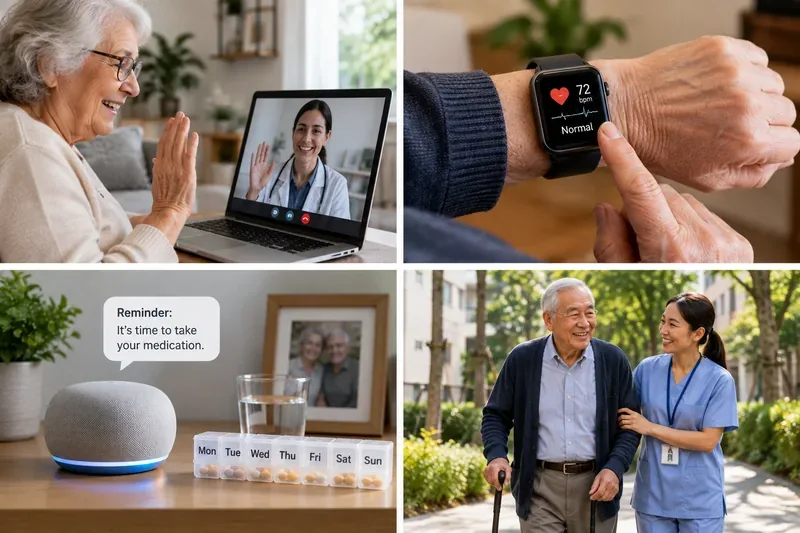
Digital elder care can span remote clinical visits, connected monitoring, medication support, and tools that complement in-person caregiving. The useful question is not how advanced the technology looks, but whether it improves independence, safety, access, or caregiver capacity.
What is already well established?
Several foundations are well supported. First, population aging is increasing the need for health, social, and long-term care. Second, assistive technology can help maintain or improve functioning and independence. WHO includes both physical products and digital solutions under assistive technology, such as communication aids, memory support, speech recognition, and software that helps people manage daily tasks. WHO estimates that more than 2.5 billion people currently need one or more assistive products and that this need could exceed 3.5 billion by 2050. See the WHO assistive technology fact sheet.
Third, digital services can support integrated care. WHO's healthy-aging work emphasizes person-centered, coordinated services across homes, primary care, hospitals, and long-term care settings. Its Integrated Care for Older People approach, or ICOPE, is designed around functional ability rather than treating each disease in isolation. See WHO's guidance on person-centered integrated care for older people.
Action: Before buying technology, define the functional or care problem in plain language: “reduce missed medications,” “make blood-pressure follow-up easier,” “detect a fall sooner,” or “reduce time nurses spend duplicating documentation.”
Misunderstanding 1: “Technology can replace caregivers”
What is verified: digital tools can reduce some administrative, monitoring, coordination, and transport burdens. OECD analyses describe sensors, tablets, digital records, and other tools as ways to improve long-term-care productivity and give workers more time for direct care.
What depends on context: how much labor a tool actually saves depends on workflow design. A new dashboard can reduce work if it replaces duplicate phone calls and paper records; it can increase work if staff must document the same information in multiple systems.
What is not supported: the idea that digital systems will remove the need for human caregivers in core long-term-care tasks. OECD's analysis says technology is more likely to support and supplement workers than replace them entirely. See the OECD discussion of technology and future long-term-care labor needs.
Action: Evaluate a technology by how much high-value human time it creates. Track minutes spent on documentation, travel, routine checks, and direct interaction before and after deployment.
Telehealth and remote monitoring: useful capabilities, not guaranteed outcomes
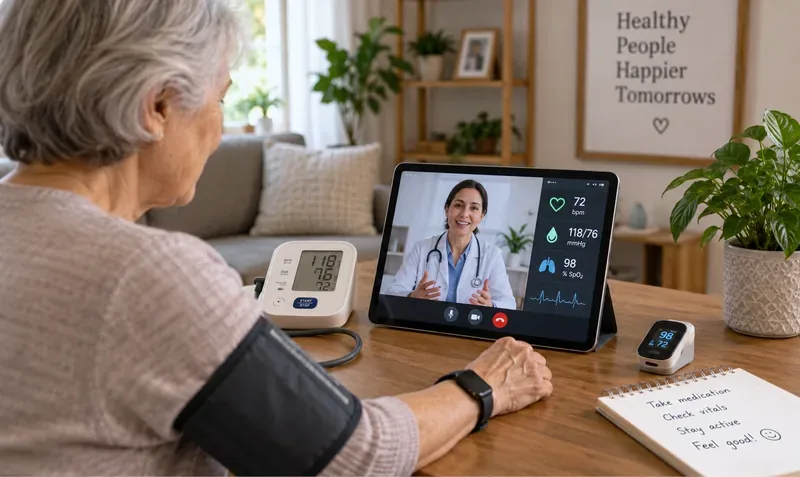
Telehealth can remove a transportation barrier and make follow-up easier for people who have mobility limitations, live far from specialists, or need frequent check-ins. Remote patient monitoring, or RPM, uses connected medical devices to collect physiologic data such as blood pressure, glucose, weight, or oxygen saturation and transmit it to a care team. The U.S. Centers for Medicare & Medicaid Services describes RPM as a combination of patient education, connected-device data, and clinical treatment management. See the current CMS remote patient monitoring overview.
What is verified: RPM can make data available to clinicians between visits, and telehealth can improve access in situations where travel is difficult.
What depends on context: value depends on who is monitored, what data are collected, whether staff can respond, and whether the intervention changes treatment. A stream of readings that nobody reviews promptly has little value.
What remains uncertain: a connected device does not automatically reduce hospitalization. A randomized trial of high-risk older adults found no significant reduction in hospitalizations and emergency department visits with one telemonitoring program compared with usual care. That does not prove all telemonitoring fails; it shows outcomes depend on the specific population and care model.
Action: Every monitoring program should define an escalation pathway: which reading triggers action, who receives the alert, how quickly they respond, and what happens when data stop arriving.
Smart-home safety can support aging in place—if privacy is treated as a design requirement
“Aging in place” means living safely and independently in one's own home and community as long as practical. Digital tools can support this goal through fall detection, door and motion sensors, emergency call systems, connected lighting, environmental alerts, and simple reminders.
WHO's 2025 long-term-care financing work states that technologies can support functional capacity, help older adults live safely and independently, and potentially delay more intensive long-term-care needs. See the WHO Kobe Centre's 2025 summary on technologies for healthy aging.
What is verified: safety and assistive technologies can make specific daily activities easier and can support home-based living.
What depends on context: fall sensors only help when someone can respond. Location tracking may support independence for one person and feel intrusive to another. Connectivity, battery maintenance, false alarms, housing layout, and caregiver availability all affect performance.
What is still uncertain: long-term evidence for many newer smart-home combinations is less mature than the marketing language around them. WHO has long warned that the impact of innovative assistive technologies is nuanced and that privacy, autonomy, and social participation need case-by-case consideration. See the WHO World report on ageing and health.
Action: Use the minimum monitoring necessary. Get meaningful consent, define who can access the data, set retention periods, and document what will happen when the system detects a problem.
Assistive technology is often more important than “AI for elder care”
Digital elder-care conversations often jump quickly to artificial intelligence, humanoid robots, or predictive analytics. Yet many of the highest-value interventions are simpler: hearing support, visual aids, mobility devices, medication organizers, captioning, communication tools, accessible phones, and memory aids.
This matters because a basic functional limitation can block every more advanced service. A person who cannot hear a telehealth visit clearly may benefit more from appropriate hearing support than from a more sophisticated video platform. A person with poor vision may need larger text, high contrast, voice control, or screen reading before a digital care plan is usable.
Action: Fix the access layer first. Review hearing, vision, mobility, dexterity, cognition, language, and connectivity before selecting the digital service that sits on top of them.
Misunderstanding 2: “Older adults simply cannot use digital technology”
That statement is too broad. Older adults are not a single user group, and age alone does not predict whether someone can use a device. WHO/Europe highlights digital health opportunities for older people while also identifying accessibility, digital literacy, privacy, and personalization as major implementation challenges. See WHO/Europe's healthy aging in a digital world overview.
What is verified: digital exclusion is real, and some users need training, accessible interfaces, caregiver support, or alternative channels.
What depends on context: a 90-year-old familiar with video calls may use telehealth independently, while a much younger person with impaired vision, low literacy, cognitive decline, or limited connectivity may struggle.
What is wrong with the stereotype: designing around chronological age can hide the real barrier. The better design variables are functional ability, experience, confidence, language, accessibility, and support.
Action: test services with real older users. Offer large text, strong contrast, simple navigation, voice or caregiver-assisted options, clear error recovery, and a telephone or in-person fallback.
Medication support works best as a layered system
Medication adherence can involve memory, dexterity, prescription complexity, changing instructions, refill logistics, and side effects. Digital reminders can help, but a reminder is only one layer. WHO's mAgeing work shows how basic mobile technologies can support self-care and self-management when they are integrated with evidence-based care rather than used alone. See the WHO and ITU mAgeing handbook.
What is verified: reminders and mobile messaging can support routines and self-management.
What depends on context: the tool must match the medication regimen and the person's cognitive, visual, and physical abilities.
What remains outside the device's role: an app cannot safely resolve an outdated prescription list, a drug interaction, or confusion about a changed dose.
Action: combine reminders with periodic medication reconciliation by a qualified clinician or pharmacist and a fallback plan for missed doses or repeated non-response.
AI and care robots: promising in narrow roles, still uncertain in broad ones
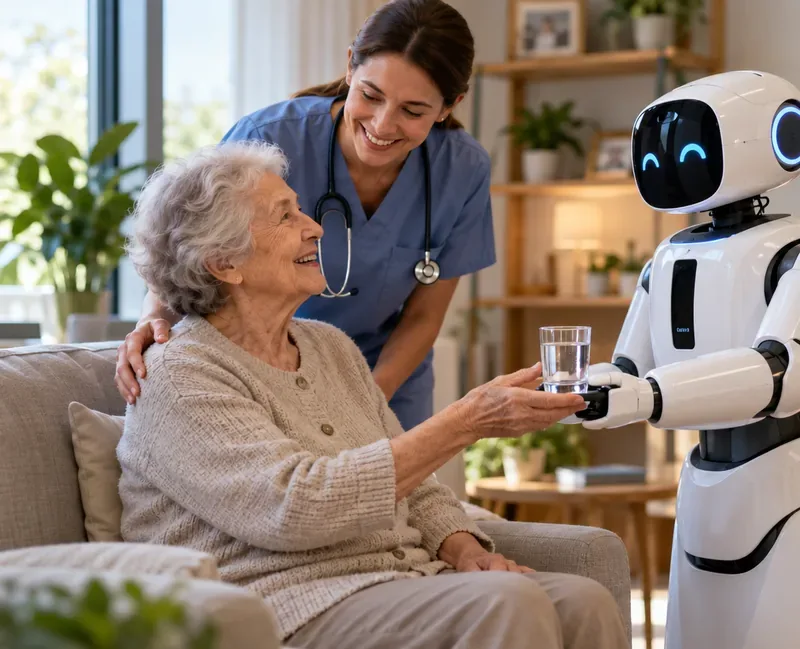
AI can summarize notes, prioritize messages, identify patterns in large data streams, assist scheduling, or flag changes that deserve clinical attention. Robots may help with logistics, rehabilitation exercises, social engagement, or selected physical tasks. These are plausible and in some settings already useful applications.
What is verified: OECD and WHO both recognize technology's potential to support care delivery and workforce productivity.
What depends on context: predictive systems are only as useful as their data, thresholds, clinical workflow, and ability to avoid excessive false alarms. AI-generated summaries can save time only if staff can trust and verify them efficiently.
What is not yet known well enough: the long-term social effects of AI companions, the cost-effectiveness of many robotics programs at scale, and how reliably AI models perform across diverse older populations with multiple conditions. Evidence for novel systems is developing faster than long-term outcome studies can be completed.
Action: pilot AI in a narrow task with measurable outcomes and a human override. Define in advance what error rate, false-alert rate, or user dissatisfaction level would trigger redesign or discontinuation.
A practical digital elder-care stack
Need
Useful digital option
Key dependency
Metric worth tracking
Clinical follow-up
Telehealth and connected monitoring
Clinical response workflow
Completed follow-ups, time to intervention, avoidable travel
Home safety
Fall, motion, door, and emergency sensors
Reliable alert recipient
Response time, false alarms, user confidence
Medication routines
Reminders, dispensers, caregiver notifications
Accurate medication list
Missed doses, refill gaps, escalation events
Functional independence
Hearing, vision, mobility, memory and communication aids
Individual assessment and fitting
Activities completed independently
Care coordination
Shared care plans and secure messaging
Interoperability and role clarity
Duplicate work, handoff failures, staff time
Workforce support
Scheduling, documentation assistance, AI triage
Verification and governance
Administrative time saved, error rate
What good implementation looks like
Successful programs tend to share a few characteristics. They begin with a measurable care objective. They include older people and caregivers in design. They provide training rather than assuming a device is self-explanatory. They integrate alerts into existing clinical or social-care workflows. They keep a non-digital fallback for outages or users who cannot participate. And they measure harms as well as benefits.
Governance also matters. Health and home-monitoring data can reveal location, routines, diagnoses, sleep, medication use, or social behavior. Collecting more data than needed increases privacy risk without necessarily improving care. Procurement therefore needs to cover cybersecurity, data ownership, interoperability, accessibility, support, replacement, and end-of-life plans for devices—not just the purchase price.
Action: require every procurement proposal to answer five questions: What outcome are we trying to improve? Who acts on the data? What happens if the system fails? What information is truly necessary? How will we know whether the service helped after six or twelve months?
The remaining unknowns should shape policy, not be hidden by enthusiasm
Several important questions remain open. Which technology combinations produce durable reductions in long-term-care need across different health systems? How do AI companions affect loneliness and human contact over multiple years? Which predictive models remain reliable for people with multiple chronic conditions, frailty, dementia, or atypical physiology? How should governments compare savings in one part of the care system with new costs in another? And how can low-resource settings adopt useful technologies without deepening digital inequality?
Those uncertainties are not reasons to stop innovation. They are reasons to build evaluation into deployment. A digital elder-care program should be treated as a service intervention that can be measured, improved, and stopped if it does not work—not as a one-time technology purchase.
Bottom line
The most credible digital strategy for aging populations is neither “technology will solve elder care” nor “older people cannot use technology.” Both are oversimplifications. The evidence supports a more practical position: digital tools can extend independence, improve access, support caregivers, and reduce some avoidable workload when they are accessible, connected to real care pathways, and governed responsibly.
The next useful step is small and concrete. Choose one problem, select the least complex tool that can address it, involve the older person and caregivers in the decision, define a human response pathway, and measure whether the change actually improves daily life or care delivery. Scale only after that is clear.