Home
» Technology
»
The Internet of Medical Things (IoMT): What It Really Changes in Remote Patient Care
The Internet of Medical Things (IoMT): What It Really Changes in Remote Patient Care
The Internet of Medical Things, or IoMT, is most useful when it closes a clinical loop: a connected device captures meaningful health data, transmits it reliably, places it in front of the right care team, and triggers a defined response when something needs attention. Simply connecting a blood-pressure cuff, wearable, glucose sensor, scale, pulse oximeter, or cardiac monitor to the internet does not create better care by itself.
That distinction has become more important in 2026. The U.S. Food and Drug Administration's Quality Management System Regulation took effect on February 2, 2026, aligning key device-manufacturing quality requirements with ISO 13485:2016. The FDA also issued updated medical-device cybersecurity guidance in February 2026. On May 13, 2026, the Centers for Medicare & Medicaid Services updated its Remote Patient Monitoring guidance. Together, these changes reinforce a practical reality: IoMT is not just a networking project. It touches device quality, clinical workflow, reimbursement, interoperability, privacy, and cybersecurity.
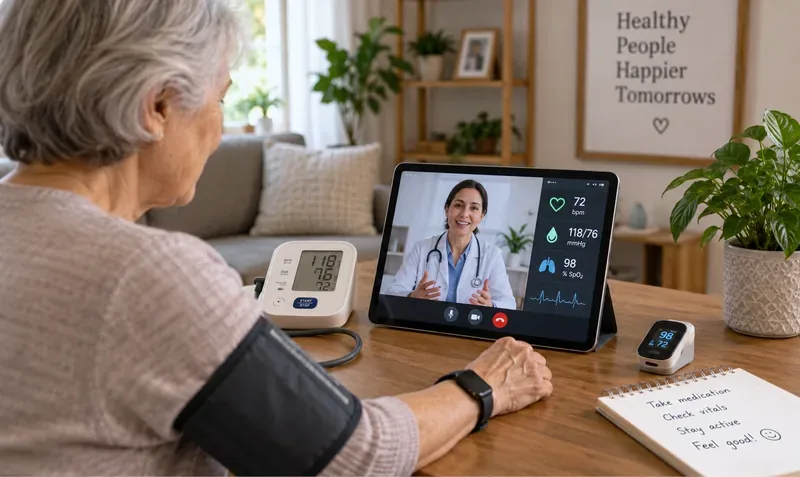
A patient uses connected monitoring equipment during a remote care visit. The value of IoMT comes from linking reliable measurements to a clinician, a workflow, and a clear response plan—not merely from putting devices online.
What exactly counts as IoMT?
IoMT is a broad industry term for connected medical technologies and related systems that collect, exchange, or act on health data. There is no single FDA regulatory category called “IoMT.” The regulatory status of a product depends on its intended use and whether it meets the definition of a medical device, not on whether a vendor markets it as IoMT.
The FDA describes digital health more broadly as technologies that use computing platforms, connectivity, software, and sensors for health care and related uses. That range extends from general-wellness products to technologies regulated as medical devices. See the FDA overview of digital health.
smart infusion, monitoring, imaging, or bedside equipment inside health facilities;
a phone, home hub, or gateway that relays measurements;
cloud services that receive, normalize, analyze, or route data;
clinical dashboards, alerting systems, and electronic health record integrations;
identity, device-management, audit, and cybersecurity services surrounding the clinical data flow.
The FDA maintains a periodically updated list of authorized medical devices incorporating sensor-based digital health technology, including wearable devices such as watches, rings, patches, and bands that may be used outside clinical settings. This is a useful reminder that a consumer-looking form factor does not tell you whether a product is a regulated medical device. See the FDA list of authorized sensor-based digital health medical devices.
Is IoMT the same thing as remote patient monitoring?
No. IoMT describes the connected technology ecosystem. Remote patient monitoring, or RPM, is a care model in which patient-generated physiologic data is collected outside the traditional clinical setting and used by a provider to manage an acute or chronic condition.
CMS currently describes RPM as a process in which a patient uses a connected medical device to collect data such as blood pressure, weight, or glucose and the device automatically transmits those measurements to the health care provider. As of the CMS page updated May 13, 2026, Medicare RPM eligibility includes an internet-connected device that meets the FDA definition of a medical device, digitally uploads data, and collects and transmits health data on at least two days in a 30-day period. Coverage and billing requirements can change, so organizations should verify the current rules rather than building a business case around an old code summary. See the current CMS Remote Patient Monitoring guidance.
An IoMT product may therefore support RPM, but many IoMT devices are used in hospitals, laboratories, ambulances, assisted-living settings, research, or other workflows that are not Medicare RPM.
What problem should you solve before choosing devices?
Start with a clinical question, not a catalog. “We want connected devices” is not a useful deployment objective. Better questions are:
Do we need earlier detection of worsening hypertension?
Are sudden weight changes important for a defined heart-failure workflow?
Do clinicians need glucose trends between office visits?
Are we monitoring oxygen saturation after discharge under a specific protocol?
Do we need adherence, symptom, rhythm, mobility, or respiratory data?
What action should occur when a measurement crosses a threshold?
The device should be chosen only after the team defines the measurement, clinical purpose, expected user, frequency, intervention threshold, response time, and escalation path. Otherwise an IoMT program can create a large stream of data without creating a care process.
How does IoMT data actually reach the care team?
Layer
Typical role
Question to verify
Medical device or sensor
Captures physiologic or device data
Is it validated and appropriate for the intended clinical use?
Local connection
Bluetooth, Wi-Fi, cellular, or another link moves data off the device
What happens when the connection fails?
Gateway or app
Pairs the device, may identify the patient, and relays readings
Can a patient accidentally pair the wrong device or account?
Cloud/platform
Stores, normalizes, analyzes, and routes measurements
Where is data stored, encrypted, logged, and backed up?
Clinical integration
Moves actionable data into a dashboard or EHR workflow
Will staff have to sign into a separate portal all day?
Human response
Reviews trends, contacts the patient, changes the plan, or escalates
Who owns the alert and how quickly must they respond?
The last row is often the hardest. A system can transmit every reading perfectly and still fail operationally if no one is responsible for reviewing the information, if alerts arrive in the wrong queue, or if clinicians cannot distinguish urgent signals from routine variation.
Which remote-care use cases are the best fit?
Hypertension and other repeatable measurements
Connected blood-pressure monitoring is a straightforward IoMT use case because the measurement is familiar, can be taken at home, and can feed a defined treatment workflow. CMS uses connected blood-pressure monitoring as an RPM example. The operational challenge is not merely receiving a number: the program needs patient training, appropriate cuff sizing and technique, data review, and a plan for abnormal or missing readings.
Diabetes and continuous sensing
Continuous and intermittently scanned glucose systems demonstrate how IoMT can turn occasional measurements into longitudinal data. The benefit is richer trend information, but the data volume also raises workflow questions: which events create alerts, who receives them, and which information belongs in the permanent clinical record?
Cardiopulmonary monitoring
Weight scales, pulse oximeters, rhythm monitors, ECG patches, and other connected sensors can support condition-specific programs when changes are clinically meaningful and a team is prepared to respond. The FDA notes that wireless medical devices can allow clinicians to remotely access patient data and that remote monitoring can support chronic-disease management outside the hospital. See the FDA guidance on wireless medical devices.
Post-discharge and Hospital-at-Home models
IoMT can extend observation into the home when a care pathway requires more visibility than occasional phone calls provide. These programs can combine medical devices, telehealth, symptom reporting, and communication. They also create a more complicated security boundary because hospital-controlled equipment is operating on home networks alongside consumer IoT devices.
Sometimes, but the evidence is not uniform across conditions, devices, and program designs. The technology is only one part of the intervention.
A 2025 systematic review and meta-analysis of 40 randomized controlled trials involving noncommunicable diseases found that remote patient monitoring may slightly reduce the proportion of patients hospitalized and may modestly reduce length of stay. However, the certainty of evidence for many utilization outcomes ranged from moderate to very low, and emergency-visit effects were uncertain. The authors emphasized that the results should be interpreted cautiously. See the original JMIR systematic review and meta-analysis.
This is an important purchasing lesson. Do not assume that adding an IoMT platform automatically reduces admissions, emergency visits, or total cost. Ask for evidence in a patient population, condition, device type, and workflow similar to yours. A program that works because nurses call patients after specific alerts cannot be evaluated as though the hardware alone produced the result.
What should you verify about interoperability?
Interoperability means more than two systems being able to send bytes to each other. The receiving system must understand and safely use what was sent: patient identity, units, timestamps, device status, measurement context, and any quality indicators all matter.
The FDA's guidance for interoperable medical devices emphasizes the safe and effective exchange and use of information between medical devices and other technology. It recommends that manufacturers define the purpose of electronic interfaces, anticipated users, data attributes, performance, risk controls, and labeling. See the FDA guidance on interoperable medical devices.
Before procurement, test the exact pathway you intend to use. A device may technically integrate with an EHR but still require manual reconciliation, delayed batch imports, a third-party interface fee, or a separate clinician dashboard. Those details can determine whether staff actually use the system.
What changed for medical-device cybersecurity in 2026?
The FDA issued final cybersecurity guidance in February 2026 covering device design, labeling, and recommended premarket documentation for devices with cybersecurity risk, including recommendations related to the statutory requirements for cyber devices. It superseded the FDA's June 2025 final guidance. See the FDA's February 2026 medical-device cybersecurity guidance.
For a health system or RPM provider, practical cybersecurity questions include:
How are devices authenticated and provisioned?
Is data encrypted in transit and at rest?
How are software and firmware updates delivered and verified?
Can default credentials be changed or removed?
Does the vendor publish a support and end-of-life policy?
Can compromised or lost devices be revoked remotely?
Are device identities and patient identities kept correctly associated?
What security logs are available to the organization?
What happens if the cloud service or vendor disappears?
Security should also be evaluated at the system level. A secure medical sensor connected through an unsupported phone, weak home Wi-Fi, an abandoned gateway, or an overprivileged cloud account can still create a weak chain.
What does the 2026 Quality Management System Regulation change?
For device manufacturers, FDA's Quality Management System Regulation became effective February 2, 2026. The regulation amended 21 CFR Part 820 and incorporated ISO 13485:2016 by reference, aligning U.S. medical-device quality management requirements more closely with an international framework. The FDA also replaced its prior QSIT inspection approach with a new inspection process aligned to QMSR. See the FDA QMSR overview.
Health systems buying IoMT products do not become device manufacturers simply by using them, but the change matters when evaluating vendors. Connected medical products are not only software subscriptions; they have lifecycle obligations involving design, manufacturing, risk management, complaints, suppliers, changes, servicing, and postmarket quality processes.
Is IoMT health data automatically protected by HIPAA?
No. HIPAA applies based on who is handling the data and in what role. HHS explains that data collected through an app offered by or on behalf of a HIPAA-covered entity generally can be protected health information. But health information that a person voluntarily enters into a consumer app not offered by or on behalf of a regulated entity may fall outside HIPAA, even if the same type of data would be protected inside a clinical system.
For patients and procurement teams, the practical question is not “Is this health data?” but “Which entity receives it, under what legal role, for what purpose, and under which privacy and breach-notification obligations?”
How should a health organization evaluate an IoMT program before launch?
Define the clinical problem. Name the condition, measurement, target population, and action the data should enable.
Confirm device status. Determine whether the product is a regulated medical device for the intended use and verify applicable FDA authorization or classification information where relevant.
Map the complete data path. Document device, phone or gateway, network, cloud, interface engine, EHR, dashboard, analytics, and third-party services.
Assign alert ownership. Specify who reviews routine data, who handles abnormal data, and what happens after hours.
Test failure modes. Simulate dead batteries, no connectivity, duplicated readings, wrong-patient pairing, clock errors, delayed uploads, and cloud outages.
Measure patient burden. Count setup steps, charging requirements, pairing tasks, passwords, required readings, and support calls.
Validate interoperability in the real workflow. Do not rely only on a compatibility logo or vendor architecture slide.
Review privacy and security contracts. Understand data ownership, permitted use, subcontractors, retention, deletion, breach response, patches, and end-of-life support.
Verify reimbursement separately. If the business case depends on Medicare or another payer, check the current coverage and billing rules for the exact service model.
Define success metrics before launch. Include clinical outcomes, adherence, alert burden, response time, technical failure rate, staff time, patient satisfaction, and total cost.
When is IoMT not the right answer?
IoMT is a poor fit when the measurement does not change management, when the patient cannot reasonably operate or maintain the equipment without support, when connectivity is unreliable and there is no offline pathway, or when the care team lacks capacity to respond to the resulting data.
It can also be the wrong solution when a simpler intervention works better. A scheduled nurse call may be more useful than continuous sensing for some patients. An ordinary home blood-pressure log may be adequate when rapid review is unnecessary. A clinic visit may still be required when physical examination, imaging, laboratory testing, or hands-on treatment is central to the decision.
What is the real transformation?
The most important change created by IoMT is not the ability to measure a vital sign at home; patients have done that for decades. The transformation is the ability to make selected measurements continuously or repeatedly available to a care system without waiting for the next appointment.
That can shift care from periodic snapshots toward longitudinal observation. But the technology only becomes clinically valuable when the signal is trustworthy, the data reaches the right place, the alert burden is manageable, and someone has authority and capacity to act.
For organizations deciding whether to deploy IoMT, the best question is therefore not “How many devices can we connect?” It is “Which connected measurement will change a decision, who will make that decision, and can we operate the entire system safely at scale?” Answer those questions first, and the device choice becomes much easier.
Regulatory, coverage, and cybersecurity information in this article was checked on September 12, 2026. FDA guidance, Medicare requirements, device authorizations, vendor capabilities, and privacy obligations can change. Verify current official requirements and product documentation before making clinical, purchasing, compliance, or reimbursement decisions.