Home
» Technology
»
The Future of Geriatric Healthcare: How Robotics and Smart Monitoring Can Work Together
The Future of Geriatric Healthcare: How Robotics and Smart Monitoring Can Work Together
The most important point: the future of geriatric healthcare is not a robot replacing a nurse, family member, or physician. It is a coordinated care system in which assistive robotics, home sensors, wearables, and remote clinical monitoring help people notice changes earlier, reduce repetitive workload, and support older adults in staying as independent as safely possible.
That distinction matters because older adults often live with several conditions at once, changing mobility, sensory limitations, medication complexity, and different levels of family or professional support. Technology is most useful when it fits into a person-centered care plan rather than becoming another device to manage. The World Health Organization's 2025 second edition of its Integrated Care for Older People guidance emphasizes coordinated, personalized assessment and follow-up across cognition, mobility, vitality, vision, hearing, psychological capacity, social support, and other needs. See the WHO ICOPE guidance for person-centered assessment and care pathways.
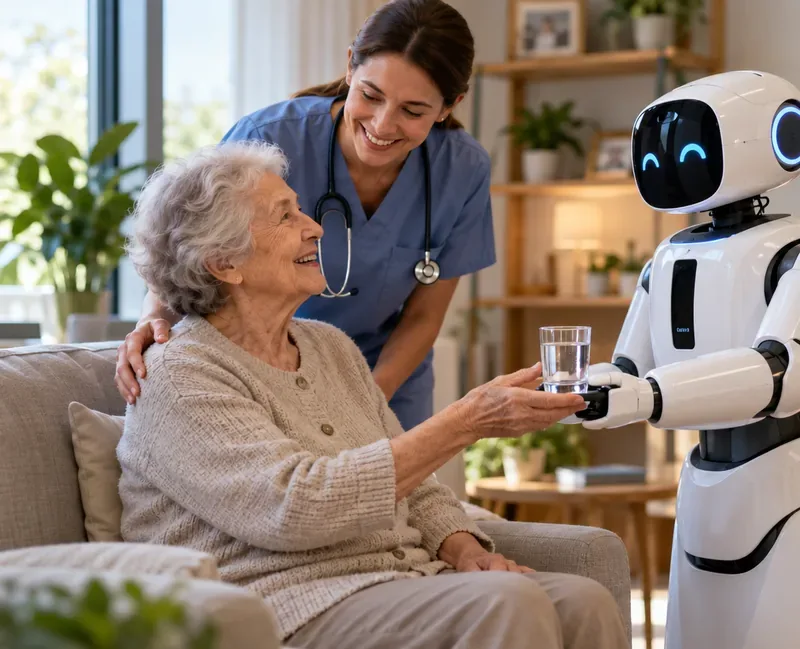
An older adult, a caregiver, and an assistive robot share the same home-care setting, illustrating a model in which technology supports rather than replaces human care.
What the next generation of geriatric care is likely to look like
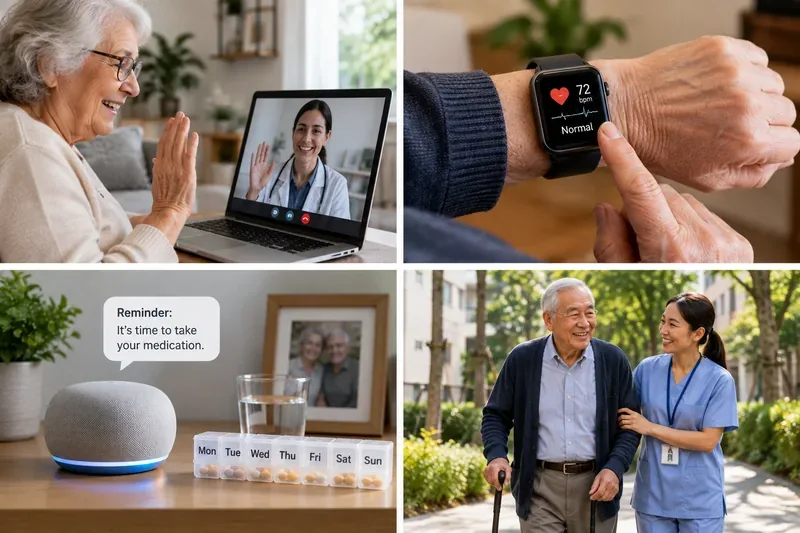
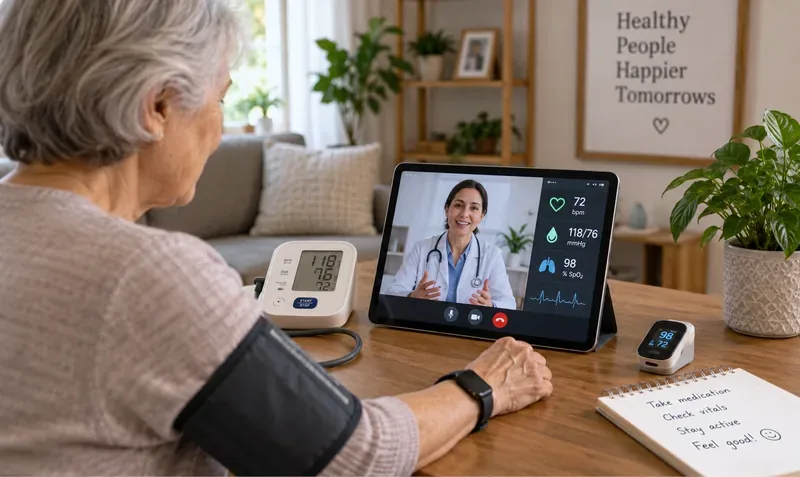
The practical model is a layered system. A wearable may track a physiological signal, a room sensor may notice a change in movement patterns, a medication device may record whether a dose was dispensed, and a robot may provide reminders or physically carry light objects. Software then turns selected data into alerts or trends for the people responsible for care.
Not every layer is appropriate for every person. The best configuration depends on the clinical question, the person's living situation, cognitive status, comfort with technology, connectivity, and who will respond when the system raises an alert.
Technology
Useful for
Key limitation
Wearable or connected medical sensor
Continuous or periodic measurement of selected health parameters
Data quality, adherence, battery life, and whether the device is validated for the intended use
Ambient home sensor
Movement, room occupancy, routine changes, or environmental conditions
Privacy, false alerts, and uncertainty about what a behavior change actually means
Socially assistive robot
Reminders, structured activities, social interaction, or simple assistance
Evidence is still mixed, and acceptance varies greatly by person and setting
Remote clinical dashboard
Reviewing trends and prioritizing follow-up
Alert fatigue and the risk of collecting more data than staff can act on
Smart monitoring is most valuable when it answers a specific care question
Remote monitoring can sound impressive while producing little benefit if nobody has defined what the data are supposed to change. A better starting point is a concrete question such as: Has this person's activity dropped sharply after a medication change? Are nighttime bathroom trips increasing? Is a chronic condition drifting outside the range the care team has defined? Has the person stopped using a device that is important to their treatment?
The U.S. Food and Drug Administration notes that wireless medical devices can support remote monitoring and allow clinicians to access patient data across locations, including the home. The agency also points out that wireless connectivity brings risks that need to be managed. See the FDA overview of wireless medical devices.
For readers evaluating wearables or connected sensors, an important distinction is whether a product is merely a consumer wellness device or has been authorized for a medical purpose. The FDA maintains a list of authorized medical devices that incorporate sensor-based digital health technology, including wearable and home-use products designed for continuous or spot-check monitoring. The list is updated periodically, so current regulatory status should be checked rather than assumed. See the FDA sensor-based digital health technology device list.
Example: monitoring mobility without turning the home into a surveillance room
Consider an older adult who lives alone, has mild mobility limitations, and has had one previous fall. A reasonable monitoring plan might use a wearable or discreet motion sensors to identify major changes in daily activity, plus a clearly defined escalation rule for a caregiver. It does not automatically require cameras in every room or continuous audio recording.
That approach is closer to the research direction supported by the U.S. National Institute on Aging, which has funded technology platforms for in-place monitoring of daily function, home safety, quality of life, and related outcomes. The NIA's CART initiative is one example of infrastructure designed to study home-based and wearable sensing in real living environments. See the NIA summary of in-place monitoring research.
Where robotics can add value
Robotics in geriatric healthcare covers very different functions. A socially assistive robot may lead a simple exercise, remind someone about an appointment, or provide a conversational interface. A mobile service robot may transport supplies in a facility. More specialized robots may assist with rehabilitation or physical tasks under professional supervision. These should not be treated as one category with one evidence base.
The strongest reason to use a robot is usually not that it looks futuristic. It is that embodiment can make a task easier to understand, more engaging, or less physically demanding. For example, a resident in long-term care may respond better to a scheduled interactive activity presented by a physical device than to another notification on a phone. A home-care robot may also provide a consistent interface for reminders when a small touchscreen is difficult to use.
Evidence should still be interpreted carefully. In the CARESSES randomized controlled trial, researchers tested culturally competent socially assistive robots in care homes in England and Japan. The study found some improvement in emotional well-being measures but did not show significant improvement across physical health subscales, and the sample was small. That makes it a useful proof of possibility, not proof that social robots broadly improve health outcomes. Read the CARESSES randomized controlled trial.
The real breakthrough is integration, not any single device
A robot becomes more useful when it can participate in a safe workflow. Imagine that a validated sensor records a trend that meets a clinician-defined threshold. Instead of sounding a generic alarm, the system could prompt the older adult to repeat a measurement, ask a simple symptom question, notify the designated caregiver, and place the event in a clinician's review queue. The robot may be the visible interface, but the real value comes from the workflow, data quality, escalation logic, and accountable human response.
This is also where artificial intelligence will likely have the most practical impact: summarizing trends, reducing duplicate alerts, adapting interfaces to hearing or vision needs, recognizing meaningful changes from an individual's own baseline, and helping staff prioritize cases. AI should be used as decision support with defined boundaries, not as an unexplained replacement for clinical judgment.
What should stay under human control?
Diagnosis and major treatment decisions should remain with qualified clinicians.
Emergency escalation rules need clear ownership and backup procedures.
Older adults or their authorized representatives should know what is being monitored, why it is collected, who can see it, and how long it is retained.
Care teams should be able to review why a system raised an alert and correct bad data or inappropriate thresholds.
There should be a workable manual process when the network, device, cloud service, or robot is unavailable.
Privacy and cybersecurity are part of clinical safety
Smart-home healthcare can connect medical devices, consumer IoT products, cloud services, phones, routers, and hospital systems. That creates a larger attack surface than a traditional standalone device. NIST's final 2025 guidance on telehealth and smart-home integration highlights risks including compromised consumer IoT devices and recommends controls such as access control, strong authentication, continuous monitoring, data security, governance, and network segmentation. See NIST CSWP 34 on telehealth smart-home cybersecurity and privacy.
Medical-device security requirements are also evolving. In February 2026, the FDA issued updated final guidance on cybersecurity considerations for medical devices with cybersecurity risk, including recommendations related to device design, labeling, quality systems, and premarket documentation. Organizations buying connected monitoring equipment should treat update mechanisms, vulnerability management, authentication, and support lifetime as procurement requirements, not optional IT features. See the FDA's February 2026 medical-device cybersecurity guidance.
How to decide whether robotics and smart monitoring fit a real care setting
Before buying technology, define the problem and the response path. A small pilot with a measurable goal is usually more informative than installing a broad platform and hoping useful patterns emerge.
Start with the care objective. Examples include reducing missed measurements, detecting functional decline earlier, supporting medication routines, or lowering repetitive staff workload.
Define the target user. Consider cognition, dexterity, hearing, vision, language, mobility, and comfort with automated systems.
Choose the minimum necessary sensing. Collect only the data needed for the care objective.
Verify device status and evidence. Check the intended use, regulatory status where applicable, published validation, and whether evidence matches the population you serve.
Design the alert workflow before deployment. Specify who receives an alert, how quickly they should respond, and what happens if they are unavailable.
Test failure modes. Include loss of Wi-Fi, discharged batteries, sensor removal, false positives, false negatives, and cloud outages.
Measure acceptance. A technically accurate system that residents dislike or staff bypass will not deliver its intended value.
What success should look like
A useful geriatric technology program should make care more understandable and more responsive, not simply produce more dashboards. Signs of success include fewer missed observations, faster follow-up on meaningful changes, manageable alert volume, improved adherence to care plans, lower staff burden for repetitive tasks, and high acceptance among older adults and caregivers.
Equally important, teams should know when to change course. If a monitoring system produces constant false alarms, if residents feel watched, if staff stop responding to alerts, or if the robot adds maintenance work without improving a defined outcome, the deployment needs redesign. Technology should earn its place in the care pathway.
The likely future: quiet technology, stronger human care
The most promising future of geriatric healthcare is not a room filled with machines. It is an environment in which sensors are unobtrusive, robots handle narrowly defined supportive tasks, and clinicians receive better information at the right time. Older adults remain participants in decisions about their own care, and families and professionals retain clear responsibility for action.
Robotics and smart monitoring are therefore best viewed as infrastructure for person-centered care. When they are selected for a specific need, validated for the intended use, integrated into a human workflow, and protected with strong privacy and cybersecurity practices, they can make aging in place and long-term care more responsive. When those conditions are missing, even sophisticated technology can become noise. The future will depend less on how advanced the devices look and more on whether they reliably support safer, more dignified, and more coordinated care.