Home
» Technology
»
Where to Study Carbon Capture Engineering in 2026: Strong Environmental and CCUS Programs
Where to Study Carbon Capture Engineering in 2026: Strong Environmental and CCUS Programs
Carbon capture engineering is becoming a more defined field of study, and 2026 has brought a useful change for prospective students: universities are moving beyond one-off electives and research groups toward dedicated CCUS credentials. The University of Calgary, for example, now lists a new Carbon Capture, Utilization and Storage specialization in its Advanced Engineering Practice graduate certificate, while Colorado School of Mines offers both a dedicated online master’s degree and a graduate certificate in CCUS.
That shift reflects what is happening in the industry. In its March 2026 update, the International Energy Agency reported that carbon-capture capacity that was operational or under construction was more than 10% higher than in the previous edition of its CCUS Projects Database. The IEA also reported more than 30 final investment decisions for CCUS projects over the prior two years and more than $5 billion of investment in 2025. See the IEA’s March 2026 CCUS update and its Financing CCUS at Scale report.
For students, the practical consequence is important: there is no single “best” carbon capture engineering degree for everyone. Capture chemistry, process design, CO₂ transport, geological storage, monitoring, permitting, life-cycle assessment, and project economics require different technical backgrounds. The programs below are therefore compared by fit, not placed in a simple prestige ranking.
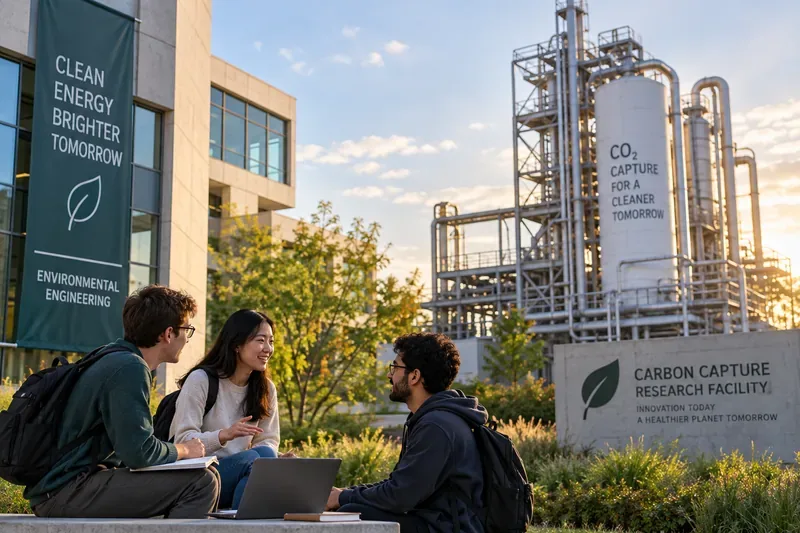
Graduate students discuss engineering work beside a modern carbon-capture research setting, reflecting the field’s mix of process engineering, environmental systems, and subsurface science.
What Does “Carbon Capture Engineering” Actually Cover?
Most jobs described as carbon capture, CCS, or CCUS engineering sit somewhere along a chain. At the front end, chemical and process engineers work on separating CO₂ from flue gas or process streams using solvents, sorbents, membranes, cryogenic methods, or other separation systems. They need thermodynamics, heat and mass transfer, process control, and process simulation.
Storage-focused engineers work farther downstream. They evaluate reservoirs, model multiphase flow, study geochemistry and geomechanics, design injection wells, and plan monitoring. In the United States, long-term geologic sequestration can also involve Class VI well requirements under the Underground Injection Control program. The U.S. Environmental Protection Agency’s Class VI overview is a useful example of why regulatory and environmental-risk knowledge matters alongside technical design.
A third path focuses on carbon management as a system: life-cycle assessment, techno-economic analysis, policy, community engagement, infrastructure planning, and measurement, reporting, and verification. Strong programs increasingly connect these areas rather than treating carbon capture as an isolated unit operation.
Best-Fit Programs for Carbon Capture, Storage, and Environmental Engineering
The following options were selected because their official 2026 or 2027 program pages explicitly identify carbon capture, CCUS, geological CO₂ storage, or closely related research as part of the curriculum. Program names and availability can change, so always recheck the official page before applying.
Program
Format
Strongest fit
What stands out
Colorado School of Mines — MS in Carbon Capture, Utilization and Storage
Fully online
End-to-end CCUS systems
Dedicated 30-credit non-thesis degree with capture, subsurface, policy, and economics options
University of Calgary — CCUS Graduate Certificate specialization
In-person evening classes; four courses over 16 months
Working engineers and applied field training
CCUS, subsurface energy, data science, life-cycle assessment, and access to a field research station
University of Manchester — MSc Subsurface Energy Engineering
Carbon dioxide capture and utilization taught within a materials-chemistry program with a substantial research project
Imperial College London — MSc Advanced Chemical Engineering
1 year, full-time
Process engineering and capture systems
Advanced chemical engineering with an optional Carbon Capture and Clean Fossil Fuels module
University of Cambridge — MPhil in Energy Technologies
11 months, full-time
Broad energy engineering with research specialization
Strong fundamentals plus a research project; CCUS fit depends on the project and modules available in a given year
UT Austin — MS/PhD in Petroleum and Geosystems Engineering
On campus, research-oriented
Subsurface CCS research in the United States
Graduate research in carbon capture and storage within a broader geosystems engineering program
1. Colorado School of Mines: Best Fit for a Dedicated, End-to-End CCUS Degree
If you already know that you want a credential centered specifically on carbon capture, utilization, and storage, Colorado School of Mines is one of the clearest options. Its official program page describes a fully online, non-thesis Master of Science in CCUS that combines thermodynamics, fluid mechanics, geochemistry, chemical engineering, subsurface geology, monitoring, and carbon-management decision making.
The current curriculum lists a 30-credit structure and specialized directions including Capture and Chemical Processing, Geological Sequestration, and Policy and Economics. This breadth is useful if you want to understand the whole value chain rather than only one technology. The format also makes it unusually practical for engineers who do not want to leave full-time work. Review the Colorado School of Mines MS in CCUS. Mines also offers a shorter CCUS graduate certificate.
Best for: working professionals, engineers moving into CCUS project roles, or students who want explicit coverage of capture, storage, policy, and economics in one program.
2. University of Calgary: Best Fit for Applied CCUS Training and Field Exposure
A notable 2026 development is the University of Calgary’s new CCUS specialization within its Advanced Engineering Practice graduate certificate. The official program page describes four courses over 16 months: CCUS Principles, Technologies and Analysis; Subsurface Energy Engineering in a Low Carbon Future; Data Science and Machine Learning; and Life Cycle Assessment.
The most distinctive feature is access to Carbon Management Canada’s field research station in Newell County, Alberta, where training can include subsurface monitoring, CO₂ injection, and site management. The program is designed around evening classes, which makes it attractive to employed engineers. The university states that two scholarship-supported Canadian cohorts were planned for January and September 2026. The Fall 2026 scholarship application deadline displayed on the page has already passed, so prospective students should verify the next intake and funding cycle rather than assume the same support will continue. See the University of Calgary CCUS specialization.
Best for: engineers and geoscientists who value work-integrated learning, field monitoring, life-cycle analysis, and the Canadian carbon-management ecosystem.
3. University of Manchester: Best Fit for Geological CO₂ Storage Engineering
Manchester’s MSc in Subsurface Energy Engineering is especially strong if you want to become a reservoir engineer, subsurface modeler, underground storage specialist, or environmental risk professional. The current program is jointly connected to chemical engineering and earth and environmental sciences and explicitly covers geological CO₂ storage.
The curriculum emphasizes subsurface characterization, rock and fluid physics, multiphase flow, reservoir simulation, fluid thermodynamics, and CCS/CCUS design using industry-standard software. That is a different profile from a capture-materials degree: the center of gravity is what happens after CO₂ has been captured and needs to be transported into a secure geological formation. The 2027 program page also states that the MSc is accredited by the Energy Institute. See the University of Manchester MSc Subsurface Energy Engineering.
Best for: students with engineering backgrounds who want deep expertise in reservoirs, storage, multiphase flow, geoscience, and simulation.
4. UCL: Best Fit for Carbon Capture Materials and Chemistry
UCL’s Materials for Energy and Environment MSc is a better match if your interest is in the materials and chemistry that make capture technologies work. The current UCL program description explicitly includes carbon dioxide capture from anthropogenic sources and advances in the utilization of captured CO₂.
The degree is broader than CCUS: it also covers batteries, fuel cells, solar energy, and environmental materials. That breadth can be an advantage for students who want flexibility across low-carbon technologies. The current structure is 180 credits and includes a 90-credit individual research project, which makes research-group fit especially important. See the UCL Materials for Energy and Environment MSc.
Best for: chemistry, materials science, and engineering graduates interested in sorbents, catalysts, membranes, characterization, or research careers.
5. Imperial College London: Best Fit for Process Design and Capture Technology
Imperial’s Advanced Chemical Engineering MSc is not a dedicated carbon-capture degree, but it can be a strong route for students who want deep process-engineering fundamentals and then specialize through electives. The current course information lists Carbon Capture and Clean Fossil Fuels as an optional module, alongside areas such as advanced fluid mechanics, membrane science, process systems, and machine learning.
This route makes sense if you want to design, integrate, or optimize capture plants rather than focus primarily on underground storage. Imperial’s current page lists the next course start as October 2027 and states that applications open September 30, 2026. See the Imperial College London MSc Advanced Chemical Engineering.
Best for: chemical engineers targeting process design, solvent systems, separations, membranes, plant integration, or techno-economic optimization.
6. University of Cambridge: Best Fit for a Broad Energy Research Path
The MPhil in Energy Technologies at Cambridge is another example of a program where carbon capture is a possible specialization rather than the entire degree. It provides broad training in energy science and engineering and includes a research project chosen from projects offered by faculty.
This can be an excellent route for students who want a research-oriented degree and may continue to a PhD, but applicants should verify that suitable carbon capture or storage projects are available in the intake they are considering. The official postgraduate page currently lists applications for Michaelmas 2027 as open from September 9, 2026, with a May 13, 2027 application deadline, while noting that some courses may close earlier. See the Cambridge MPhil in Energy Technologies.
Best for: research-minded engineers who want broad energy fundamentals and the option to specialize through a faculty project.
7. UT Austin: Best Fit for U.S. Subsurface CCS Research
The Hildebrand Department of Petroleum and Geosystems Engineering at The University of Texas at Austin offers on-campus MS and PhD programs rather than a stand-alone CCS degree. Its official graduate page identifies carbon capture and storage as one of the department’s active subsurface research areas, alongside geothermal energy, hydrogen storage, AI, and data analytics.
This is a strong route if you want thesis or doctoral research in geological storage and related geosystems engineering. It is less suitable if you need a short professional credential or a fully online program; the department’s graduate FAQ says its standard MS and PhD offerings are on campus and primarily full-time. See the UT Austin PGE graduate programs.
Best for: students seeking research-intensive U.S. training in reservoirs, subsurface flow, storage, monitoring, or related carbon-management problems.
How to Choose the Right Program for Your Career Goal
Start with the job you want, then work backward to the curriculum. If you want to design absorbers, strippers, membranes, compressors, and integrated process systems, prioritize chemical engineering, separations, thermodynamics, and process simulation. Imperial, UCL, and the capture pathway at Mines fit that profile well.
If you want to evaluate storage sites, model plume migration, design injection strategies, or work on monitoring and well integrity, look for reservoir simulation, geomechanics, geochemistry, multiphase flow, and permitting. Manchester, UT Austin, Calgary, and the geological-sequestration pathway at Mines are stronger matches.
If your target is project development, environmental consulting, carbon strategy, or public-sector work, the ideal curriculum should also include life-cycle assessment, techno-economics, risk, policy, community engagement, and regulation. A technically excellent program that omits those dimensions may leave you less prepared for real-world project development.
What to Check Before You Apply
Is CCUS central or incidental? A single elective is very different from a dedicated degree, certificate, research group, or thesis pathway.
Which part of the value chain is emphasized? Capture, transport, storage, utilization, and carbon-management strategy require different skill sets.
Is there a substantial project? A research project, capstone, or field exercise can be more valuable than an extra lecture course when you later need evidence of applied ability.
Do you learn relevant tools? Look for process simulation, reservoir simulation, geospatial analysis, data science, life-cycle assessment, or monitoring methods that match your target role.
Does the faculty actually work on CCUS? Read current research-group pages and recent projects rather than relying only on the program title.
Is there exposure to regulation and environmental risk? Storage projects in particular depend on monitoring, verification, well integrity, and permitting, not only reservoir performance.
Does the format fit your situation? Online programs such as Mines can suit working professionals, while research-heavy campus programs may be better for students aiming at a PhD or laboratory career.
Which Program Is the Best Overall?
There is no defensible single winner because the programs solve different educational problems. For a dedicated end-to-end CCUS credential, Colorado School of Mines stands out for breadth and online accessibility. For applied field-oriented training, the University of Calgary is especially interesting because of its 2026 CCUS specialization and field-station component. For geological storage, Manchester is one of the clearest specialized master’s options. For capture materials, UCL is stronger. For process engineering, Imperial is a natural fit. For research-oriented study, Cambridge and UT Austin offer broader degrees in which CCUS can become the focus through research.
The most useful way to compare carbon capture engineering programs is therefore not “Which university is highest ranked?” but “Which program gives me the technical depth, project experience, and environmental context needed for the role I actually want?” That question will usually lead to a better decision than prestige alone.