Home
» Technology
»
Beyond Large Language Models: Why Embodied AI Is the Next Frontier in Tech
Beyond Large Language Models: Why Embodied AI Is the Next Frontier in Tech
The short answer: embodied AI is emerging as a major next frontier because it extends foundation-model intelligence beyond generating words, images, or code and into a closed loop of perceiving, reasoning, acting, and learning from physical consequences. Large language models remain important inside that loop, but a robot or autonomous machine also needs spatial understanding, real-time control, memory, sensors, actuators, safety systems, and enough physical-world data to turn a useful plan into reliable motion.
That distinction matters. A language model can explain how to pick up a fragile glass. An embodied system has to find the glass, estimate its position and orientation, choose a safe grasp, move without hitting nearby objects, regulate force, notice if the glass slips, and recover before something breaks. The intelligence is no longer judged only by whether an answer sounds correct; it is judged by what actually happens.
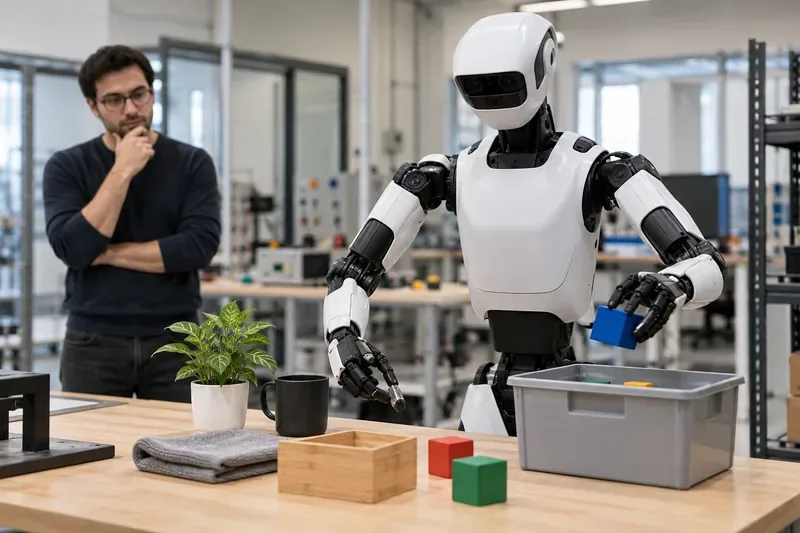
A humanoid robot sorts objects at a workbench while an engineer observes, illustrating the perception-to-action loop that distinguishes embodied AI from purely digital systems.
Embodied AI does not replace LLMs; it adds action and feedback
Modern embodied AI systems often build on the same foundation-model ideas that made LLMs powerful: broad pretraining, multimodal inputs, transfer learning, and instruction following. The difference is the output. Instead of stopping at text tokens, an embodied model may generate robot actions, trajectories, waypoints, grasp poses, or commands for lower-level controllers.
One important architecture is the vision-language-action model, or VLA. A VLA combines visual observations and language instructions with an action policy so a machine can map what it sees and what a person asks into physical behavior. Google DeepMind's earlier RT-2 research demonstrated this idea by adapting vision-language models to predict robot actions. More recent systems have pushed the concept toward longer tasks, whole-body motion, local inference, and cross-robot transfer.
Capability
Typical LLM or digital agent
Embodied AI system
Why the difference matters
Input
Text, images, audio, files, software state
Those inputs plus cameras, depth, force, proprioception, location, and other sensors
The system must estimate what is physically happening now
Output
Text, code, API calls, digital actions
Motor commands, trajectories, grasps, navigation, tool use
Errors can have physical cost and safety consequences
Feedback
Usually digital and discrete
Continuous and closed-loop
The machine must detect slippage, obstacles, contact, and task progress
Timing
Seconds can be acceptable for many tasks
Some control loops require much faster responses
Latency can directly affect stability and dexterity
Success rate, safety, precision, recovery, cycle time, wear, and energy
A plausible plan is not enough if the robot cannot execute it reliably
Why the frontier is moving now
1. Foundation models are starting to transfer useful knowledge into robot control
Robotics historically depended on highly engineered, task-specific systems. That works extremely well in fixed production cells, but it becomes expensive when objects, instructions, layouts, or workflows change frequently. Foundation models offer a different approach: learn broad representations once, then adapt them to many tasks.
The research trend is visible across several independent efforts. Physical Intelligence's π0 generalist policy, published in 2024, combines a pretrained vision-language model with robot data and continuous action generation. The team reports training across eight robot configurations and producing motor commands at frequencies up to 50 Hz for dexterous manipulation. The important point is not that one model has solved general robotics; it has not. The point is that semantic knowledge learned from broad visual-language data can now be connected to action policies rather than rebuilt from scratch for every skill.
2. Cross-robot datasets are reducing the “one robot, one model” problem
Embodied AI has a data problem that LLMs did not face in quite the same way. The public web contains enormous amounts of text and images, but it does not contain billions of clean examples of robot joints, forces, failures, and successful manipulation trajectories for every machine.
Projects such as Open X-Embodiment were created to pool robot experience across institutions and platforms. The original research assembled data from 22 different robots and demonstrated hundreds of skills, with experiments aimed at learning policies that benefit from experience collected on other embodiments. This is a crucial direction: if knowledge transfers across robot bodies, developers may need far less task-specific data for every new platform.
3. Systems are becoming hierarchical instead of asking one model to do everything
Real physical tasks have different time scales. “Clean this area” is a high-level goal. Deciding what to pick up next is a planning problem. Closing a gripper around an object without crushing or dropping it is a control problem. Trying to force all three into one model can make a system harder to verify and tune.
Current research increasingly separates these roles. Google DeepMind's Gemini Robotics ER 2 is presented as a high-level embodied reasoning model that plans multi-step tasks and hands motor execution to a lower-level VLA. In July 2026, DeepMind also introduced Gemini Robotics 2, reporting whole-body humanoid control, dexterous manipulation, local on-device operation, and multi-robot collaboration in research demonstrations.
Those are vendor-reported research results, not evidence that general-purpose humanoids are already ready for unrestricted deployment. But the architecture is instructive: a planner can reason at a slower semantic level while a specialized policy and conventional controllers handle fast physical execution.
4. Simulation and synthetic data can expand training without risking hardware every time
Robot data is expensive because collecting it can require hardware, operators, maintenance, floor space, and recovery from failed trials. Simulation helps by generating additional experiences and testing policies before they touch real equipment. NVIDIA's GR00T N1.6, released in December 2025, is an open foundation model for generalist humanoid robots that NVIDIA evaluated in simulation and on real robot platforms. NVIDIA's broader robotics stack also emphasizes simulated and synthetic trajectories as a way to supplement scarce real-world data.
Simulation is not a free substitute for reality, however. Friction, lighting, deformable materials, sensor noise, backlash, wear, and unexpected human behavior can create a “sim-to-real” gap. A practical system still needs real-world validation in the actual environment where it will operate.
What embodied AI can do that matters commercially
The best near-term use cases are not necessarily the most human-like robots. They are tasks where physical variability is high enough that conventional automation becomes expensive, but the environment is still bounded enough to test and manage risk.
Use case
Why embodied AI may help
Conditions that make it a better fit
Flexible warehouse handling
Objects, bins, and orders vary more than in a fixed robot cell
Known workspace, repeatable object families, measurable pick success, safe fallback process
Factory tending and changeovers
A general policy may reduce reprogramming for small-batch variation
Still difficult today because homes are unstructured, safety-critical, and full of rare edge cases
A useful rule is this: if the task happens entirely on a screen, embodied AI is probably unnecessary. A software agent or LLM with tools will usually be cheaper, easier to update, and easier to contain. Embodiment becomes valuable when the business problem includes physical work that cannot be reduced to a fixed sequence of deterministic motions.
The real bottleneck is reliability, not the demo
Robotics demonstrations can be impressive because they show a difficult behavior at least once. Production engineering asks a harder question: how often does the system succeed over thousands of cycles, across lighting changes, object variation, partial occlusion, worn grippers, network interruptions, and people entering the workspace?
That gap explains why embodied AI should be evaluated with operational metrics, not only benchmark scores. Teams should measure task success, intervention rate, recovery success, collision or near-miss rate, cycle time, downtime, calibration drift, and the cost of failures. A 90% success rate may be excellent for research and unacceptable for a production line if the remaining 10% stops downstream operations.
Safety changes the engineering standard
Once an AI system can move hardware, safety cannot be delegated to the model's general reasoning ability. Practical deployments need layered controls: speed and force limits, protected zones, emergency stops, collision avoidance, deterministic low-level controllers, safe-state transitions, human override, logging, and a risk assessment matched to the application.
For industrial robots, ISO 10218-1:2025 covers safety requirements for industrial robots, while ISO 10218-2:2025 addresses integration of industrial robot applications and cells. These standards do not cover every embodied-AI setting—service robots and consumer environments have different scopes—so organizations need to identify the standards and regulations that actually apply to their product and jurisdiction.
This is one reason a hybrid architecture is attractive: a high-level model can propose goals and plans, while certified or tightly constrained subsystems enforce motion limits and safety rules that the generative model cannot override.
How to decide whether embodied AI fits your problem
Before buying a humanoid robot or starting a VLA research program, ask whether the task has enough economic and technical structure to justify embodiment. A promising candidate usually answers “yes” to most of the following:
The work creates meaningful cost, delay, safety exposure, or labor scarcity in the physical world.
The task repeats often enough to justify integration and data collection.
The environment can be bounded, mapped, instrumented, or gradually simplified.
Success and failure can be measured objectively.
Failures can be detected quickly and moved into a safe recovery path.
A human can supervise early deployments while the system accumulates evidence.
The hardware already has sufficient sensing, reach, payload, precision, and endurance for the job.
The expected value is high enough to pay for robots, compute, integration, maintenance, and safety engineering—not just model inference.
If several of these are false, a simpler automation stack may be better. Fixed robotics, machine vision plus rules, a digital agent, or a human-in-the-loop workflow can outperform an ambitious embodied-AI system on cost and reliability.
Why 2026 feels different from earlier robotics waves
As of September 2026, the strongest evidence for a shift is not one single humanoid or one benchmark. It is the convergence of several capabilities that used to be developed separately: language-conditioned planning, strong visual representations, cross-embodiment robot policies, synthetic-data pipelines, on-device inference, and foundation models specialized for physical reasoning.
DeepMind's 2025 Gemini Robotics 1.5 described an agentic architecture that combines high-level embodied reasoning with a VLA for multi-step physical tasks. Its 2026 successor extends that direction toward whole-body control and multiple robots. NVIDIA's GR00T line shows a parallel effort around open humanoid foundation models. Physical Intelligence is exploring generalist robot policies that learn dexterous behavior across multiple platforms. Open-source efforts such as OpenVLA make the core VLA approach easier for researchers to inspect and adapt.
None of this proves that general-purpose robots will scale as quickly as chatbots did. Physical systems face manufacturing costs, battery limits, actuator wear, maintenance, safety certification, and data collection constraints that software products do not. The analogy to the LLM boom is useful for understanding the foundation-model strategy, but it should not be used to assume the same adoption curve.
What the next frontier is likely to look like
The most credible path is not a sudden replacement of LLMs by robots. It is a stack in which language and multimodal foundation models become one layer of a broader physical intelligence system. High-level models will interpret intent, retrieve knowledge, plan, and explain. Vision-language-action policies will convert goals into embodied skills. Classical control and dedicated safety systems will stabilize motion and enforce hard limits. Simulation and real-world data will continuously improve the policy.
That combination could make robots more adaptable than traditional automation without pretending that probabilistic models are enough on their own. The companies that benefit first are likely to be those that choose constrained, valuable tasks, instrument them well, measure failure rigorously, and keep a safe fallback path.
Bottom line: embodied AI is compelling because it turns intelligence into accountable physical action. LLMs taught machines to manipulate symbols at remarkable scale; embodied AI asks whether that knowledge can survive contact with the real world. The answer is increasingly “sometimes”—and turning that into “reliably, safely, and economically” is the frontier that matters.