Home
» Technology
»
AI Fraud Detection in 2026: How Financial Institutions Secure Real-Time Transactions
AI Fraud Detection in 2026: How Financial Institutions Secure Real-Time Transactions
Real-time fraud detection is changing quickly because real-time payments leave almost no recovery window. A notable update came on September 2, 2026, when Visa announced an enhanced A2A Protect service that combines Visa and Featurespace technology into a unified fraud score for account-to-account payments. The point is not that one product solves fraud. The broader shift is that financial institutions are increasingly combining transaction-level AI with behavioral signals and network intelligence before money leaves an account.
That matters because a payment can now move from sender to recipient in seconds. A bank cannot wait for an overnight batch process to decide whether a transfer is suspicious. The fraud system has to collect signals, score risk, apply policy, and choose an action within the authorization or payment window—while still approving legitimate transactions quickly.
Visa's September 2026 announcement is available in its A2A Protect release. It is one example of a wider industry move toward real-time, network-informed decisioning rather than relying only on static rules inside a single institution.
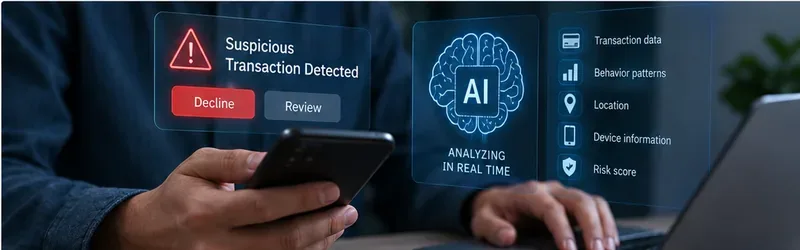
Real-time fraud systems combine transaction, behavior, device, location, and network signals to produce a risk decision before or during payment authorization.
What AI Fraud Detection Actually Does
AI fraud detection is the use of statistical and machine-learning models to estimate whether an activity is legitimate or suspicious. In payments, the model rarely works alone. It normally sits inside a larger decision system that also includes deterministic rules, authentication controls, velocity limits, sanctions or compliance checks, and human investigation.
For a card purchase, the institution may be deciding whether to approve, decline, or request stronger authentication. For an instant account-to-account transfer, it may be deciding whether to allow the payment, pause it where the payment scheme and law permit, request additional customer confirmation, or route the event to a fraud team.
Visa's current AI fraud detection overview describes real-time systems that analyze transaction and behavioral data rather than relying only on static rules or blacklists. That basic architecture is durable even as specific models and vendors change.
Why Real-Time Payments Raise the Stakes
Traditional fraud programs had more time in some payment flows to review unusual activity after the fact. Instant payments compress that timeline. The Federal Reserve's FedNow Service, for example, allows participating institutions to send and receive payments around the clock with recipients gaining access to funds immediately.
In June 2025, Federal Reserve Financial Services added an account-activity threshold feature to FedNow. Participating institutions can define dollar-value and transaction-velocity thresholds by customer segment. That is a useful illustration of modern fraud defense: AI is one layer, while simple controls such as amount and frequency limits remain valuable because they are fast, transparent, and easy to combine with model scores. See the Federal Reserve Financial Services announcement.
The Real-Time Fraud Detection Pipeline
1. Capture the transaction context
The system begins with the payment itself: amount, merchant or recipient, time, channel, payment type, currency, and account identifiers. A $12 grocery purchase and a $12,000 new-recipient transfer should not enter the same decision path simply because both are payments.
2. Add behavioral and device signals
The payment is compared with recent account behavior. Useful signals can include login history, device identity, IP or network characteristics, geolocation consistency, time since password or contact-detail changes, account age, transaction velocity, previous recipients, and typical payment amounts.
These features help distinguish “unusual” from “fraudulent.” A customer buying an airline ticket from another country may look unusual in isolation but normal when the system also sees a recent travel booking, a known device, and a long-established cardholder relationship.
3. Add network intelligence
Some fraud is easier to see across a network than inside one account. Mule accounts, coordinated scams, synthetic identities, and laundering structures can involve many senders and recipients spread across institutions.
The Bank for International Settlements' Project Hertha, published in June 2025, explored AI-based transaction analytics for real-time retail payment systems. In experiments using a synthetic dataset of 1.8 million accounts and 308 million transactions, adding payment-system analytics helped simulated banks and payment providers identify 12% more illicit accounts, with a 26% improvement when detecting previously unseen behavior. These were experimental results on synthetic data, not production-bank performance guarantees. The value of the project is the design lesson: network patterns can reveal relationships that an individual bank cannot see from its own ledger. See the BIS Project Hertha report.
4. Produce one or more risk scores
Models convert the features into a probability, score, or risk category. Institutions may use several models at once—for example, one for account takeover, another for card-not-present fraud, another for scam risk, and a network model for suspicious recipient relationships.
A model score is not automatically the final decision. A bank may combine it with rules such as “new device plus new payee plus unusually high amount” or with customer-segment thresholds. The aim is to balance fraud losses against the cost of blocking genuine customers.
5. Orchestrate an action
Typical outcomes include approve, decline, step-up authentication, request a confirmation, delay where permitted, or refer for review. Step-up authentication means asking for stronger proof only when risk is elevated—for example, an additional in-app confirmation or another authentication factor.
The decision engine must be fast enough to fit inside the payment flow. Card authorization platforms commonly make risk decisions in milliseconds, while instant-payment systems generally have only seconds from initiation to settlement.
What Data Signals Matter Most?
Signal group
Examples
What it can reveal
Transaction
Amount, currency, merchant or recipient, time, payment rail
Unusual size, destination, or transaction type
Behavior
Normal spending range, login sequence, payee history, velocity
Deviation from the customer's established pattern
Device and network
Device fingerprint, IP reputation, location consistency, browser or app signals
It is easy to describe rules as outdated and machine learning as their replacement. In production fraud systems, that is usually too simplistic. Rules are excellent for known conditions that need deterministic action: blocked countries, impossible transaction types, regulatory requirements, duplicate events, hard amount limits, or newly introduced emergency controls.
AI is strongest when the decision depends on combinations of signals or behavior that cannot be expressed cleanly as a short rule list. Mature institutions therefore use a layered approach: rules for clear policy, machine learning for complex risk, network analytics for relationships, and human review for ambiguous or high-impact cases.
Why False Positives Are a Core Security Metric
A fraud system that blocks everything is technically effective at stopping fraud but unusable as a payment system. A false positive is a legitimate transaction incorrectly classified as suspicious. Too many false positives create customer friction, call-center costs, abandoned purchases, and loss of trust.
That is why institutions track more than raw fraud catch rate. Important measures include fraud loss, recall or detection rate, precision, false-positive rate, approval rate, customer-friction rate, manual-review volume, latency, and the financial cost of each decision type.
The optimal threshold is context-specific. A $50 card purchase may justify a different tolerance than a $250,000 business transfer to a new account. Real-time fraud control is therefore an optimization problem, not merely a classification problem.
Authorized Push Payment Scams Are Harder Than Stolen-Credential Fraud
Some fraud is relatively straightforward: a criminal steals credentials and initiates a payment the customer did not authorize. Another class, often called authorized push payment (APP) fraud, occurs when the customer is manipulated into sending the money personally.
That is harder for AI because the login, device, authentication, and final confirmation may all be genuine. The suspicious signals may instead appear in the recipient network, transaction narrative, unusual beneficiary relationship, payment velocity, or broader scam pattern.
This is one reason network-level intelligence is gaining attention. Mastercard's 2025 launch of TRACE in the Philippines' real-time payment network and its A2A fraud tools in the UK are examples of providers trying to identify risk across multiple institutions rather than treating each bank's data as an isolated island.
Model Drift: Fraudsters Change Faster Than Static Models
Model drift occurs when the statistical relationship between inputs and fraud outcomes changes over time. Consumer behavior changes, new products launch, seasonal patterns shift, and criminals deliberately probe controls to find weak points.
Institutions respond with monitoring, retraining, champion-challenger testing, threshold tuning, rule updates, and feedback from confirmed fraud cases. Good labels are especially important. Project Hertha highlighted labeled training data, robust feedback loops, and explainable algorithms as key factors in effectiveness.
Real-time systems also need safeguards against poisoned or low-quality labels. If customers incorrectly dispute legitimate transactions, or investigators classify cases inconsistently, a model can learn the wrong pattern.
Explainability and Human Review Still Matter
Fraud decisions affect access to money, customer experience, and regulatory obligations. Institutions need enough explanation to understand why a model is behaving differently, investigate errors, and justify changes to thresholds or policies.
Explainability does not require every model to be simple. It does require useful operational outputs: which signals drove risk, which rules fired, how the score changed over time, and whether a decision was consistent with approved policy.
For high-risk or ambiguous events, investigators remain important. Human review can incorporate context that a model does not have, identify emerging scam narratives, and create better labels for the next model update.
2026 Model Governance Matters as Much as Model Accuracy
In April 2026, the OCC, Federal Reserve, and FDIC issued revised interagency model-risk-management guidance emphasizing a risk-based approach. The guidance discusses model development and use, validation and monitoring, governance and controls, and third-party models. It also states that generative AI and agentic AI are not within the scope of that particular guidance because they are novel and rapidly evolving.
For fraud teams, the practical takeaway is that a high-performing model is not enough. Institutions need clear ownership, documented intended use, testing, monitoring, change control, data governance, and appropriate oversight of vendor models. See the OCC's 2026 revised model-risk guidance.
NIST's voluntary AI Risk Management Framework provides a broader cross-sector structure around Govern, Map, Measure, and Manage. It is not banking regulation, but it is useful for organizing questions about reliability, transparency, privacy, security, and accountability.
Where Generative AI Fits—and Where It Does Not
Generative AI can help investigators summarize cases, extract information from notes, draft investigation narratives, or search large policy and case repositories. That does not mean a large language model should be the sole authorization engine deciding whether a payment is legitimate.
Core real-time fraud scoring usually depends on structured statistical models optimized for low-latency classification, anomaly detection, graph analysis, and calibrated risk scores. Generative systems may augment the workflow, especially after an alert, but financial institutions still need deterministic controls and measurable model behavior in the transaction path.
What Customers Experience When the System Works
Most AI fraud detection is invisible. A normal payment is approved with no extra step. A moderately unusual payment may trigger an in-app confirmation. A high-risk transaction may be declined or referred for review. The goal is selective friction: add security only when the risk justifies it.
For customers, that means the most advanced fraud system may feel less intrusive than an older one because it can distinguish normal behavior from suspicious activity more accurately. For institutions, the challenge is keeping that experience while responding to new fraud patterns at payment speed.
A Practical Architecture for Financial Institutions
Collect high-quality transaction, account, device, and behavioral signals in real time.
Use deterministic rules for clear policy and known high-risk conditions.
Apply supervised and anomaly-detection models for transaction-level risk.
Add graph or network analytics where mule and recipient relationships matter.
Combine scores in a decision engine with segment-specific thresholds.
Use step-up authentication or review when risk is uncertain rather than automatically declining every anomaly.
Feed confirmed fraud, customer responses, and investigation outcomes back into model monitoring.
Validate material models and monitor drift, data quality, and vendor dependencies.
Maintain clear escalation paths when models, data feeds, or payment systems fail.
The Direction of Travel
The September 2026 Visa A2A Protect update, FedNow's configurable risk controls, and BIS Project Hertha point in the same direction: fraud defense is moving from isolated transaction rules toward layered real-time intelligence. The strongest systems combine individual behavior, account context, device data, network relationships, rules, and human expertise.
AI improves the ability to rank risk quickly, but it does not eliminate tradeoffs. Financial institutions still have to decide how much friction is acceptable, how models are validated, which data can legally and ethically be used, how third-party systems are governed, and what happens when the model is uncertain.
That is the practical meaning of AI fraud detection in real-time finance: not a single algorithm that “knows” fraud, but an engineered decision system that continuously converts fast-moving evidence into proportionate action before a transaction becomes an unrecoverable loss.