Home
» Technology
»
Brain-Computer Interfaces: How Neural Tech Is Redefining Human Capability
Brain-Computer Interfaces: How Neural Tech Is Redefining Human Capability
Brain-computer interfaces, or BCIs, are systems that turn measurable brain activity into commands for a computer, communication device, robotic system, or other external technology. The idea sounds futuristic, but the strongest progress today is not about giving healthy people superhuman abilities. It is about restoring functions that injury or disease has taken away.
To make that distinction concrete, this article follows a hypothetical example. Imagine Maya, a fictional person with advanced amyotrophic lateral sclerosis (ALS) who can think clearly but can no longer speak reliably or use her hands to control a computer. Maya is considering whether a research BCI could help her communicate and work more independently. She is not a real patient, and the scenario is not a testimonial or a report of a specific trial result. It is simply a way to connect current evidence with practical questions a person might face.
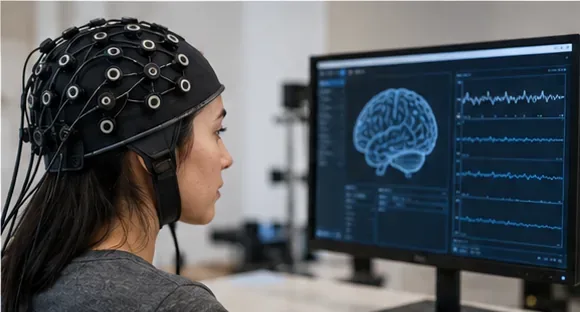
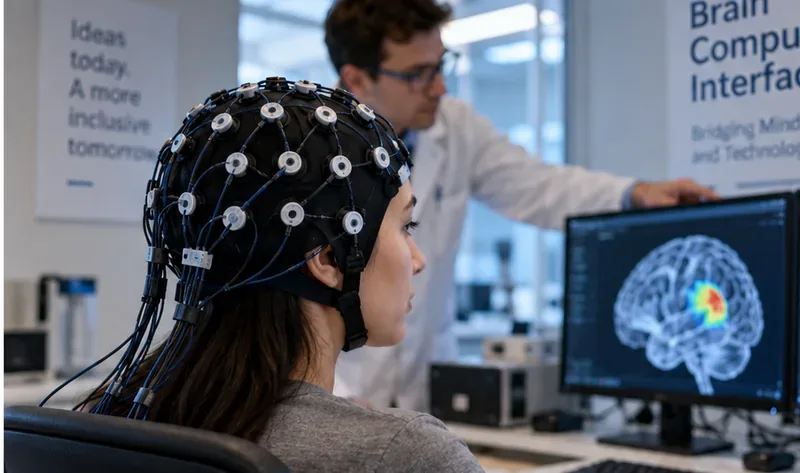
A noninvasive EEG-style research setup illustrates one way brain activity can be recorded for a brain-computer interface; the image is a general illustration, not documentation of a specific clinical trial.
What a brain-computer interface actually does
A BCI typically has four functional layers: it records neural signals, processes those signals, uses an algorithm to infer an intended action, and converts that inference into an output. The output might be moving a cursor, selecting letters, synthesizing speech, or controlling an assistive device.
For Maya, the most important question is not whether a system can “read minds.” It is whether it can reliably decode a narrow, useful intention such as attempted speech or imagined movement. Current high-performance systems are generally trained for specific tasks and often for a specific user. They do not provide a universal window into every private thought.
This distinction matters because recent research on “inner speech” can be easy to overinterpret. In 2025, NIH summarized work showing real-time decoding of internally spoken words from implanted recordings in research participants, but the work remained experimental and task-specific. See the NIH summary of inner-speech BCI research.
Two broad approaches: noninvasive and implanted BCIs
Approach
How signals are recorded
Practical strengths
Main limits
Noninvasive
From outside the skull, commonly with electroencephalography (EEG) or other sensing methods
No brain surgery; easier to deploy for research and some assistive tasks
Signals are weaker and less spatially precise, which can limit speed and complexity
Implanted
With electrodes placed on or in the brain
Can capture higher-resolution neural activity and support more complex decoding
Requires surgery, long-term device management, and careful evaluation of safety and reliability
In Maya's case, a noninvasive system may be preferable if avoiding surgery is the top priority. But if her main goal is fast speech decoding or precise cursor control, some of the strongest published results have come from implanted systems. That does not mean an implant is automatically the better choice. It means the benefit-risk tradeoff depends on the task, the person's condition, the evidence behind the device, and the burdens of surgery and long-term maintenance.
The U.S. Food and Drug Administration has specific guidance for implanted BCIs intended for people with paralysis or amputation, including recommendations for nonclinical testing and clinical study design. The guidance is a useful reminder that experimental performance alone is not enough; durability, biocompatibility, reliability, surgical risk, software behavior, and human factors also matter. See the FDA guidance on implanted BCI devices.
Where the technology is strongest today: restoring communication
If Maya's first goal is communication, current research gives a clearer reason for cautious optimism than it did only a few years ago. In a 2026 Nature Medicine study, one man with ALS and severe speech impairment used an intracortical BCI independently at home for more than 3,800 hours over roughly 19 months. The system decoded attempted speech into text and also supported cursor control. The participant used it for everyday communication and computer access, including work-related activities. The researchers reported an average communication rate of 56 words per minute during personal use and strong performance in formal prompted testing.
Those results are important because they move beyond a short laboratory demonstration. At the same time, they came from a single participant in an ongoing research setting, so they should not be treated as proof that the same outcome is available to every person with paralysis. The original study is available in Nature Medicine's 2026 report on long-term independent BCI use, and NIH also published an accessible summary of the at-home speech BCI research.
Another line of work is focused on making synthesized speech feel more immediate and expressive rather than simply converting neural signals into text. A 2025 Nature study demonstrated instantaneous voice synthesis from intracortical recordings in a participant with ALS, including modulation of some vocal features. That work suggests a future in which a person like Maya might communicate with less delay and with more of the rhythm and expression of natural speech. The study remains a research demonstration, not a generally available medical service. See the original Nature study on an instantaneous voice-synthesis neuroprosthesis.
BCIs are also expanding digital and physical control
Communication is only one path. For someone who cannot reliably move a hand, a BCI can potentially translate intended movement into cursor motion, clicks, or control signals for another device. In 2025, researchers reported a high-performance finger-decoding BCI in a person with paralysis that enabled multidimensional control for a virtual task. This kind of work matters because computer access depends on more than typing words; users also need navigation, pointing, selection, and continuous control. See the Nature Medicine study on finger decoding and multidimensional BCI control.
A further step is to connect decoded intent to the body itself. A 2026 Nature Medicine paper described a “double neural bypass” in one participant with chronic tetraplegia. The system combined an intracortical BCI with stimulation of the spinal cord and brain to support hand movement and sensation. The study reported both immediate device-assisted function and some persistent sensorimotor improvements. This is early evidence from a highly specialized research system, but it shows how the boundary between “computer control” and “restoring body function” may become increasingly fluid. See the original 2026 neuroprosthesis study.
What “redefining human capability” means in practice
For the near term, the most defensible interpretation is restoration before enhancement. BCIs can potentially give a person a new route to capabilities they already value: speaking, writing, controlling software, moving a limb, or receiving sensory feedback. That is already a profound change in human capability because it shifts the interface from muscle output toward direct neural intent.
For Maya, success would not be measured by whether the technology feels futuristic. It would be measured by practical outcomes: Can she initiate a message without another person positioning a device? Can she communicate quickly enough for a real conversation? Does the system work day after day? How much calibration is required? Can she use it outside a laboratory? How often does it make errors, and can she easily correct them?
These are better questions than asking whether BCIs will soon create “superintelligence” or effortless telepathy. Evidence for elective cognitive enhancement in healthy people is far less mature than evidence for assistive restoration. Claims about instant memory upgrades, direct knowledge transfer, or broad thought reading should be treated skeptically unless they are supported by reproducible human data.
Why AI is central to modern neural interfaces
Brain signals are noisy and variable. The same intended action may not produce an identical pattern every time, and signals can change with posture, fatigue, electrode stability, disease progression, and other factors. Machine-learning models help map these changing patterns to useful outputs.
That makes the decoder a core part of the BCI, not a background feature. For Maya, the hardware determines what signals can be recorded, but the software determines how effectively those signals become language or control. Modern systems may use recurrent neural networks, transformers, language models, or other statistical methods to improve accuracy and reduce calibration.
The practical consequence is that a BCI should be evaluated as a full system: sensor plus decoder plus user interface plus feedback loop. A device with excellent neural recordings can still be frustrating if the decoder drifts, the interface is slow, or correction is difficult. Conversely, software improvements can make existing hardware more useful without changing the implant itself.
The limits are as important as the breakthroughs
Small studies do not equal broad clinical availability
Many headline-making BCI results still involve one or a small number of participants. That is normal for early neurotechnology, but it limits how confidently results can be generalized across different diagnoses, ages, anatomies, and daily environments.
Implants introduce long-term engineering and medical questions
Implanted systems must keep recording useful signals over long periods while minimizing risks related to surgery, infection, tissue response, hardware failure, and device maintenance. FDA's regulatory work on neurological devices explicitly considers long-term safety and performance, not just short-term decoding accuracy.
Noninvasive systems trade convenience for signal quality
EEG-based systems avoid brain surgery, but electrical activity has to pass through tissue and skull before it is measured. That generally reduces spatial detail compared with implanted electrodes. For some tasks this may be acceptable; for others it may constrain speed or precision.
Training and calibration remain part of the experience
BCIs are often personalized. Users may need repeated sessions so the system can learn stable patterns, while the user learns how to produce consistent control signals. Newer research is reducing this burden, but “put it on and it instantly understands everything you intend” is not a realistic default.
Neural privacy, autonomy, and consent are moving to the center
Maya's decision would not only be medical. It would also involve data governance. Neural data can be unusually sensitive because it may support inferences about intention, movement, language, attention, or other aspects of mental activity. Questions about who stores the data, who can access it, how long it is retained, whether it is used to improve algorithms, and whether a user can withdraw consent deserve the same attention as decoding accuracy.
In November 2025, UNESCO adopted a global Recommendation on the Ethics of Neurotechnology. The framework emphasizes human dignity, autonomy, mental privacy, and safeguards as neurotechnology moves into healthcare and other parts of society. The certified recommendation and related materials are available through UNESCO's Recommendation on the Ethics of Neurotechnology.
For a person evaluating a BCI study or future product, practical privacy questions include:
What raw neural data is collected, and what derived data is produced from it?
Is data processed locally, in the cloud, or both?
Can the user delete stored data or opt out of secondary research uses?
Who can access decoder logs, transcripts, or inferred commands?
What happens to the system and the data if the research program or company ends?
How Maya would evaluate a BCI realistically
A sensible evaluation starts with a concrete goal rather than the technology itself. Maya might rank her priorities as: reliable conversation, independent computer access, minimal daily setup, and acceptable medical risk. She would then compare a candidate system against those goals.
Define the target capability. Speech, typing, cursor control, limb movement, or sensory feedback require different signal sources and interfaces.
Ask what evidence matches the target user. A result in one person with ALS may not directly predict outcomes for stroke, spinal cord injury, or another condition.
Separate laboratory performance from home performance. Reliability across weeks and months can matter more than a peak accuracy result from a supervised session.
Count the hidden workload. Daily setup, caregiver help, charging, calibration, cleaning, troubleshooting, and software updates all affect usefulness.
Review the exit plan. For implants, users need clear information about long-term follow-up, device support, revision surgery, and what happens if hardware or software is discontinued.
What the next phase is likely to look like
The most credible near-term direction is not a sudden leap to generalized mind reading. It is a gradual improvement in reliability, independence, bandwidth, and integration. Speech BCIs may become faster and more expressive. Cursor systems may require less calibration. Neural interfaces may be combined with stimulation to restore movement and sensation. Hardware may become less invasive or easier to maintain. Decoders may adapt more continuously to each user.
At the same time, higher capability will increase the importance of governance. A neural interface that is useful enough to become part of someone's daily communication or work life is not just a gadget. It becomes part of that person's agency. Security, repairability, access, consent, and continuity of support therefore become core design requirements.
The bottom line
Brain-computer interfaces are already redefining human capability in a specific and meaningful sense: they can create new pathways for communication and control when conventional muscle-based pathways are damaged or unavailable. The most compelling evidence as of September 2026 comes from assistive research in people with paralysis and severe speech or motor impairment, including long-term home use, rapid speech decoding, multidimensional computer control, and experimental restoration of hand function.
For our hypothetical Maya, the right question is not “Can a BCI do anything I imagine?” It is “Can this particular system help me achieve a specific goal, reliably enough and safely enough to improve my daily life?” That question captures both the promise and the current boundary of neural technology.