Home
» Technology
»
AR/VR in 2026: Is the Metaverse Really Making a Comeback?
AR/VR in 2026: Is the Metaverse Really Making a Comeback?
Yes—but not in the way the metaverse was originally sold. In 2026, AR and VR are clearly getting fresh investment, better hardware, stronger operating systems, and more practical uses. What is not returning is the old expectation that most people will soon spend large parts of their lives inside one persistent, shared virtual world.
The comeback is happening under different labels: mixed reality, spatial computing, extended reality (XR), and increasingly AI glasses. The practical focus has shifted from “enter the metaverse” to “make digital information fit naturally into the physical world.” That difference matters if you are deciding whether to buy a headset, build an XR product, or invest time in the ecosystem.
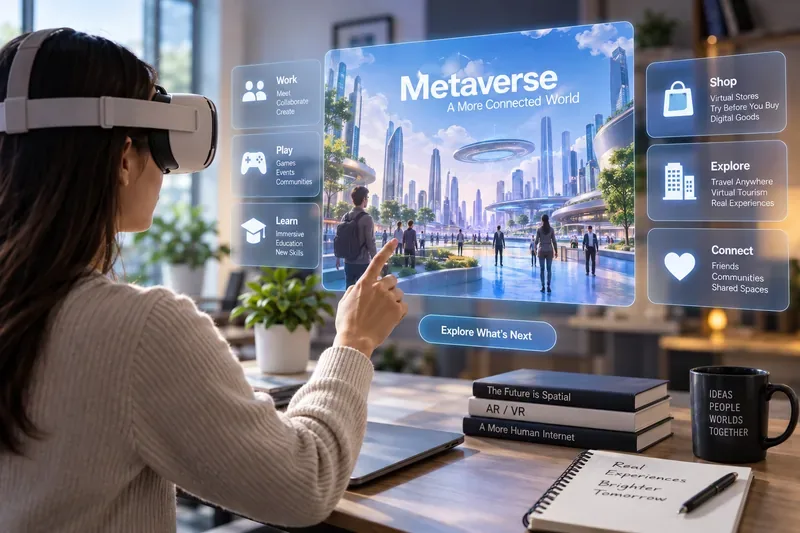
A headset user interacts with spatial panels for work, entertainment, learning, shopping, exploration, and social activity, illustrating how today's XR vision combines virtual content with everyday tasks.
First, what do AR, VR, MR, and XR actually mean?
Virtual reality (VR) replaces most or all of your view with a digital environment. Games, simulations, virtual theaters, and fully immersive training experiences are common examples.
Augmented reality (AR) adds digital information to your view of the real world. That could mean navigation cues, labels, messages, or contextual information shown through glasses or another display.
Mixed reality (MR) goes further by allowing virtual objects to appear anchored in and responsive to your physical surroundings. Meta, for example, documents passthrough and environment-depth features on Quest 3 and Quest 3S that let apps blend digital content with the room around the user. See Meta's current Horizon OS passthrough documentation.
Extended reality (XR) is the umbrella term that covers AR, VR, and MR. When companies now talk about XR platforms, they are usually referring to a range of experiences rather than one single “metaverse” destination.
Why the comeback looks real
1. Major platforms are still investing in immersive computing
Meta has not abandoned headsets. Its September 2026 developer documentation still identifies Quest 3 and Quest 3S as its current-generation headsets, with Horizon OS supporting controllers, hand tracking, gaze input, passthrough mixed reality, spatial audio, and other immersive capabilities. Meta also supports several development paths, including Unity, Unreal Engine, OpenXR, Android apps, WebXR, and its Spatial SDK. You can verify the current platform direction in Meta's Horizon OS quick-start guide and device comparison.
Apple is continuing to develop Vision Pro rather than treating it as a one-off experiment. In October 2025, Apple released an updated Vision Pro with the M5 chip and a new Dual Knit Band. Apple also continues to evolve visionOS; at WWDC 2026 it previewed visionOS 27 with new Apple Intelligence and Siri AI capabilities for Vision Pro. The current product direction is documented in Apple's Vision Pro M5 announcement and its WWDC 2026 software announcement.
Google is also back in XR in a serious way. Android XR, built with Samsung and Qualcomm, is designed for headsets and glasses. At Google I/O 2026, Google said its next major Android XR milestone would be intelligent eyewear, including audio glasses and display glasses. The first audio-glasses products from partners were announced for fall 2026. As of September 2026, that makes them announced and approaching release—not something that should be described as already broadly available. Google's current direction is outlined in its Android XR intelligent-eyewear announcement.
2. The experience is becoming less isolating
The first wave of modern VR often asked users to leave the physical room behind. The newer wave increasingly tries to preserve awareness of the real environment. Full-color passthrough, hand tracking, eye tracking, room understanding, and spatial windows all make it possible to move between ordinary computing and immersion instead of choosing one or the other.
That is a major change in product philosophy. Meta's current Horizon OS documentation says ordinary Android apps can appear as floating 2D panels in 3D space, while developers can add deeper immersive features when needed. Apple's visionOS similarly lets apps start as windows, add 3D content, and transition into fully immersive scenes. See Apple's visionOS developer overview.
3. AI gives spatial hardware a more convincing reason to exist
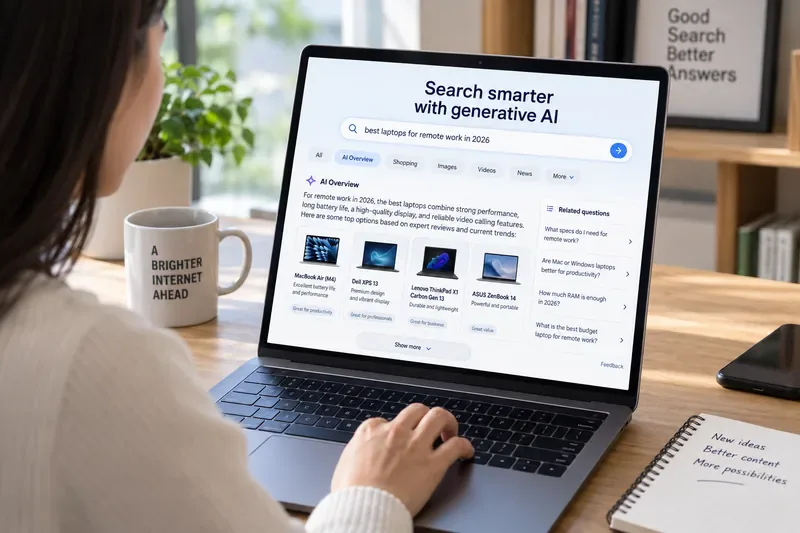
Generative AI may be more important to the future of AR than the word “metaverse.” A headset or pair of glasses becomes more useful when it can understand what you are looking at, answer questions conversationally, summarize information, translate speech, or surface relevant guidance without requiring a traditional screen.
Google explicitly positions Gemini as part of Android XR across headsets and glasses. Meta is also pushing AI wearables beyond headsets; in 2026 it announced new Meta Glasses in partnership with EssilorLuxottica, describing them as AI glasses designed for all-day assistance. Those glasses are not the same thing as full visual AR, but they show where the broader wearable-computing market is heading. See Meta's 2026 Meta Glasses announcement.
Why this is not the old metaverse comeback
The original metaverse pitch often bundled several ideas together: persistent virtual worlds, digital economies, avatars, virtual offices, virtual real estate, social spaces, and interoperable identities. Today's momentum is much more fragmented and task-specific.
Area
Where momentum looks strongest
What remains uncertain
VR gaming
Established headset ecosystems, controllers, hand tracking, immersive titles
Whether VR becomes a mainstream daily habit beyond gaming and entertainment
Mixed reality
Passthrough, spatial windows, room-aware applications, fitness and productivity
How often consumers want to wear a headset for ordinary computing
Spatial computing
Premium visualization, media, design, enterprise workflows, large virtual displays
Cost, comfort, battery life, and the size of the long-term consumer market
AI glasses
Hands-free assistance, cameras, voice interaction, navigation, contextual help
Display quality, privacy expectations, battery life, social acceptance, and app ecosystems
Shared virtual worlds
Games, events, communities, collaborative niches
Whether a universal, interoperable “metaverse” ever emerges
The most defensible conclusion is that XR is recovering faster than the metaverse concept itself. Companies are building platforms and devices around concrete activities rather than asking users to adopt a new digital identity or spend their day inside one branded world.
Where AR/VR makes sense right now
For gaming and immersive entertainment
This is still one of the clearest reasons to buy a VR headset. The value proposition is straightforward: if you want motion-controlled games, immersive fitness, 3D media, or virtual cinema experiences, a standalone headset can deliver something a phone or television cannot.
A product such as Quest 3 or Quest 3S is a more natural fit for this use case than a premium spatial-computing device designed around productivity and media. The condition is simple: you need enough physical space, tolerance for wearing a headset, and content you genuinely want to use repeatedly.
For work, visualization, and training
XR can be compelling when the task itself is spatial. Reviewing a 3D model, practicing a procedure, inspecting a design at full scale, or placing multiple virtual displays around a workspace can justify a headset in ways that ordinary email or document editing may not.
Apple has highlighted enterprise examples on Vision Pro, including interactive 3D workflows. Meta's developer platform similarly emphasizes mixed-reality and spatially aware applications. If a workflow benefits from depth, scale, simulation, or hands-free guidance, XR deserves a serious evaluation. If the work is mostly text, spreadsheets, and browser tabs, a conventional monitor may still be simpler and cheaper.
For everyday AR, glasses may matter more than headsets
The biggest long-term opportunity may be lightweight eyewear rather than full headsets. Google has announced Android XR intelligent eyewear for fall 2026, while Meta continues expanding AI-glasses products. That does not prove that mainstream AR glasses have arrived, but it does show that the industry is trying to reduce the friction that made earlier VR-heavy visions difficult to sustain.
The key condition is whether future glasses can deliver useful information without becoming heavy, distracting, socially awkward, or dependent on constant charging. Those constraints are not solved simply by adding AI.
What could still hold the market back?
Comfort remains fundamental. Even a powerful headset is hard to use for long periods if it creates facial pressure, eye fatigue, heat, or motion discomfort. Apple addressed fit in its M5 Vision Pro update with the Dual Knit Band, while headset makers continue to refine weight balance and passthrough quality, but the physical problem has not disappeared.
Price still shapes adoption. Apple's M5 Vision Pro starts at $3,499 in the United States according to Apple's October 2025 announcement, putting it in a very different category from mainstream consumer electronics. Lower-cost headsets widen access, but buyers still need a reason to keep using them after the novelty wears off.
Privacy becomes more sensitive as devices see and hear more. Cameras, microphones, eye tracking, environment mapping, and always-available AI create new questions about what is processed, stored, or shared. Anyone evaluating an XR device for work should review device-management, data-processing, and app-permission policies rather than assuming a headset behaves like a standard laptop.
Fragmentation is another risk. Meta Horizon OS, visionOS, Android XR, and web standards can overlap, but they do not create one universal application ecosystem. A developer should decide which hardware and user base matter before investing heavily in a platform-specific experience.
So, is the metaverse worth paying attention to again?
Yes—if you redefine the question. The important story in 2026 is not whether the “metaverse” brand is fashionable again. It is whether spatial interfaces are becoming useful enough to earn a place beside phones, PCs, consoles, and wearables.
For gamers, immersive creators, 3D professionals, training teams, and businesses with spatial workflows, the technology is already relevant. For ordinary consumers who mostly want messaging, browsing, streaming, and productivity, the case is less universal. AI glasses may eventually change that equation, but several announced products are still reaching the market and long-term usage patterns remain uncertain.
The comeback, then, is real but narrower and more practical: less “live inside a virtual world,” more “bring digital intelligence into the world you already inhabit.” If that direction continues, the most successful descendants of the metaverse may not look like the metaverse at all.