Home
» Technology
»
Autonomous Systems at Scale: How Smart Automation Is Reshaping Modern Factories
Autonomous Systems at Scale: How Smart Automation Is Reshaping Modern Factories
Factory automation is entering a different phase. The issue is no longer simply whether a plant can automate one welding station, inspection camera, or material-handling route. The harder question is how dozens or hundreds of semi-autonomous systems can share data, coordinate decisions, recover from exceptions, and remain safe when production conditions change.
Two recent reference points make that shift especially visible. In July 2026, the U.S. National Institute of Standards and Technology published a roadmap for AI and machine learning in smart manufacturing that highlights autonomous systems, digital twins, advanced sensing, industrial data, explainability, reliability, safety, and emerging foundation-model approaches as important parts of the next manufacturing stack. Separately, the International Federation of Robotics reported in its World Robotics 2025 data that 542,000 industrial robots were installed globally in 2024, the fourth consecutive year above 500,000 installations.
Those figures do not mean factories are becoming fully self-running. They do mean that automation is becoming dense enough that integration, governance, and system-level performance matter as much as the capabilities of any individual robot.
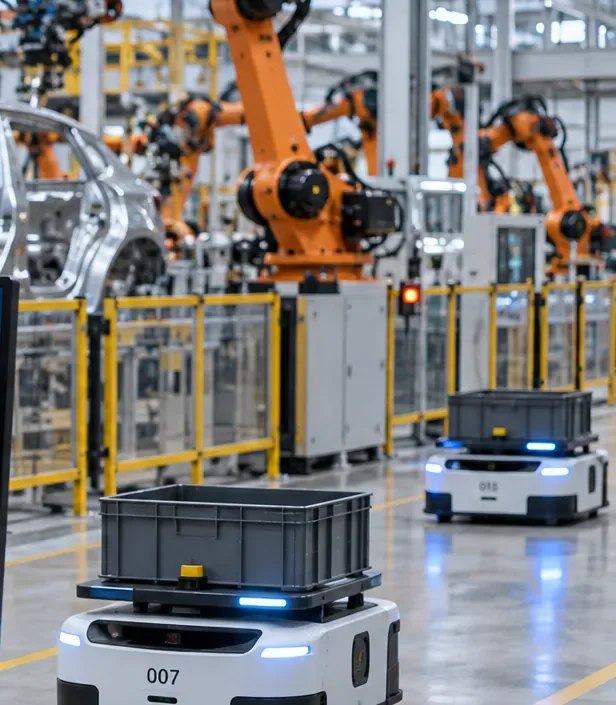
Autonomous mobile robots move material between guarded robotic workcells, illustrating how transport, robotics, and production flow can become coordinated parts of one factory system.
Consider Harborline Components, a fictional mid-sized manufacturer used only as an illustrative example. It produces machined motor housings and small gearbox assemblies for several customers. The plant already has CNC equipment, a few robotic loading cells, barcode tracking, and a conventional manufacturing execution system. None of the results described below are real test results or customer claims; the scenario simply provides a practical thread for understanding how autonomy can be applied.
Harborline's problem is familiar. One automated cell can run quickly, yet upstream material may arrive late. A vision station can reject defects, but the process that caused the defects may continue unchanged. An autonomous mobile robot can move totes without a driver, but it may still deliver the wrong priority if scheduling data is stale. Local automation works; factory-level coordination does not.
The company's goal is therefore not “lights-out manufacturing.” It is to create bounded autonomous behavior that can make routine decisions quickly while keeping safety, quality limits, process authority, and escalation rules under human control.
What an autonomous factory system actually includes
At scale, autonomy is a stack rather than a single technology. Robots provide physical action, sensors provide state, software provides context, and policies determine what decisions are allowed. A useful way to think about the system is by function.
Capability
Factory role
Typical scaling challenge
Industrial robots and automated equipment
Execute repeatable physical tasks such as loading, assembly, welding, or inspection
Safety integration, changeovers, tooling, and coordination with surrounding machines
Autonomous mobile robots and driverless vehicles
Move material, containers, tools, or work-in-process between areas
Traffic management, route conflicts, charging, priority rules, and mixed human traffic
Machine vision and sensing
Identify parts, measure conditions, detect defects, and establish process context
Lighting variation, calibration, data drift, false alarms, and traceability
Edge control and industrial networks
Keep time-sensitive control close to equipment and exchange operational data
Latency, deterministic behavior, interoperability, segmentation, and fault isolation
AI, optimization, and analytics
Estimate conditions, prioritize work, predict failures, or recommend adjustments
Trustworthiness, explainability, validation, model drift, and safe decision boundaries
Digital thread and production systems
Connect product definition, process plans, quality results, maintenance, and execution data
Identifiers, version control, semantics, master-data consistency, and cross-system ownership
From a fast machine to a coordinated factory
Local autonomy should stay local when the decision is local
Harborline first gives a machining cell authority to make a narrow set of decisions: identify the correct part, verify that required tooling is available, run an approved recipe, detect a defined fault condition, and stop or request assistance when limits are exceeded. This is useful autonomy because the cell has the information and authority needed to act without waiting for a central system.
The key design principle is that autonomous systems should not receive broader authority merely because they technically can. Safety parameters, approved process windows, quality dispositions, and recipe changes can remain governed by separate approval processes.
Coordination begins when one system's decision affects another
Now add autonomous material movement. A mobile robot should not simply collect the nearest waiting tote. It needs context: which operation is starved, which batch has the highest production priority, whether a destination buffer is full, whether the route is temporarily closed, and whether the material identity matches the work order.
This is where factories often discover that “robotics” is not the main integration problem. The difficult part is shared state. If the scheduling system, machine controller, quality database, and mobile robot fleet disagree about which job is active, autonomous execution can amplify the inconsistency faster than manual operations would.
The digital thread becomes operational infrastructure
NIST describes the digital thread as an integrated flow of product and manufacturing information across the lifecycle. Its Digital Thread for Manufacturing project emphasizes product-definition standards, conformance testing, interoperability, and data trust because connected manufacturing depends on reliable information moving between engineering, production, and quality systems.
For Harborline, that means an autonomous inspection station should not merely output “pass” or “fail.” It should associate the result with a durable part identity, the correct revision, the machine and tool state, the process parameters, and the relevant quality requirement. If the tolerance definition changes, downstream systems need to know which version applies to which units.
Autonomy at scale therefore depends on mundane disciplines that are easy to underestimate: naming conventions, timestamps, equipment identities, product revisions, calibrated measurements, transaction history, and controlled interfaces.
Interoperability reduces the cost of coordination
A factory that must build a custom adapter for every controller, robot, sensor, and software package will struggle to scale. Standardized interfaces do not remove integration work, but they can reduce one-off engineering and make system behavior easier to reason about.
The OPC Foundation's OPC UA Field eXchange specification series is one example of the industry push toward vendor-independent industrial interoperability. The current UAFX release includes controller-to-controller interactions, while additional interaction types are planned for future releases. That scope matters: standards should be used for what they actually specify rather than treated as a universal connector for every factory problem.
For the Harborline example, the practical objective is not to adopt as many protocols as possible. It is to define a stable information contract: what a machine state means, how a job is identified, how a quality event is reported, how commands are acknowledged, and what happens when communication is lost.
Scaling autonomy changes the failure modes
When an operator controls one machine, a mistake may stay local. When software coordinates an entire line, a bad assumption can spread. Three failure modes deserve particular attention.
Local optimization can damage global flow
A machining cell that maximizes its own utilization may create excess work-in-process downstream. An AMR scheduler that minimizes travel distance may starve the most important order. A maintenance model that postpones service to avoid downtime may push equipment risk into the next shift.
Harborline therefore evaluates decisions against system-level constraints: customer priority, downstream capacity, quality hold status, maintenance risk, energy limits, and safety zones. The objective is not “maximize every asset.” It is “meet the production goal without violating constraints.”
Exception handling becomes more important than normal operation
Autonomous systems usually look impressive during the happy path. Scale is tested by exceptions: a barcode is unreadable, a fixture is missing, a robot cannot reach a station, a quality measurement is borderline, a network segment is unavailable, or a worker blocks a mobile robot route.
Harborline designs an explicit fallback for each class of event. Some events trigger a retry. Others pause a task, reroute material, quarantine a part, or request human approval. Good automation does not eliminate human intervention; it makes intervention targeted and informative.
Human authority must be designed, not assumed
As autonomy grows, operators need clear answers to simple questions: What is the system doing? Why did it do that? Can I stop it safely? What will happen if I override it? Which decision was made by a model, which by deterministic logic, and which by a person?
This is one reason NIST's 2026 AI/ML roadmap places emphasis on explainability, reliability, availability, maintainability, and safety alongside raw AI capability.
Safety boundaries are part of system architecture
Industrial autonomy is physical. Software decisions can move robots, vehicles, tooling, or heavy loads, so safety cannot be added after optimization is complete.
For industrial robots, ISO published updated editions of ISO 10218-1:2025 for industrial robots and ISO 10218-2:2025 for robot applications and cells. Driverless industrial trucks, including systems commonly described as AGVs or AMRs, are covered by ISO 3691-4:2023; ISO is also developing a newer edition.
These standards apply to different equipment and system contexts, which is exactly the point: a scalable autonomous factory needs safety engineering at the robot, cell, vehicle, route, and integrated-system levels. A centralized optimization engine should never be able to bypass independent safety functions simply because production demand is high.
Cybersecurity becomes production reliability
More autonomy means more connected assets, software dependencies, remote administration paths, identities, models, and update mechanisms. Cybersecurity is therefore not separate from uptime. A compromised scheduling service or corrupted machine instruction can become a physical production problem.
NIST's 2025 initial public draft of the Cybersecurity Framework 2.0 Manufacturing Profile updates manufacturing guidance around the CSF 2.0 structure, including the Govern function, supply-chain risk management, platform security, and technology-infrastructure resilience. Because this document is an initial public draft rather than a final publication, factories should treat it as evolving guidance.
In the Harborline scenario, practical controls include network segmentation, unique device identities, least-privilege access, authenticated software and model updates, change logs, recoverable configurations, offline recovery procedures, and the ability to isolate one automation domain without stopping the entire plant.
An illustrative path from automation to coordinated autonomy
The following progression is not a universal standard or a promised implementation sequence. It is simply a practical way Harborline might reduce risk while expanding autonomy.
Stabilize a constrained cell. Make equipment states observable, standardize fault codes, confirm safety behavior, and establish reliable part identity.
Connect material flow. Add mobile transport with explicit pickup, delivery, traffic, and exception rules tied to production priorities.
Close the quality loop. Connect inspection outcomes to the correct product revision and process history so recurring defects can trigger controlled investigation rather than blind continuation.
Coordinate schedules and constraints. Allow orchestration software to reprioritize routine work only within approved capacity, quality, maintenance, and safety limits.
Add predictive and adaptive models carefully. Use AI where it adds measurable value, but keep confidence thresholds, fallback behavior, validation data, and human escalation explicit.
Scale only after recovery is proven. Test network loss, sensor failure, unavailable stations, bad data, and operator overrides before replicating the architecture across more lines.
How Harborline would judge whether the system is working
The fictional plant does not declare success because more robots are running. It compares operating outcomes against a pre-automation baseline and watches both production and control quality.
Measure
Why it matters
First-pass yield
Shows whether higher automation is preserving or improving product quality rather than only increasing speed
Unplanned downtime and mean time to recover
Reveals whether autonomy is making the plant more resilient or merely more complex
Schedule adherence
Tests whether local decisions support actual customer and production priorities
Work-in-process age and queue time
Exposes bottlenecks that can be hidden by high utilization at individual machines
Human intervention and override rate
Helps identify brittle automation, confusing rules, or conditions the system cannot handle safely
AMR mission completion and blocked time
Separates useful autonomous transport from traffic congestion and poor route design
Alarm recurrence
Shows whether the plant is correcting root causes or repeatedly clearing the same symptoms
Model drift and decision-confidence trends
Indicates whether AI-based decisions remain valid as products, tools, materials, or environments change
Safety events and near misses
Confirms that operational gains are not being purchased with unacceptable physical risk
When to scale up, and when to change course
Harborline expands the system only when a production area has stable data, documented interfaces, tested safety behavior, a clear owner, and a recovery procedure. It pauses expansion if automation increases unresolved alarms, operator workarounds, false quality decisions, network dependencies, or time needed to recover from common faults.
That stopping rule matters. Autonomous systems can produce excellent results in one process and poor results in another. High product variability, weak sensing, poorly structured data, frequent engineering changes, or ambiguous decision ownership may make additional autonomy premature. In those cases, improving process discipline and information quality can be more valuable than adding another model or robot.
What changes next
The most important direction is not a single new robot form. It is the convergence of robotics, digital twins, industrial AI, advanced sensing, interoperable data, and production orchestration. NIST's 2026 roadmap also points to physics-informed AI, semantic AI, explainable AI, industrial large-language-model approaches, and foundation models as emerging research directions for highly connected manufacturing systems.
Factories should interpret those developments carefully. A more capable model does not automatically deserve more control authority. The production value of an autonomous system still depends on whether it can operate within verified constraints, explain or expose enough context for supervision, fail safely, recover predictably, and improve the performance of the whole system rather than one isolated asset.
The practical takeaway
Autonomous systems reshape factories most effectively when autonomy is treated as an engineering property of the full production system, not as a feature purchased with an individual machine. The scalable pattern is to combine reliable sensing, deterministic control, bounded AI decisions, interoperable information, independent safety functions, cybersecurity, and clear human authority.
In the Harborline example, the real transformation is not that robots make more decisions. It is that machines, mobile systems, quality processes, maintenance, and people operate from a shared and trustworthy view of production. That is the difference between scattered automation and an autonomous manufacturing system that can scale without losing control.