Home
» Technology
»
Where to Study Brain-Computer Interface Engineering: 9 Strong Degree Programs
Where to Study Brain-Computer Interface Engineering: 9 Strong Degree Programs
Search for a “brain-computer interface engineering degree” and you quickly run into a confusing problem: very few universities use that exact degree title. Instead, the strongest paths into brain-computer interface work are usually housed inside biomedical engineering, electrical and computer engineering, neuroengineering, neurotechnology, computational neuroscience, or neural computation programs.
That matters for a beginner because two programs with equally impressive neuroscience branding can prepare you for very different jobs. One may emphasize implanted electrodes and medical devices. Another may focus on machine learning for neural signals. A third may be designed for basic neuroscience rather than engineering. The right choice depends on which part of a brain-computer interface you want to build.
This guide compares current university programs using official curriculum and program pages checked on September 13, 2026. It is not a universal ranking. The programs are highlighted because they offer unusually direct access to BCI-relevant coursework, neural engineering research, signal processing, neurotechnology, or brain-machine interface training.
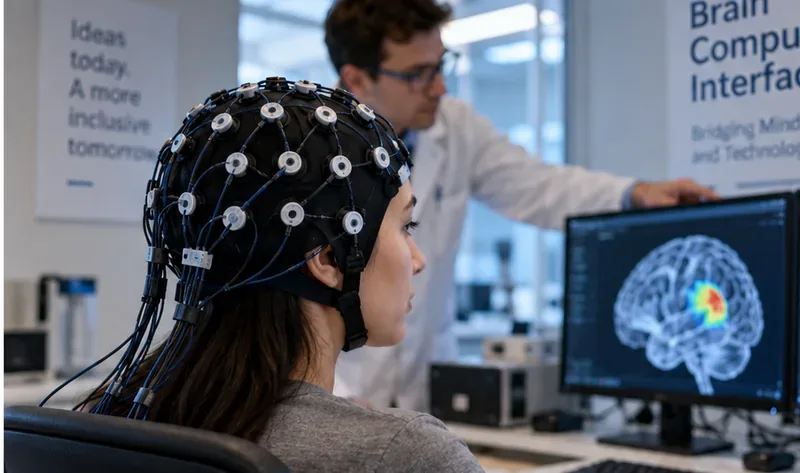
A student wears a multi-electrode EEG cap in a neurotechnology lab, illustrating the combination of neural signal acquisition, computing, and engineering that students encounter in brain-computer interface work.
First, understand what BCI engineering actually includes
A brain-computer interface, or BCI, is a system that measures brain activity and translates that activity into an output that can interact with a computer or another device. The U.S. National Institute of Biomedical Imaging and Bioengineering describes a BCI as a system that uses brain electrical signals to let a person control a computer cursor or devices such as a robotic arm or wheelchair. See the NIBIB glossary.
In practice, BCI engineering spans several technical layers:
Neural signal acquisition: recording activity with electroencephalography (EEG), electrocorticography, implanted microelectrodes, or other sensors.
Electronics and instrumentation: amplifiers, analog-to-digital conversion, low-noise circuits, wireless systems, and implantable-device design.
Signal processing: filtering, artifact removal, spectral analysis, feature extraction, and time-series methods.
Machine learning and decoding: turning neural activity into estimates of intended movement, communication, or other useful variables.
Control and feedback: connecting decoded signals to software, prostheses, stimulation systems, robots, or assistive devices.
Neuroscience and physiology: understanding what is being measured, which brain systems generate the signals, and how learning changes the interface.
Clinical translation and neuroethics: designing systems that are safe, useful, testable, and appropriate for human participants.
You do not need to master all of these before starting a degree. You do need a program that develops enough of them to match your intended role.
What should you study before specializing in BCI?
For most engineering-oriented BCI paths, the strongest preparation is a quantitative undergraduate foundation. Calculus, linear algebra, probability and statistics, programming, signals and systems, and basic neuroscience are especially useful. If you want to build hardware, add circuits, electronics, embedded systems, and control. If you want to build decoders, add machine learning, data structures, and numerical computing.
Students coming from biology or neuroscience can enter BCI, but they often need to strengthen mathematics and programming. Students coming from electrical engineering or computer science usually face the opposite gap: they may already know signal processing and software but need physiology, neuroscience, experimental methods, and biomedical context.
Several programs below explicitly accept students from multiple disciplines, so there is no single “correct” bachelor’s major.
Best BCI-related degree programs to compare
University and program
Level
Best fit
Why it stands out for BCI
Johns Hopkins University — B.S. Biomedical Engineering, Neuroengineering focus
Bachelor’s
Students who want a structured biomedical engineering foundation early
Formal neuroengineering focus area plus neural signals, computation, modeling, and lab options
University of Washington — B.S. Electrical & Computer Engineering, Neurotechnology pathway
Bachelor’s
Hardware, embedded systems, neural interfaces, and device algorithms
The pathway explicitly includes brain-computer interfaces, neural recording, stimulation, and closed-loop systems
University of Pittsburgh — Professional M.S. Bioengineering, Neural Engineering focus
Master’s
Students who want one of the most explicit BCI-focused master’s curricula
BCI is a named concentration area alongside neural interfaces, imaging/signals, and neural devices
University of Michigan — M.S./M.S.E. Biomedical Engineering, Bioelectrics and Neural Engineering
Master’s
Neural interfaces, medical devices, recording/stimulation, and translational research
Program and research strengths include brain-machine interfaces and high-density neural recording
Duke University — M.S. Biomedical Engineering with Neural Engineering concentration/certificate
Master’s
Broad BME training with a customizable neural engineering sequence
Courses include neural signal acquisition, stimulation, computational neuroengineering, and prosthetic systems
EPFL — M.Sc. Neuro-X
Master’s
Students seeking a broad European neurotechnology engineering degree
Combines neuroscience, computational neuroscience, neuroengineering, data science, projects, and internship options
ETH Zurich / University of Zurich — M.Sc. Neural Systems and Computation
Master’s
Computational neuroscience, neuroinformatics, and neurotechnology
Strong quantitative curriculum spanning neural computation, systems neuroscience, and neurotechnologies
Imperial College London — MRes Neurotechnology
Research master’s
Students preparing for research or a PhD
Research-focused training with a Brain Machine Interfaces module listed in the curriculum
Carnegie Mellon University — Ph.D. Neural Computation
PhD
Advanced computational BCI, neural decoding, ML, and research careers
Deep quantitative neuroscience training plus joint options with machine learning, robotics, and statistics
1. Johns Hopkins University: a strong undergraduate neuroengineering route
Johns Hopkins offers a B.S. in Biomedical Engineering with Neuroengineering as one of its formal focus areas. The current undergraduate program requires 129 credits, and students build an 18-credit focus-area sequence on top of the BME core. The neuroengineering curriculum includes options such as Models of the Neuron, Practical Human Neuroimaging, and Neural Signals and Computation, while the broader program includes a Neuroengineering Laboratory.
This route is especially useful if you are still early in your education and want biology, physiology, engineering analysis, modeling, data science, signals, and controls in the same degree rather than trying to assemble the pieces yourself. Review the Johns Hopkins BME undergraduate requirements and its Neuroengineering program page.
2. University of Washington: best fit for an electrical engineering route into neurotechnology
The University of Washington’s B.S. in Electrical & Computer Engineering includes a Neurotechnology pathway. The university explicitly describes brain-computer interfaces, devices that record from neurons, neural stimulation, closed-loop control, embedded computing, wireless power and data, and machine-learning algorithms as part of this area.
This is a particularly attractive route if you want to become the engineer who designs acquisition electronics, implantable or wearable systems, firmware, signal-processing pipelines, or closed-loop devices. UW also offers a Neural Computation and Engineering minor and, at the graduate level, a certificate associated with its neurotechnology ecosystem. See the official UW Neurotechnology pathway and Center for Neurotechnology undergraduate page.
3. University of Pittsburgh: one of the clearest master’s paths specifically mentioning BCI
Pitt’s Professional M.S. in Bioengineering with a Neural Engineering focus is unusually direct. The 30-credit program asks students to build competency in at least two concentration areas, which can include brain-computer interfaces, neural tissue interfaces, neural imaging and signals, and neural devices or neuromorphic engineering.
The BCI concentration lists coursework such as Introduction to Neural Engineering, Machine Learning, Neuro-Signal Modeling and Analysis, Neural Data Analysis, Neural Signal Processing, and Quantitative Systems Neuroscience. The university says the program can be completed in two semesters depending on background, although most students take three.
For a student who already has an engineering or quantitative bachelor’s degree and wants a focused professional master’s, this is one of the most straightforward programs to evaluate. See Pitt’s Neural Engineering focus curriculum.
4. University of Michigan: strong for brain-machine interfaces and neural devices
Michigan Biomedical Engineering offers M.S. and M.S.E. pathways with a Bioelectrics and Neural Engineering concentration. The program emphasizes electrical fields in biological systems, computational analysis, neuron modeling, neural recording and stimulation, signal processing, and medical-device development.
Its research environment is especially relevant to students interested in invasive and translational neural interfaces. Michigan lists high-density neural recording and stimulation, computational neuromodulation, brain-machine interfaces, and work spanning preclinical models to clinical trials among its neural engineering strengths.
That combination makes Michigan worth considering if your goal is not only to decode neural signals but also to work on the physical interface between electronics and the nervous system. See the Michigan BME master’s options and Neural Engineering research area.
5. Duke University: flexible neural engineering training inside a broad BME master’s
Duke’s M.S. in Biomedical Engineering is a 30-credit program with thesis and non-thesis options. Students can choose a Neural Engineering concentration, and Duke also offers a Neural Engineering certificate for eligible BME master’s students.
The course menu is relevant to both device and computational BCI work: Introduction to Neural Engineering, Neural Signal Acquisition, Computational Neuroengineering, Electrical Stimulation of the Nervous System, Neural Prosthetic Systems, and biomedical amplifiers and implanted devices are among the listed options.
Duke is a good fit when you want flexibility rather than a narrowly prescribed BCI curriculum. The tradeoff is that you need to choose your courses and research environment carefully so the degree actually becomes BCI-focused. See the Duke BME M.S., master’s concentrations, and Neural Engineering certificate.
6. EPFL Neuro-X: a broad European master’s built around neuroscience and engineering
EPFL’s Neuro-X master’s is one of the clearest dedicated neurotechnology degrees in Europe. The program combines foundations of neuroscience, computational neuroscience, and neuroengineering, with additional training in data science, machine learning, imaging, projects, and scientific or industrial work.
The current program structure is 120 ECTS and includes multiple research projects, an engineering internship, and a master’s project. That makes it a strong option for students who want to combine technical depth with repeated project experience rather than studying BCI only as one elective inside a broader engineering degree.
7. ETH Zurich and University of Zurich: strong for neural computation and neuroinformatics
The joint M.Sc. in Neural Systems and Computation is a 90-ECTS, 1.5-year English-language program run through the Zurich neuroscience and neuroinformatics ecosystem. Students cover core neuroscience and information processing and can select among systems neuroscience, neural computation and theoretical neuroscience, and neurotechnologies or neuromorphic engineering.
The program accepts applicants from a wide range of quantitative and scientific backgrounds, including electrical engineering, computer science, mathematics, physics, neuroscience, biology, and related fields. It is a particularly strong match if you are interested in decoding, computational models, neuroinformatics, or the algorithmic side of BCI rather than primarily medical-device manufacturing.
8. Imperial College London: a research-heavy Neurotechnology MRes
Imperial’s MRes in Neurotechnology is designed for students who want to work at the interface of neuroscience and engineering and are likely to continue into research, a PhD, or advanced R&D. The official curriculum lists a Brain Machine Interfaces module, along with computational neuroscience and other neurotechnology options.
For the currently posted cycle, Imperial lists the qualification as an MRes with a one-year full-time or two-year part-time format, with the next listed start date in October 2027. The page states that applications open on September 30, 2026. Because dates and module availability can change, applicants should re-check the page when applying.
9. Carnegie Mellon University: an advanced computational path for PhD-level BCI research
Carnegie Mellon’s Ph.D. in Neural Computation is aimed at students with strong quantitative backgrounds who want to apply mathematics, statistics, computer science, engineering, and machine learning to neuroscience. It includes training in computational and experimental neuroscience and supports joint pathways with Machine Learning, Robotics, and Statistics.
For BCI, that environment is especially relevant to neural decoding, adaptive algorithms, motor control, computational models, and data-intensive brain research. CMU also operates a Neural Interfacing Training Program for selected PhD students in Biomedical Engineering, Electrical and Computer Engineering, or Neural Computation, further strengthening the hardware-to-algorithm connection.
This is not an entry-level professional degree. It is a research path for students who already know that they want to create new methods rather than primarily apply established ones. See the CMU Ph.D. in Neural Computation and the Neural Interfacing Training Program.
How to choose the right program for your BCI career goal
If you want to build BCI hardware
Prioritize electrical engineering, instrumentation, embedded systems, low-noise circuit design, sensors, wireless systems, and neural interfaces. The University of Washington’s ECE Neurotechnology pathway is especially direct at the bachelor’s level. Michigan and Pitt are strong graduate options because their curricula and research cover recording, stimulation, neural devices, and interfaces.
If you want to build neural decoding algorithms
Choose programs with strong signal processing, machine learning, statistics, computational neuroscience, and access to real neural datasets. ETH/UZH and CMU are particularly well aligned with this path, while Pitt, EPFL, Duke, and Johns Hopkins can also support it through the right electives and labs.
If you want to work on clinical neurotechnology
Look for programs connected to hospitals, medical schools, rehabilitation research, neurosurgery, or clinical trials. Biomedical engineering programs often have an advantage here because they combine engineering with physiology, medical devices, safety, and translational research.
If you are not yet sure which BCI layer interests you
A broad undergraduate BME or ECE program with a formal neurotechnology pathway is usually safer than specializing too early. At the graduate level, EPFL Neuro-X, Johns Hopkins BME, Duke BME, Michigan BME, and Pitt Neural Engineering all offer enough breadth to explore before narrowing your research topic.
What should your application preparation look like?
A strong BCI applicant does not need a commercial EEG headset or a publication. What matters more is evidence that you can handle quantitative work and connect it to neuroscience or biomedical problems.
Mathematics: be comfortable with calculus, linear algebra, probability, statistics, and basic differential equations.
Programming: Python is especially useful; MATLAB and C/C++ can also matter depending on the lab and hardware stack.
Machine learning: understand regression, classification, cross-validation, feature engineering, and eventually deep learning for temporal data.
Neuroscience: know basic neurophysiology, action potentials, neural coding, motor and sensory systems, and what EEG or implanted electrodes actually measure.
Project evidence: a well-documented signal-processing or neural-data project can be more convincing than a long list of unrelated online courses.
If you have access to public EEG or neural datasets, a useful portfolio project is to build a complete pipeline: load the data, inspect artifacts, preprocess it, extract features, train a baseline decoder, evaluate it with proper cross-validation, and explain what the model can and cannot infer. The point is to demonstrate engineering judgment, not just model accuracy.
Common mistakes when choosing a BCI degree
Mistake 1: choosing by university name instead of lab and curriculum fit
BCI is still a research-intensive field. A famous university with no lab working on your target problem may be less useful than a program with direct access to neural interfaces, human-subject experiments, or a strong decoding group. Before applying, identify at least two faculty members whose recent work genuinely overlaps your interests.
Mistake 2: confusing artificial neural networks with neural engineering
A machine-learning degree can be valuable for BCI, but “neural network” coursework alone does not teach neurophysiology, neural recording, artifacts, electrode physics, or closed-loop experimentation. If you enter from AI, deliberately add neuroscience and signal acquisition.
Mistake 3: ignoring the physical side of neural data
BCI signals are not ordinary tabular data. Electrode placement, impedance, motion, muscle activity, stimulation artifacts, sampling hardware, and experimental design can affect the data before an algorithm ever sees it. Look for hands-on labs, instrumentation courses, or research access.
Mistake 4: assuming a BCI degree automatically leads to implant work
Noninvasive EEG, invasive cortical interfaces, peripheral nerve interfaces, deep-brain stimulation, and neuroprosthetics require overlapping but different skills. Read faculty research descriptions and course lists carefully instead of assuming that “neurotechnology” covers all of them equally.
Mistake 5: overlooking ethics and human-subject research
BCI systems can affect privacy, autonomy, communication, and medical decision-making. Programs that include neuroethics, clinical research practices, or responsible human-subject experimentation can prepare you for the real constraints of the field, not just the technical prototype.
A practical self-check before you apply
You are ready to build a serious BCI program shortlist when you can answer these questions for every school:
Which degree or concentration actually contains BCI-relevant coursework?
Which faculty members work on neural recording, decoding, stimulation, neuroprosthetics, or brain-machine interfaces?
Can students get hands-on access to neural data, instrumentation, or human/animal research where appropriate?
Does the curriculum fill your current gaps in neuroscience, programming, signal processing, electronics, or machine learning?
Is the degree designed for industry, research, or PhD preparation?
Can you name the kind of BCI role you would be better prepared for after graduating?
Are the current admission requirements, deadlines, costs, and visa conditions realistic for you?
If you cannot answer those questions from the official program and lab pages, do more research before treating the school as a top choice.
Bottom line
There is no single best degree called “Brain-Computer Interface Engineering.” For most students, the best route is a degree that gives them strong engineering fundamentals and direct access to neural signals, neurotechnology research, or brain-machine interface projects.
At the bachelor’s level, Johns Hopkins and the University of Washington provide especially clear structured routes. For a focused master’s, Pitt’s Neural Engineering program is unusually explicit about BCI, while Michigan, Duke, EPFL, ETH/UZH, and Imperial each offer different strengths in devices, computation, or research. At the PhD level, Carnegie Mellon is a strong choice for quantitatively intensive neural computation and decoding research.
The most useful question is therefore not “Which university has the best BCI degree?” It is “Which program trains me for the BCI layer I want to build, with faculty and facilities that let me practice it?” Answer that well, and the program list becomes much easier to narrow.