Home
» Technology
»
Navigating the Low-Altitude Economy: Building UTM for a Scalable Drone Airspace
Navigating the Low-Altitude Economy: Building UTM for a Scalable Drone Airspace
A delivery drone, a utility-inspection drone, a public-safety aircraft, and a medical helicopter can all need the same low-altitude corridor within minutes. The hardest problem is no longer proving that each aircraft can fly. It is making sure every participant knows which airspace constraints apply, who else is operating nearby, who has priority, and what to do when a flight deviates or a data link fails.
That challenge is moving quickly from research into regulation and deployment. As of September 2026, the United States is still transitioning toward routine beyond-visual-line-of-sight (BVLOS) operations: the FAA's 2025 proposal would create Part 108 for scalable BVLOS operations and Part 146 for automated data service providers that can support UAS Traffic Management (UTM). The FAA reopened part of the comment process in January 2026 to gather more input on electronic conspicuity and right-of-way. In Europe, the U-space regulatory framework is already in force, and the current consolidated version of Regulation (EU) 2021/664 reflects changes through February 22, 2026. A January 2026 SESAR U-space Implementation Handbook also distilled early deployment experience into 70 lessons and recommendations plus six technical appendices.
Those developments point in the same direction: the future of the low-altitude economy depends less on a single drone breakthrough and more on reliable digital infrastructure, interoperable services, clear accountability, and safe coordination with existing aviation. The FAA describes UTM as a collaborative ecosystem that complements, rather than replaces, traditional air traffic services.
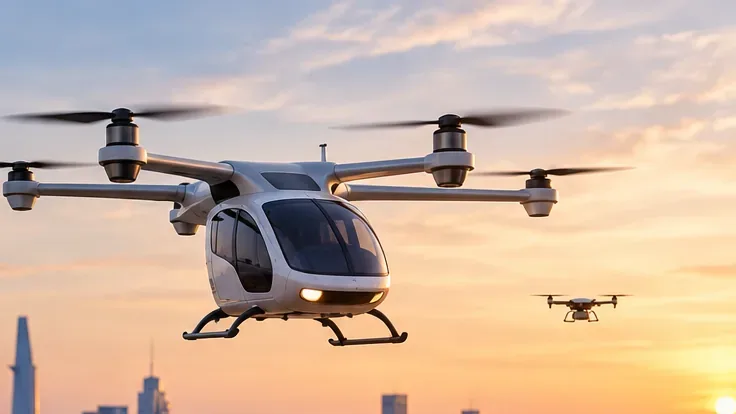
Low-altitude traffic may eventually mix delivery drones, inspection aircraft, public-safety operations and larger uncrewed vehicles; UTM is intended to coordinate shared airspace while remaining complementary to conventional air traffic management.
Why Does the Low-Altitude Economy Become a Traffic Problem So Quickly?
Low-altitude aviation is difficult because the environment is both crowded with obstacles and operationally dynamic. Buildings, terrain, cranes, temporary flight restrictions, weather, radio interference, GNSS degradation, emergency operations and changing local constraints can all matter within a short flight. A route that is clear when planned may be unavailable minutes later.
Scale also changes the safety problem. A handful of manually coordinated drone flights can be managed with phone calls, visual observers and one-off approvals. Hundreds or thousands of repeatable operations need machine-readable constraints, automated authorization, shared flight intent, conformance monitoring and a dependable way to resolve conflicts. NASA's UTM research demonstrated the value of a distributed model built around digital sharing of planned operations and common situational awareness; the agency transferred that work toward FAA implementation after its original UTM project concluded.
Finally, low-altitude airspace is not isolated from the rest of aviation. Helicopters, general aviation, airport traffic, emergency responders and future advanced-air-mobility vehicles may enter or cross the same environment. ICAO's UTM guidance therefore emphasizes harmonization and interaction with conventional air traffic management rather than building a separate digital sky with no connection to existing aviation.
What Should a Real UTM System Actually Do?
UTM is sometimes reduced to a map showing drone positions. That is far too narrow. A scalable system needs several layers of trusted information and decision support. The exact service names vary by jurisdiction, but the core jobs are broadly similar.
Capability
What it must answer
Why it matters
Identity and registration
Who is operating this aircraft, and what aircraft is it?
Creates accountability and supports authorized access to operational data.
Geo-awareness and constraints
Where can the aircraft legally and safely operate right now?
Prevents plans from relying on stale or incomplete airspace information.
Flight intent and authorization
What does the operator plan to do, when, and under what conditions?
Allows conflicts and constraints to be checked before launch.
Strategic deconfliction
Do planned operations compete for the same volume of airspace?
Reduces conflicts before they become tactical emergencies.
Tracking and conformance
Is the aircraft actually following its approved plan?
Turns a preflight plan into a monitored operation.
Tactical conflict management
What happens when traffic converges unexpectedly?
Provides a response when strategic planning is no longer enough.
ATM and emergency interface
How are crewed aviation, emergency priorities and dynamic restrictions represented?
Prevents UTM from becoming an isolated system that misses higher-priority users.
Cybersecurity and audit
Can participants trust the data, and can decisions be reconstructed later?
Supports resilience, oversight and incident investigation.
How Do You Build UTM from the Easiest Problems to the Hardest?
1. Start with authoritative data and unambiguous roles
The first step is not autonomous conflict resolution. It is agreeing on who publishes authoritative airspace data, who can designate restrictions, which entities provide services, and which actor remains responsible for the flight. If two systems disagree about a restriction or the status of an operation, there must be a defined source of truth and a traceable decision path.
Europe's U-space model makes this explicit through common information services and certified U-space service providers. Regulation (EU) 2021/664 requires at least network identification, geo-awareness, UAS flight authorization and traffic information services in designated U-space airspace. The consolidated EU regulation is especially useful because it shows how service obligations, common information and operator responsibilities fit together in an actual legal framework.
2. Digitize the preflight workflow before automating the sky
A strong early UTM deployment should make it easier to submit an operation, validate the airspace, receive authorization where required and distribute a consistent version of the approved intent. This is less glamorous than real-time avoidance, but it produces immediate value and exposes data-quality problems early.
The most important design choice is interoperability. Flight intent should not be trapped inside one fleet-management product. Different operators and service providers need a predictable way to exchange the minimum information required for safety while protecting commercially sensitive and personal data.
3. Add network-level strategic deconfliction
Once multiple operators share the same low-altitude region, the system needs to detect incompatible plans before aircraft launch. That does not necessarily mean assigning rigid lanes to every drone. A more flexible approach can reserve or negotiate four-dimensional operating volumes: latitude, longitude, altitude and time.
The U.S. proposal illustrates how important this layer may become. The FAA's 2025 BVLOS notice of proposed rulemaking describes strategic deconfliction and conformance monitoring as important automated data services and proposes Part 146 oversight for providers whose services affect NAS safety and efficiency. It is still a proposal, not a final rule, but it shows a shift from treating UTM as optional software toward treating certain digital services as safety-relevant aviation infrastructure.
4. Monitor conformance and prepare for deviations
A planned route is only useful if the system can tell when the aircraft is no longer following it. Conformance monitoring needs reliable position updates, clear tolerance thresholds and rules for escalation. A minor navigation error should not trigger the same response as a drone entering protected airspace or losing command-and-control connectivity.
This is where contingency management becomes essential. A production UTM architecture should define what happens after loss of GNSS, loss of command-and-control, degraded network service, a weather change, a priority emergency flight, or an aircraft that cannot comply with the original plan. The system should fail predictably rather than simply disappearing when connectivity degrades.
5. Integrate crewed aviation and emergency priorities
Low-altitude airspace cannot be optimized only for cooperative drones. Crewed aircraft may not participate in the same digital network, and emergency helicopters may need immediate access to an area occupied by routine drone traffic. Europe addresses this through requirements for coordination between U-space and air traffic services, including mechanisms for dynamic reconfiguration of U-space airspace in controlled airspace.
Electronic conspicuity—the ability of an aircraft to make its presence electronically detectable—is one of the difficult policy and technical questions because not every airspace user carries the same equipment. The FAA's January 2026 reopening of the BVLOS comment period specifically requested more input on electronic conspicuity and right-of-way, showing that mixed traffic remains one of the hardest unsolved implementation questions.
6. Treat service providers as part of the safety system
At high scale, UTM becomes a network of networks. One operator may rely on a flight-planning service, another on a separate deconfliction provider, while authorities publish constraints through another channel. That means the safety of one participant can depend on data produced by another company it does not control.
The response cannot be “trust the API.” Mature UTM requires service-level requirements, data integrity controls, authentication and authorization, change management, incident reporting, cybersecurity, resilience and oversight. The FAA's current UTM program already uses a Near-Term Approval Process to evaluate whether certain third-party services provide enough safety value to receive credit in waiver or exemption applications, even before a future regulatory framework is finalized.
What Can the United States, Europe and ICAO Teach Us?
Framework
Current direction
Practical lesson
United States
FAA UTM is a collaborative, decentralized ecosystem; routine BVLOS scaling remains tied to the proposed Part 108/Part 146 framework and current approval pathways.
Do not separate operational rules from oversight of the digital services that provide safety credit.
European Union
U-space regulation is in force in designated U-space airspace, with mandatory services and defined roles for common information and service providers.
Define the minimum service set and information responsibilities before trying to add advanced automation.
ICAO
Edition 4 of the UTM framework provides global, non-binding guidance aimed at harmonization and ATM integration.
National systems should be designed with cross-border interoperability in mind from the beginning.
Europe also offers a useful maturity perspective through SESAR's U-space research, which groups capabilities from foundational U1 services through progressively more automated U2, U3 and U4 concepts. These labels are not a substitute for the legal requirements in Regulation (EU) 2021/664, but they are useful when planning a roadmap. The 2026 U-space Implementation Handbook is particularly valuable because it captures lessons from actual European deployment efforts rather than only describing a target architecture.
What Should Not Be Mistaken for UTM?
A live map is not UTM. Visualization is useful, but traffic management also requires trusted identity, authorization, conflict management, conformance and contingency processes.
Remote identification is not traffic management. Knowing who an aircraft is does not resolve competing flight plans or determine who should yield.
Detect-and-avoid alone is not enough. Airborne collision avoidance can be an important last layer, but network-level strategic deconfliction reduces the number of conflicts that ever reach that stage.
Fixed corridors are not a complete answer. Corridors can simplify some operations, but weather, emergency response and changing restrictions still require dynamic information and priority rules.
A single proprietary platform is not a scalable ecosystem. A city may begin with one provider, but long-term resilience and competition require interoperable interfaces and governance across providers.
How Can You Check Whether a UTM Architecture Is Ready to Scale?
The following is a practical self-check, not a regulatory certification standard. A program that cannot answer these questions clearly is probably still a demonstration rather than production infrastructure.
Can every operation be tied to an accountable operator and aircraft identity?
Are airspace restrictions and geo-awareness data authoritative, versioned and updated fast enough for the operation?
Can conflicting flight intents be detected before launch across different operators and service providers?
Can the system detect when an aircraft leaves its authorized operating volume?
Is there a defined response for lost command-and-control, lost navigation, degraded surveillance or service-provider outage?
Can emergency and crewed aircraft receive priority without relying on ad hoc phone coordination?
Can two independent UTM service providers exchange the minimum safety-critical information without exposing unnecessary commercial data?
Are cybersecurity, authentication, authorization and audit logging treated as safety requirements rather than IT add-ons?
Is there a documented interface with conventional ATM where the operating environment requires it?
Can regulators and investigators reconstruct what information each participant received and what decisions were made after an incident?
If most of those answers depend on manual intervention, one vendor's internal database or a perfect communications link, the architecture is not yet ready for dense operations. If the answers remain valid when traffic volume grows, providers fail, restrictions change and emergency users enter the airspace, the system is much closer to the infrastructure that a real low-altitude economy needs.
The Future of UTM Is Infrastructure, Not an App
The low-altitude economy will not scale safely by adding more drones to today's approval processes one waiver at a time. Nor will it scale through a single centralized control room that manually directs every aircraft. The emerging direction in the United States, Europe and ICAO guidance is toward interoperable, highly automated services with clear responsibilities and strong connections to existing aviation.
The near-term priority is therefore practical: make authoritative data shareable, make flight intent machine-readable, resolve predictable conflicts before launch, monitor conformance, design for failures, and build an accountable bridge between UTM and ATM. More advanced automation can follow. When those foundations are dependable, low-altitude airspace can begin to function less like an experimental zone and more like transportation infrastructure.
For additional technical background, NASA's overview of UTM research explains the distributed flight-intent model that helped establish today's UTM concepts, while the FAA's 2025 Drone Integration BVLOS Concept of Operations describes the U.S. vision for routine, scalable operations over the coming decade.