Home
» Wiki
»
Can the UN Prevent a Hypothetical Nuclear Attack? What Its Powers Actually Allow
Can the UN Prevent a Hypothetical Nuclear Attack? What Its Powers Actually Allow
The United Nations can call emergency meetings, pursue diplomacy, recommend steps to de-escalate and, if the Security Council agrees, decide on sanctions or authorize other measures. It cannot guarantee that a state will refrain from using nuclear weapons. Any proposed action depends on its legal basis, political agreement and implementation by member states.
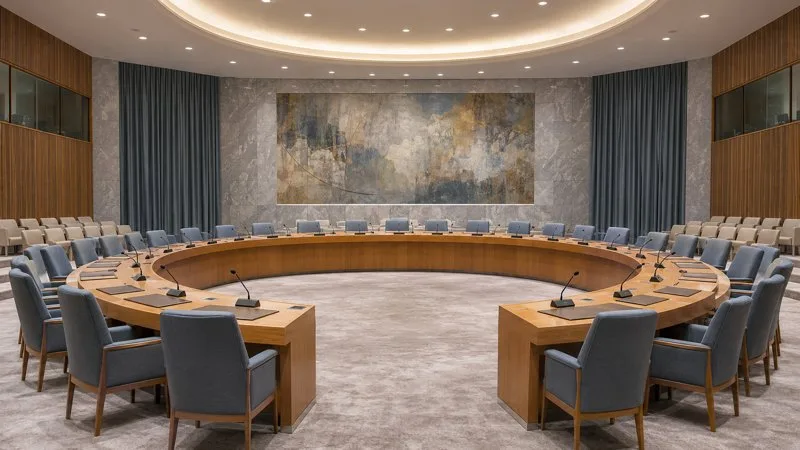
AI-generated illustration of a generic diplomatic chamber; it does not depict a specific meeting or UN location.
This guide addresses a hypothetical nuclear attack involving the United States and Israel; it does not assert that either country has carried out or plans such an attack. The United States reported to the Security Council that it began conventional combat operations against Iran in cooperation with Israel on 28 February 2026. In July, the UN described a US–Iran ceasefire as fragile and encouraged diplomacy. Those documented events should not be confused with nuclear use or treated as proof of future intentions.
Before you begin: what to check
Sources: The UN Charter, Security Council voting guidance, UN peace and security resources, and contemporaneous UN statements.
Time: About 10 minutes to follow the six steps.
Difficulty: Intermediate. The guide explains legal and institutional terms as they arise.
Scope: An overview of institutions, not a prediction of a military event or a legal ruling on particular conduct.
How to understand the UN response, step by step
Step 1: Separate a hypothetical from an established event
Start by identifying exactly what has been independently documented. A statement describing conventional fighting, attacks on nuclear facilities or an alleged threat is not by itself proof that a nuclear weapon has been used. Look for a date, the originating organization, the event described and the evidence supporting it. A government letter to the UN records that government's position; it does not automatically settle disputed claims about legality or responsibility.
In its March 2026 letter, the US described operations in Iran and presented its legal position. In a July 2026 briefing, the UN described a subsequent ceasefire and urged restraint. These sources establish a historical context, not the present state of the conflict or evidence of a nuclear strike.
Step 2: Identify the Security Council's role
The 15-member Security Council has primary responsibility under the Charter for maintaining international peace and security. It can meet, investigate a situation, hear briefings, urge negotiation or adopt decisions. These tools can help bring governments together, document concerns and increase pressure for restraint. A meeting or public statement alone, however, is not a physical barrier to an attack.
Under Chapter VII of the Charter, the Council determines whether a threat to peace, breach of peace or act of aggression exists. It may call for provisional measures and can decide on measures under Articles 41 and 42. Every measure requires the relevant decision-making process; the text of the Charter does not mean that a particular sanction or military operation is automatically authorized.
Step 3: Check whether a proposal can pass
For most substantive Council decisions, at least nine of the 15 members must vote in favor and no permanent member can cast a negative vote. The five permanent members are China, France, Russia, the United Kingdom and the United States. An abstention by a permanent member does not by itself block a resolution. A negative vote on a substantive decision is commonly called a veto.
This matters particularly in a scenario involving the United States: the US is itself a permanent member. A draft imposing action it opposes could be vetoed. Israel is a UN member but does not hold a permanent seat or veto. The Charter contains a specific abstention rule for parties to disputes concerning Chapter VI and Article 52(3); this should not be generalized to every Council vote, including Chapter VII decisions. See the Council's voting guidance.
Step 4: Distinguish sanctions from the use of force
Article 41 covers measures that do not involve armed force, which can include restrictions on economic relations or diplomatic ties. Article 42 provides for action involving air, sea or land forces if the Council considers non-force measures inadequate or that they have proved inadequate. Both are legal possibilities within the Charter, not automatic responses or forecasts of what states would approve.
Implementation is another constraint. Measures can require national authorities, financing, personnel and cooperation; the UN does not possess an independent standing military force it can instantly deploy at will. Some Security Council decisions are binding, but whether a specific resolution creates binding obligations depends on its terms and legal context. The UN library explains that Chapter VII decisions are generally considered binding.
Step 5: Consider the General Assembly and diplomacy
The General Assembly brings together UN member states and can debate, draw attention to threats, and make recommendations. Under the 1950 “Uniting for Peace” procedure, the Assembly may consider collective recommendations when a permanent member's negative vote prevents the Council from acting in a qualifying crisis. This is a political route for discussion and recommendations, not a power to erase a veto or automatically make an Assembly recommendation binding on states.
The Secretary-General and UN officials can use public appeals, contacts and good offices to encourage negotiations and warn against escalation. Their ability to persuade depends on the parties' willingness to engage. The UN's peace and security overview explains both the Assembly's role and the effects of Council deadlock.
Step 6: Follow evidence and humanitarian response
If a serious threat or actual attack occurred, monitor dated UN briefings and resolutions as well as official public-safety instructions relevant to your location. UN agencies and humanitarian partners may coordinate assistance according to their mandates and access, but the scale of a nuclear emergency could severely strain response capacity. Avoid assuming that a draft resolution has been adopted or that an emergency meeting means a specific measure has been approved.
Disarmament and non-proliferation work continues outside any single crisis. The UN disarmament overview identifies the Security Council, General Assembly bodies and the UN Office for Disarmament Affairs among the institutions involved. Treaty obligations and international humanitarian law may also be relevant, but their application depends on the facts and the applicable legal instruments.
Common misunderstandings and how to resolve them
“The UN passed a resolution, so it must be binding.” First identify which body adopted it and read its operative language. Assembly recommendations and binding Council decisions are different.
“A veto prevents all UN action.” A veto can block a substantive Council decision, but debate, diplomatic engagement and Assembly recommendations can still occur in appropriate circumstances.
“A UN warning proves an attack will happen.” A warning identifies a risk or urges restraint; compare it with verified facts and do not present a hypothetical as an imminent event.
Frequently asked questions
Can the United Nations order a country not to use nuclear weapons?
The Security Council may adopt decisions under the Charter when the required votes are obtained. The exact legal effects depend on the decision, and compliance and enforcement remain practical challenges. The UN cannot guarantee prevention.
Can the General Assembly overrule a Security Council veto?
No. The Assembly can discuss a crisis and, in appropriate circumstances, recommend collective measures under its established procedures, but it cannot cancel a veto or substitute its recommendations for a Council decision.
Does this article say a nuclear attack has happened?
No. It explains the UN's potential institutional response to a hypothetical scenario. The cited 2026 conventional conflict and UN calls for restraint should not be presented as evidence that a nuclear weapon was used.