Home
» Wiki
»
First 24 Hours After a Nuclear Detonation: A Step-by-Step Safety Guide
First 24 Hours After a Nuclear Detonation: A Step-by-Step Safety Guide
After a nuclear detonation, the safest next action depends on where you are and the immediate hazards. For people who can act, U.S. public-health guidance emphasizes getting into a substantial building as soon as safely possible, staying inside and listening for official instructions. Do not wait outside for a visible fallout cloud or assume a fixed arrival time.
This guide describes a hypothetical emergency, not a report or prediction of an attack. It follows the first day as a sequence of decisions rather than a precise countdown: blast, fire, building damage and fallout can vary by location and event. Life-threatening injuries, fire or an unsafe building may require immediate emergency action.
Before you start: preparation and context
Who this is for: people planning how to respond to an emergency alert or a possible detonation.
Time to review: about 10 minutes; the actual response may extend beyond 24 hours.
Difficulty: basic; instructions from emergency officials take priority.
Helpful preparation: know a nearby substantial building or basement, keep a battery radio and write down household contacts.
Important: do not leave a safe shelter to collect supplies or relatives when officials warn it is unsafe outside.
First 24 hours: a practical sequence
Step 1: Respond immediately to a warning or flash
If an official warning is issued, get inside and move toward a basement or the middle of a substantial building, away from windows. If a bright flash occurs while you are outside near a blast, the CDC advises turning away, closing and covering your eyes, dropping face down and remaining flat until the heat and shock waves have passed. Broken glass and debris can be dangerous.
As soon as it is safe to move, seek shelter in a building. These actions do not guarantee survival near a detonation, and the right response depends on the immediate situation. The CDC’s nuclear-blast guidance describes the initial protective actions.
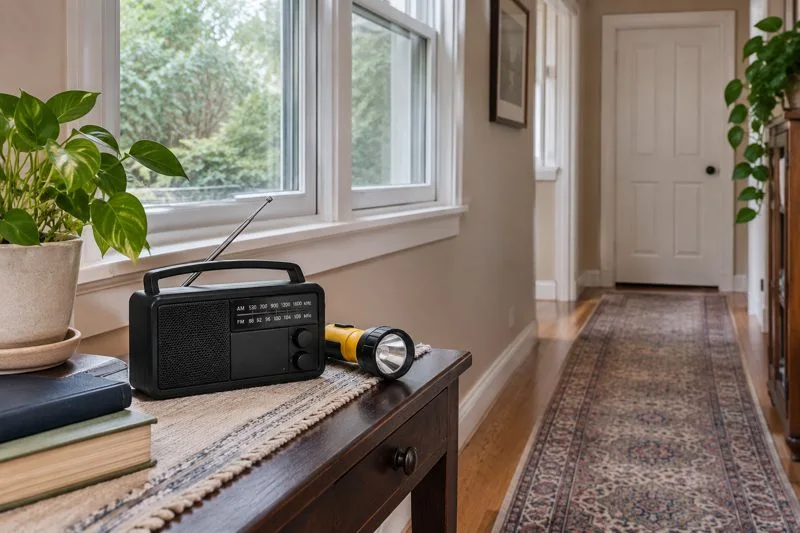
AI-generated illustration of indoor emergency readiness; not an image of an actual event.
Step 2: Get inside rather than wait for fallout
Move promptly into the nearest accessible, structurally sound building. A basement or the center of a larger building can put more material between you and radioactive particles outside. If you are in a vehicle, get into a building as soon as safely possible; vehicles provide limited protection from fallout.
Fallout timing depends on the detonation, weather and your location. FEMA describes radioactive particles beginning to fall after a detonation in some scenarios, but an approximate timeline is not a guaranteed safe interval. Do not go outdoors to watch, photograph an event or calculate how much time remains.
Step 3: Once indoors, move to a safer interior location
Go to a basement or the middle of the building, away from exterior walls, the roof and windows. Close and lock doors and windows and follow official instructions concerning ventilation. If the building is on fire or at imminent risk of collapse, address that immediate danger and seek the safest available shelter.
The CDC’s get-inside guidance explains why staying within a building helps reduce exposure to radioactive material outside. People in different locations may receive different instructions as responders learn more.
Step 4: Remove possible contamination after sheltering
If you were outside and may have radioactive dust on you, remove the outer layer of clothing carefully after getting indoors. Place it in a plastic bag or another container away from people and pets. Wash exposed skin or shower with soap and water if available; if not, use a damp cloth or wipes. Put on clean clothes when possible.
The FEMA response guidance describes changing clothing, washing and using damp wipes. Do not delay getting into shelter in order to decontaminate outside. Follow officials’ instructions and avoid vigorous scrubbing that can damage the skin.
Step 5: Stay informed and account for household members
Use a battery-powered radio, phone or another available channel to receive instructions from emergency officials. Information about affected areas, water and evacuation may change as responders assess conditions. If phone networks are congested, brief messages may be more practical than repeated calls.
If family members are at school, a childcare center, hospital or another facility, the CDC advises staying sheltered rather than going outside to collect them during a radiation emergency. Those facilities should follow their own emergency procedures. Continue trying to contact them from shelter if it is safe and possible.
Step 6: Remain sheltered and reassess only with reliable guidance
Use bottled water and food in sealed containers if available, and follow local health advice on water safety. Do not take potassium iodide unless public-health or emergency officials or a healthcare provider direct you to do so. It only helps protect the thyroid from radioactive iodine in certain circumstances; it does not replace shelter.
Why the exact timeline is uncertain
A nuclear detonation can produce an intense flash, heat, blast pressure and radiation. Fallout consists of radioactive particles that may settle downwind. The amount, arrival time and affected area depend on the event and conditions; not every detonation produces the same pattern of fallout. Officials use monitoring and other information to decide which areas should shelter or evacuate.
Communications and emergency response may also be disrupted. FEMA and CDC planning materials describe a range of possible impacts, not a fixed schedule for when help or power returns. The best available guidance is to take protective action promptly and update decisions as credible local instructions become available.
Troubleshooting common situations
I am in a vehicle when the warning arrives
A car is not a good fallout shelter. As soon as safely possible, enter a nearby substantial building and move to its basement or interior. Avoid delaying shelter to continue a planned trip.
I cannot reach my family by phone
Remain sheltered if authorities say the area outside is unsafe. Listen for official information and try a brief message when service permits. Schools and care facilities have emergency procedures; going outside to collect someone can increase exposure.
The building is unsafe
Fire, collapse risk or a life-threatening medical emergency can require immediate action. Contact emergency services if available and move to the safest accessible alternative, following responders’ instructions. Do not interpret a general shelter recommendation as a requirement to remain in an immediately dangerous building.
Frequently asked questions
Is this a prediction of a nuclear attack?
No. This is general information for a hypothetical emergency, based on public-health and emergency-management guidance.
Does fallout always arrive after exactly ten minutes?
No. Arrival varies with the event, weather and location. FEMA’s approximate descriptions are not a guaranteed period in which it is safe to remain outside.
Is it automatically safe to leave after 24 hours?
No. The CDC advises that at least 24 hours indoors can be protective, but officials determine incident-specific instructions. Follow an evacuation order or seek urgent help for a life-threatening situation.