Can the UN Prevent a Hypothetical Nuclear Attack? What Its Powers Actually Allow
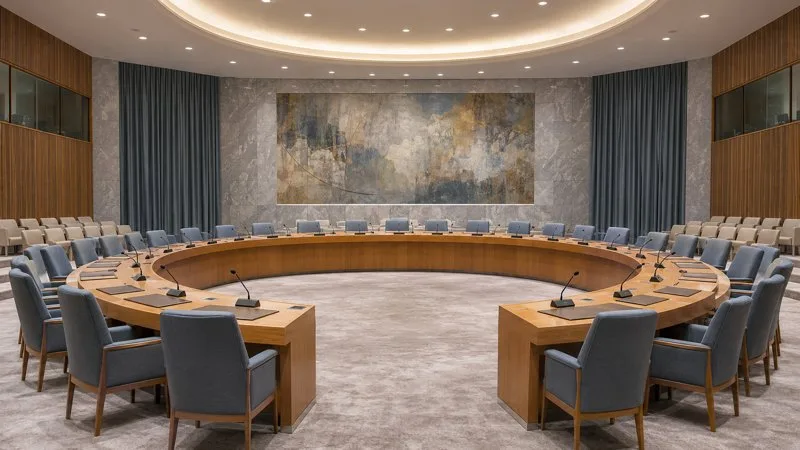
Explore six steps to understand UN diplomacy, Security Council powers, vetoes and the limits of preventing nuclear use.
This is a general explainer for preparedness, not a report of an ongoing nuclear event. There is no single distance that answers how far “radiation” travels or marks a universal safe boundary. The word can refer to the immediate energy from a blast, or to radioactive particles carried as fallout. Those behave differently. This five-step guide explains the distinction, why a fallout footprint changes from one scenario to another, and what to do with official information. The linked agencies are U.S. government sources; readers elsewhere should use their own emergency-management and public-health authorities.
| What you need | Purpose |
|---|---|
| A phone or battery-powered radio and the official emergency-alert channels for your area | To receive incident-specific directions instead of relying on generic maps or estimates. |
| Access to a local emergency-management or public-health website | To find the right authority for your country or region. |
| No radiation calculator or specialist device is needed for this explainer | Public safety decisions should come from measurements and instructions issued by responders. |
Estimated reading time: About 8–10 minutes. Difficulty: Easy; this guide explains the terms without requiring technical calculations.
A nuclear detonation can produce heat, a blast wave, and initial radiation. These are immediate effects whose impact generally lessens with distance, but their range depends on the size and height of the detonation, terrain, buildings, and weather. Fallout is different: it is radioactive material attached to particles of vaporized soil, water, and other debris that cool and return to the ground. The CDC explains that wind can carry fallout particles miles from an explosion site. So “how far does the radiation travel?” needs a follow-up: are you asking about the initial blast effects, or the route and concentration of fallout particles? See the CDC’s nuclear-blast FAQ and the HHS Radiation Emergency Medical Management overview.
A detonation at or near the surface can pull soil, concrete, and other debris into the radioactive cloud. Those materials affect the size and behavior of fallout particles. In general, larger particles settle sooner and closer to the detonation, while finer particles can remain in the air longer and travel farther. A burst at a different height interacts with a different amount of ground material, so it can produce a different fallout pattern. This is why a distance chart based on one assumed scenario should not be treated as a prediction for every possible event. FEMA’s planning guide describes its maps as scenario-specific; it also explains that fallout size, timing, and location can change with conditions.
Fallout does not necessarily travel in a neat straight line that matches the wind you feel at street level. Winds can change speed and direction with altitude, creating irregular or multi-lobed patterns. Rain or snow can bring particles down in particular areas, increasing local deposition while reducing what continues farther downwind. A Lawrence Livermore National Laboratory study archived by the U.S. Department of Energy found that wind changes with altitude, precipitation, and other uncertainties can significantly alter modeled deposition. Do not use a ground-level windsock, weather-app arrow, or a guess about which way the cloud is moving to decide that a place is safe.
Topography and nearby structures can influence how a plume moves and where material settles. The result may be an uneven footprint, not a perfect circle around a point on a map. HHS says fallout could potentially travel hundreds of miles, while its concentration and radiation decrease as it spreads and as time passes. FEMA’s public-preparedness guidance also distinguishes heavier, earlier fallout from finer particles that can move much farther with weather and are generally less dangerous. These statements describe possible transport, not a universal danger radius: a particle traveling far does not mean every location along the route receives the same amount or dose.
The U.S. Environmental Protection Agency notes that weather and wind patterns determine where fallout settles. For past above-ground weapons tests, some material reached the upper atmosphere and circulated widely. That history helps explain long-range transport, but it does not provide a map of risk for a future, hypothetical detonation. A person’s risk also depends on the radiation level measured at their location, the time spent exposed, and the protection between them and the source.
No fixed mileage, online scenario map, or visible cloud can establish that a particular address is safe. Emergency responders combine incident information, atmospheric modeling, and radiation measurements to identify affected areas and update guidance. If authorities issue a radiation warning, follow the instructions for your location. CDC’s public advice (CDC radiation-emergency steps) is to get inside, stay inside, and stay tuned: enter a substantial building, move to a basement or the center away from windows and the roof, and remain sheltered for at least 24 hours unless officials tell you to evacuate or take another action. Do not drive away based on a guessed plume direction. For a real incident, local authorities—not a generic distance estimate—will give the relevant protective actions.
It can under some conditions. HHS says fallout could potentially travel hundreds of miles; FEMA says finer material may travel much farther with weather. As particles spread, their concentration and radiation decrease, and long-range transport does not mean every area receives a dangerous dose. Only measurements and incident-specific guidance can assess a location.
No. Wind speed and direction can differ at different altitudes, precipitation can bring particles down unevenly, and terrain can alter the plume. The pattern may be irregular and may not match the surface wind.
Do not decide from distance alone, a generic map, or whether you can see particles. Monitor your local emergency-management and public-health authorities. If they advise sheltering, get inside and remain there until they provide updated instructions.
Official sources: CDC: Nuclear Blasts FAQ; HHS REMM: Blast Range and Significant Effects; FEMA: Planning Guidance for Response to a Nuclear Detonation; FEMA: Nuclear Detonation Preparedness; EPA: Radioactive Fallout; DOE/LLNL fallout-modeling study (DOE OSTI).
Explore six steps to understand UN diplomacy, Security Council powers, vetoes and the limits of preventing nuclear use.
Understand six steps about tactical and strategic nuclear weapons, civilian harm, escalation risk and international humanitarian law.
Use this 5-step guide to separate Russia and China’s documented 2026 diplomacy from uncertain responses to hypothetical nuclear escalation.
Use these 5 steps to assess a hypothetical nuclear strike on Tehran, verify claims, map humanitarian needs, and avoid unsupported casualty forecasts.
Learn six steps for outage readiness, backups, shielding limits, safe power and shelter priorities in a hypothetical EMP emergency.
Learn six protective steps after a hypothetical nuclear detonation, from immediate shelter and decontamination to official updates.
Use this 5-step guide to check local fallout shelter plans, verify nearby options, and prepare a household response.
Use this 5-step guide to trace supply risks, market reactions, and inflation channels in a hypothetical Iran-related strike.
Use this 5-step guide to understand fallout distance, why it varies, and how to follow official safety instructions.
Use 5 steps to manage fear about WW3, set news boundaries, regain routine, and know when to seek mental-health support.