Home
» PC Tips
»
How to fix The User Profile Service failed the logon error on Windows 10
How to fix The User Profile Service failed the logon error on Windows 10
Most Windows errors occur after you log in to your computer. However, the "User Profile Service Failed the Logon" error doesn't allow you to log in at all, which is why it's harder to fix than other Windows errors.
The "User Profile Service Failed the Logon" error occurs due to a corrupted NTUSER.DAT file, a corrupted registry entry or core system file, or an improperly configured User Profile Service. However, you can use the following steps to effectively diagnose and fix the problem.
Enable the built-in admin account using Windows Recovery Environment
The first thing you should do is enable the built-in admin account if you can't log in with your account. All other fixes won't be possible without this hidden account.
There are many ways to enable the built-in administrator account in Windows, but the traditional methods won't work here. So we'll use the Windows Recovery Environment (WinRE) to open an instance of Command Prompt and modify the registry to enable the account.
Warning : Before proceeding with the steps mentioned below, manually backup the system registry to USB using the Export option in Registry Editor, if possible.
Follow these steps to enable the admin account:
1. Click the Power icon .
2. Hold down the Shift key and click on the Restart option .
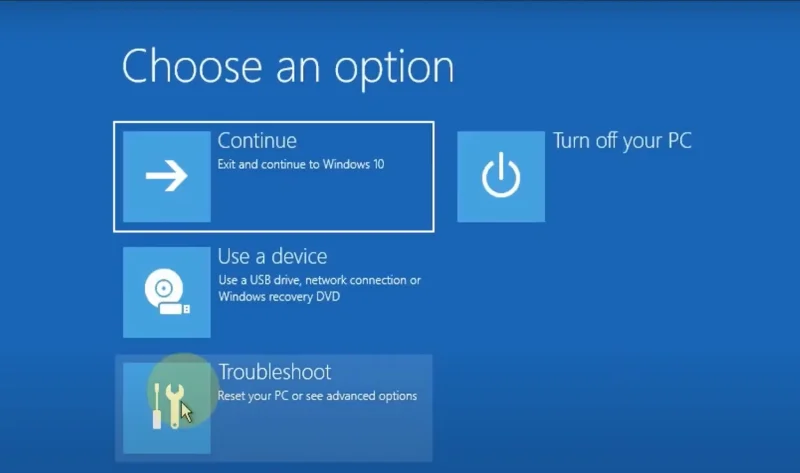
3. After your PC restarts, click Continue .
4. Select Troubleshoot .
Windows Recovery Environment
5. Click Advanced Options > Command Prompt .
6. Type regedit into the Command Prompt window and press Enter .
7. Click on the HKEY_LOCAL_MACHINE key on the left.
8. Click File > Load Hive .
9. Select the This PC option .
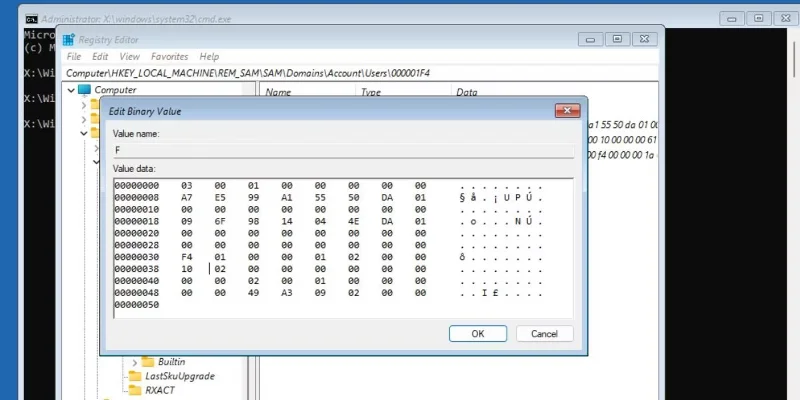
Modify the binary value F in the registry to enable the admin account
10. Click Windows > System 32 > config .
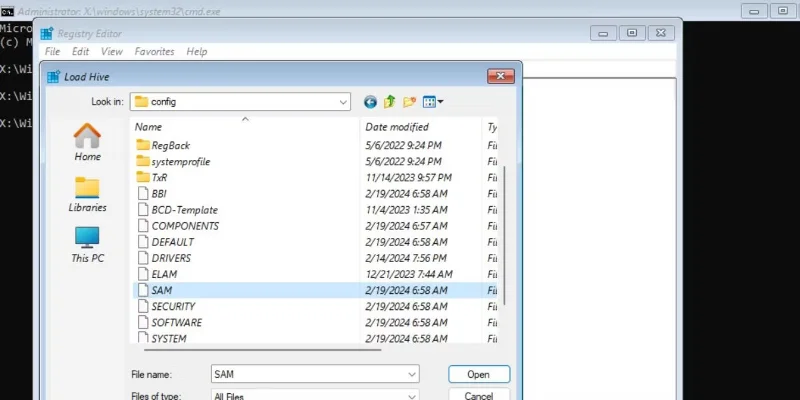
11. Find the SAM file and double-click it.
Select the SAM file to load Hive in Registry Editor
16. Modify the value 11 in the second column of row 00000038 to 10 .
17. Click OK .
18. Exit the registry editor window.
19. Close Command Prompt.
20. Click Continue to boot into the lock screen. You will see an additional admin account on the lock screen.
Boot into Safe Mode
After enabling the built-in admin account, the first thing you should do is boot Windows into Safe Mode . Safe Mode essentially starts Windows with the bare minimum of features and programs needed to function.
Replace the NTUSER.DAT file
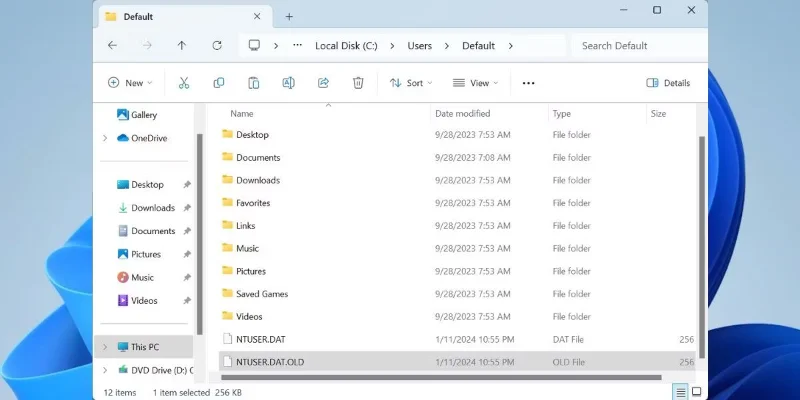
The NTUSER.DAT file stores data about user accounts and if it is corrupted, you will need to replace it. Log in to the admin account that you enabled earlier. Then repeat the following steps:
The most likely cause of the "User Profile Service Failed the Logon" error is a corrupted user file. This can happen for a variety of reasons, from an antivirus scan at startup to a sudden power loss when you turn on your computer.
Fortunately, Windows has a number of built-in utilities that can help you automatically find and repair corrupt Windows files. One such utility is called System File Checker (SFC), and it is executed using the Command Prompt.
Restore computer to previous state
Windows has a useful feature called System Restore that allows you to undo changes to your computer and restore it to an earlier point in time.
Before proceeding, you should know that this feature is not enabled by default and you have to create restore points manually unless you configure Windows to create restore points daily.
If you remember creating a restore point before the error appeared, follow these steps:
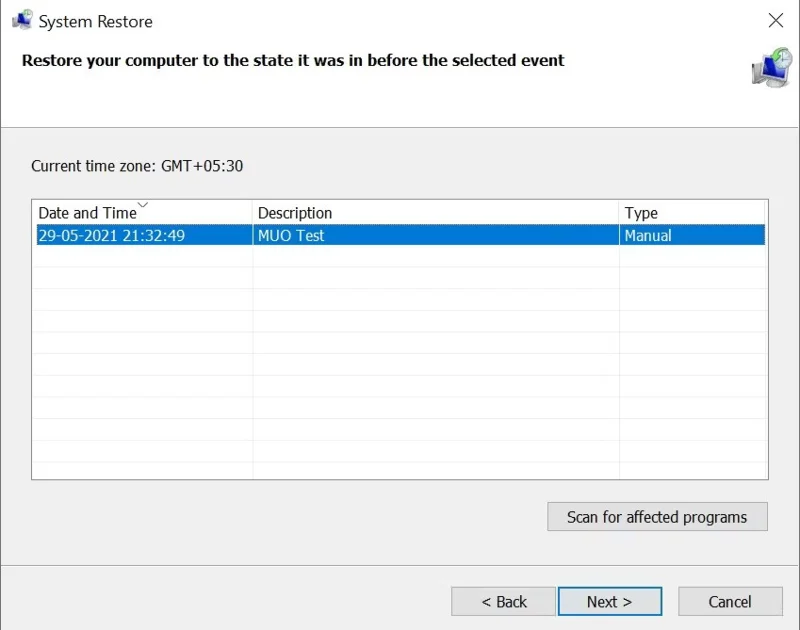
In the Run box , type rstrui.exe and press Enter .
On the System Restore dialog box, click Next .
Select a restore point from the list.
On the next window, double check everything and click Finish .
Windows will restore itself to its previous state and you can now log in without any trouble.
You should back up any important data or applications they may have installed after creating a restore point.
Change registry configuration
Another way to fix the "User Profile Service Failed the Logon" error is to make some changes to the registry. This is an advanced troubleshooting method and you should create a system restore point before proceeding.
Do the following to configure the registry properly:
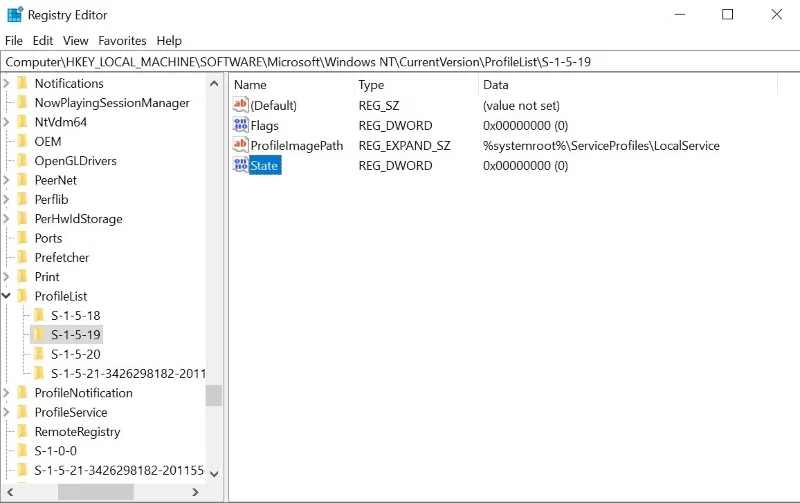
Registry Editor Windows 10
1. Boot into Safe Mode using the steps in the first section of this article.
2. Press Windows key + R to open the Run prompt. Type regedit and press Enter .
3. In Registry Editor, using the navigation bar on the left, go to:
HKEY_LOCAL_MACHINE\Software\Microsoft\Windows NT\Current Version\Profile List
4. Here you will see two files with the same name, but one will have the .bak extension.
5. Right-click on the file with the .bak extension and select Rename . Delete the .bak extension but do not touch the file name and press Enter .
6. Now right click on the original file without the .bak extension and add .bak at the end of the file.
7. In the folder containing the renamed file from step 5, right-click State , then select Modify .
8. Change the value in Value data from 8000 to 0 (zero).
9. Then right-click on the RefCount entry and change the value in Value data to 0 (zero).
10. Confirm the changes and close Registry Editor.
11. Restart your computer and log in.
What if you can't find the .bak file in Registry Editor?
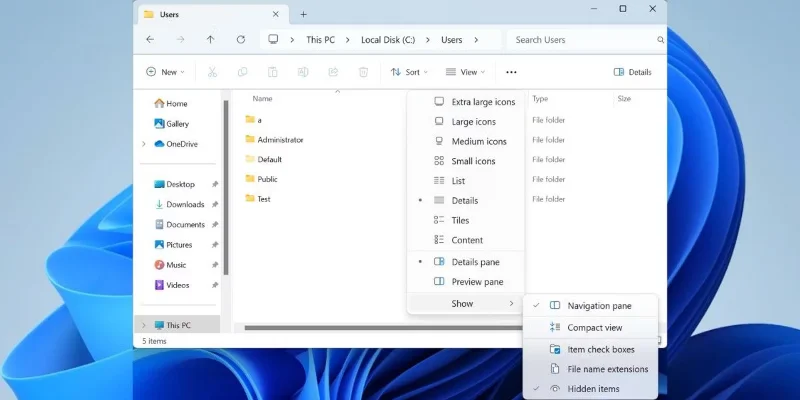
This is unlikely, but your computer may not have created a file with the .bak extension. In this case, open Windows Explorer and go to:
C:\Users\Default\AppData\Local\Application Data
If you find another folder named Application Data in the folder you are using, delete it and restart your computer. It should fix the problem.
Enable User Profile Service
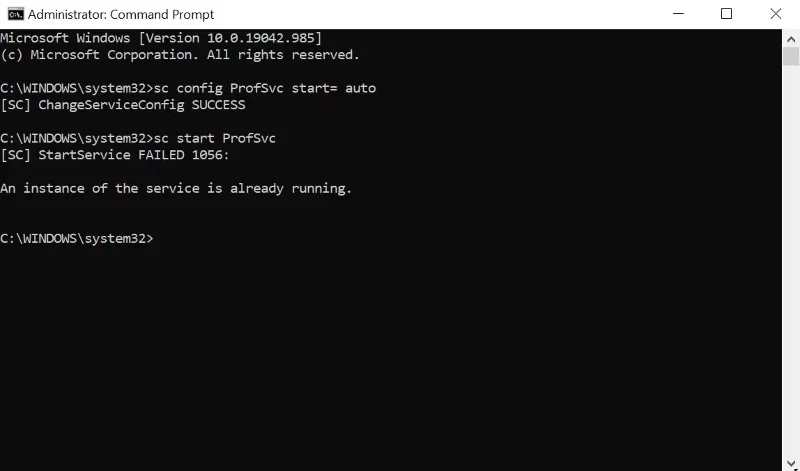
In certain cases, the User Profile Service can become disabled. Usually, a third-party application is the culprit. Luckily, you can enable it by running a simple command in a Command Prompt window:
Command Prompt in Windows 10
Boot your computer into Safe Mode.
In the Start menu search bar, type cmd . From the search results, right-click Command Prompt > Run as administrator .
In the Command Prompt window, type sc config ProfSvc start= auto and press Enter .
Then, type sc start ProfSvc and press Enter .
Close Command Prompt and restart your computer.
Some of these methods are also useful for diagnosing many other common Windows errors, so it's helpful to keep them in mind when you encounter other problems on your computer.