Home
» Discover
»
How to Store Your Halloween Decorations So They Last for Years
How to Store Your Halloween Decorations So They Last for Years
To store your Halloween decorations so they last for years, put them away clean, completely dry, disconnected from power, and protected from crushing. Then choose a cool, dry storage location suited to the most delicate item in each box. A tightly packed tote in a hot attic can undo the care you took wrapping everything.
Before starting, gather clean cloths, suitable boxes, cushioning, cord ties, and labels. Make three groups: ready to pack, needs cleaning or drying, and needs repair or replacement. Keep questionable electrical items out of the ready-to-use collection. These four storage stages help you make the important decisions before closing a lid.
What needs cleaning and drying before it goes into storage?
Anything used outdoors deserves a check for dirt, moisture, and debris. Unplug powered decorations before handling them, and let hot components cool. Brush away loose leaves and soil gently; then use the cleaning method specified for that item. A washable plastic pumpkin and a painted foam tombstone should not automatically get the same treatment.
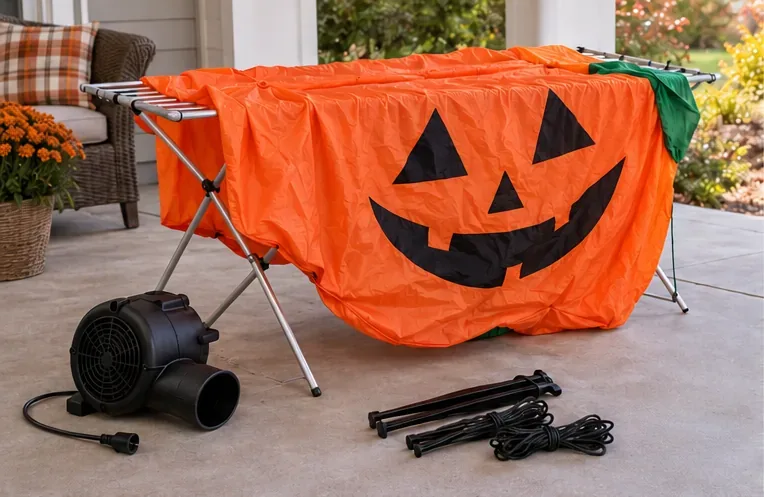
For an example of manufacturer guidance, this Gemmy Airblown instruction manual recommends wiping the inflatable with a damp cloth, using mild detergent if needed, and allowing it to dry before storage. Check your own model's instructions rather than assuming every inflatable has identical care requirements. Keep water away from electrical components.
Spread cleaned fabric out in a sheltered, ventilated area. Check seams, folds, undersides, and the area around the blower before packing. There is no universal drying time: weather, fabric, and trapped moisture all matter. If a tucked-away section is still damp, leave the decoration out longer. A storage bin cannot dry it for you.
Spirit Halloween's care guidance also says outdoor decorations should dry completely before storage and warns against using a hair dryer, which can damage adhesives. Clean fabric covers according to their care instructions; do not assume an animatronic's attached costume is machine washable.
Let inflatable fabric dry completely before folding and packing it.
Should you remove batteries and disconnect the lights?
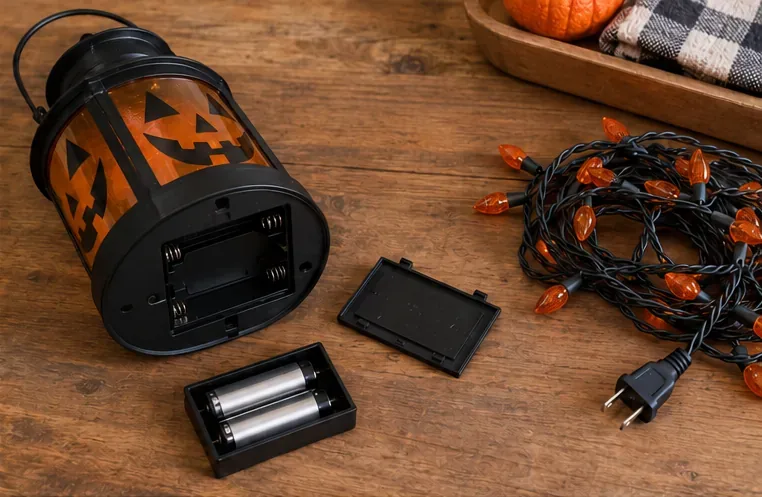
Yes: remove user-replaceable batteries from decorations that will sit unused for months. Switching a prop off is not the same as removing its batteries. Check lanterns, flameless candles, sound boxes, and remotes. For built-in rechargeable batteries, follow the manufacturer's storage and charging instructions instead of trying to remove a sealed battery.
Energizer's battery-care guidance recommends removing batteries during extended periods of nonuse and storing batteries in a cool, dry place at normal room temperature. Keep usable batteries in their packaging or an appropriate case, away from loose metal hardware and out of children's reach. Do not return leaking or damaged batteries to your supplies.
As you take down light strings, examine the cords, sockets, and plugs. The Electrical Safety Foundation International's post-holiday guidance recommends unplugging by the plug's gripping area and discarding lights with cracked, frayed, or damaged wire insulation. Do not hide that damage under tape and pack the set as ready to use.
Loosely wind sound, dry light strings around a suitable reel or cord organizer without pulling wires tight or making sharp bends. Keep indoor-only and outdoor-rated sets clearly identified. Label each detachable adapter with its matching prop, leaving electrical specifications visible; similar-looking connectors do not establish compatibility.
Remove user-replaceable batteries and check unplugged light strings before storage.
How should you pack different Halloween decorations?
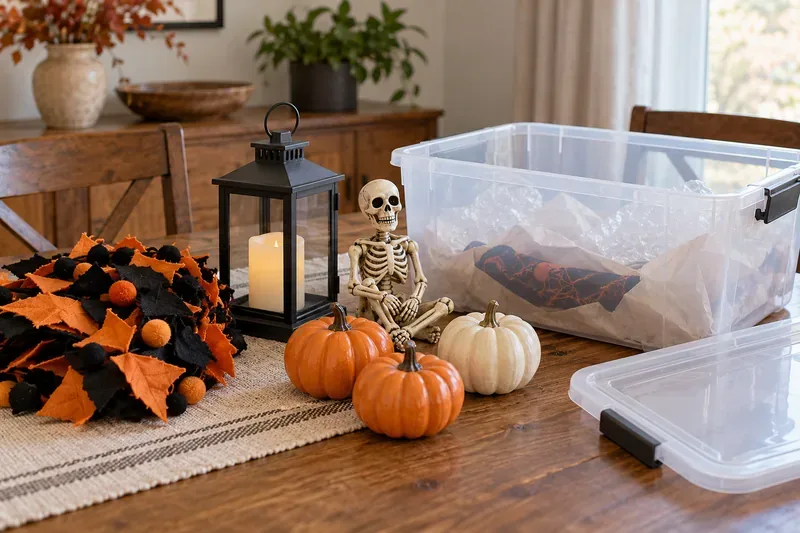
Choose packaging by material, shape, and weight. One giant tote is convenient until a heavy base lands on a ceramic pumpkin or a foam gravestone. A useful rule is to give fragile pieces their own supported space and keep dense hardware separate.
Decoration
Practical packing method
Avoid
Ceramic or glass pieces
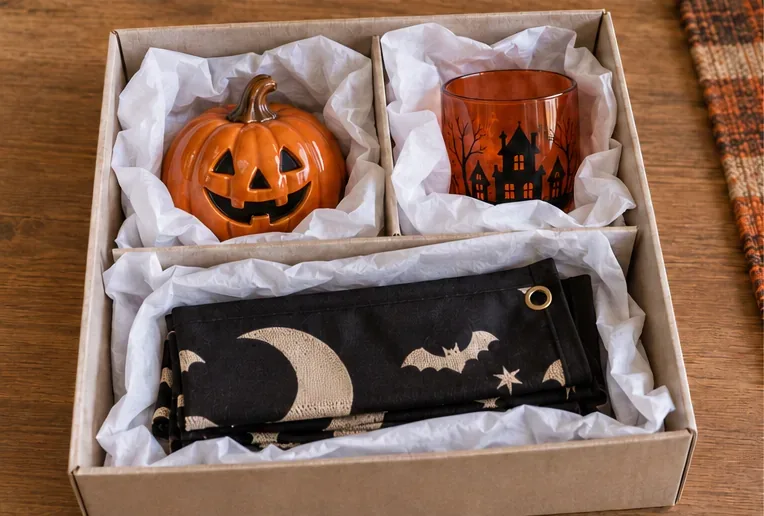
Cushion individually in a rigid, divided box; support the body and leave room around stems and handles.
Pieces touching each other or a lid pressing on projections.
Foam tombstones and signs
Use a flat box or supported upright slot that keeps surfaces from rubbing.
Bending panels or stacking heavy bins on them.
Fabric banners and table linens
Store clean and dry with minimal folding and suitable tissue between delicate surfaces.
Sharp creases, damp fabric, and crushing embellished areas.
Inflatables
Fold loosely after drying, following the model's instructions; isolate sharp stakes from the fabric.
Forcing fabric around hard components to fit an undersized container.
Wreaths and dimensional garlands
Use a container deep enough to preserve their shape.
Compressing bows, flowers, branches, or attached ornaments.
What wrapping materials are worth using?
For keepsake textiles, use unbuffered, acid-free tissue or clean, prewashed cotton as a liner and fold support. The Canadian Conservation Institute's textile guidance recommends suitable polyethylene or acid-free boxes and padding unavoidable folds. Its advice is especially useful for sentimental fabric decorations you want to preserve over many seasons.
For ordinary hard decorations, reuse clean, intact fitted packaging when it supports the item properly. Put enough cushioning around fragile objects to limit shifting, without squeezing them. Do not apply packing tape directly to painted or glittered surfaces. Wrap and secure the protective material instead.
What about large skeletons and animatronics?
Photograph connections and assembled sections before taking them apart. Follow the model's disassembly instructions, and keep labeled fasteners, the correct adapter, and the manual together. Only detach parts intended for user removal; do not force joints, release springs, or open a mechanism based on generic advice.
Support bulky pieces so their weight does not rest on thin fingers, jaws, wiring, or costume attachments. Spirit Halloween specifically warns that weight placed on stored animatronics can crush parts or damage welds. If the original box no longer fits safely, choose a larger protective container rather than pressing the lid down.
Separate fragile pieces and cushion them so they cannot knock together.
Where should you store the packed decorations?
A dry interior closet or suitable indoor storage room is usually a better choice than a location exposed to extreme heat, cold, or dampness. This follows the manufacturers' cool, dry storage advice and the Canadian Conservation Institute's recommendation to protect textiles from light and abrupt temperature or humidity changes. Check product-specific temperature limits where provided.
An attic, garage, or basement is not automatically suitable or unsuitable; its actual conditions matter. Look for leaks, condensation, musty odors, pest activity, and seasonal temperature extremes. If a space stays damp, fix the moisture problem or move vulnerable decorations. Do not rely on a sealed tote or a small desiccant packet to solve a wet storage environment.
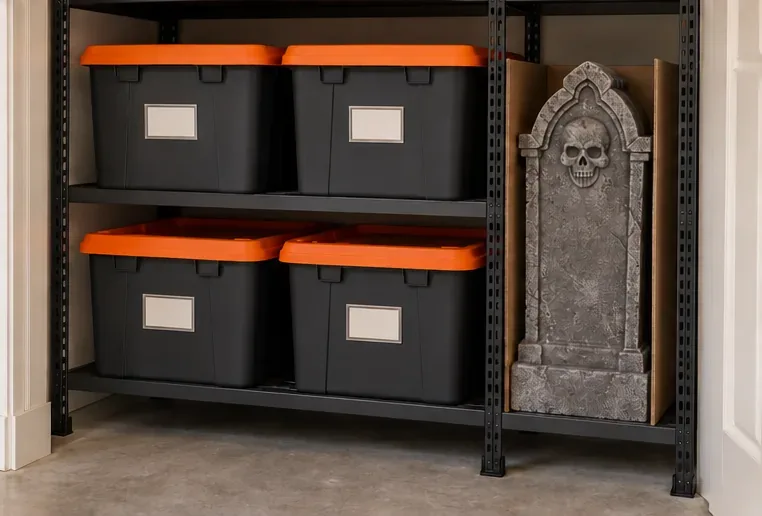
Use sturdy shelving to keep containers off the floor, and follow shelf and container load limits. Place heavy boxes low and leave fragile props free of loads above them. Opaque containers can help limit light exposure, but they still need dry contents and a suitable location.
Label the front and top of each box with its contents and any handling needs. For example, “Halloween—porch lights—outdoor rated” is more useful than “Halloween.” Keep an inventory photo on your phone so you can find the right container without opening every lid. Keep assembly instructions with the items they describe.
Keep packed decorations off the floor and protect bulky props from crushing.
What should you check before calling the job finished?
Everything is clean and dry, including folds and hidden surfaces.
User-replaceable batteries are removed, and electrical damage has been addressed.
Fragile pieces cannot knock together or carry the weight of other objects.
Adapters, stakes, fasteners, and instructions are identified and accounted for.
Boxes close without pressure and sit in a suitable storage location.
Check the storage area during the off-season, especially after a leak or a major change in conditions. Good packing reduces avoidable damage; it does not guarantee a fixed lifespan for every material. Finding moisture, pests, or a failing container early gives you a chance to act before next Halloween.