Can the UN Prevent a Hypothetical Nuclear Attack? What Its Powers Actually Allow
Explore six steps to understand UN diplomacy, Security Council powers, vetoes and the limits of preventing nuclear use.
This is a preparedness guide, not a report that a nuclear attack has occurred. No checklist can guarantee survival in every emergency. If officials ever issue a radiation warning, follow their instructions for your location. The core public guidance is to get inside, stay inside, and stay tuned for updates. The linked CDC and Ready.gov sources are U.S. government guidance; readers elsewhere should follow their local emergency-management and public-health authorities, whose alerts and actions may differ.
Radioactive fallout consists of particles that can settle on people, buildings, food, and water. The CDC says wind can carry fallout miles from an incident area. In practical terms, a self-chosen distance or driving direction cannot replace official alerts. A substantial building between you and outdoor fallout offers shielding; the basement or central part of a large building is generally a better place than a car, mobile home, or spot near exterior walls and the roof. See the CDC radiation emergency FAQ.
| Item | Why it helps |
|---|---|
| List of shelter locations at home, work, school, and regular destinations | Helps you move to a building without first making a long trip. |
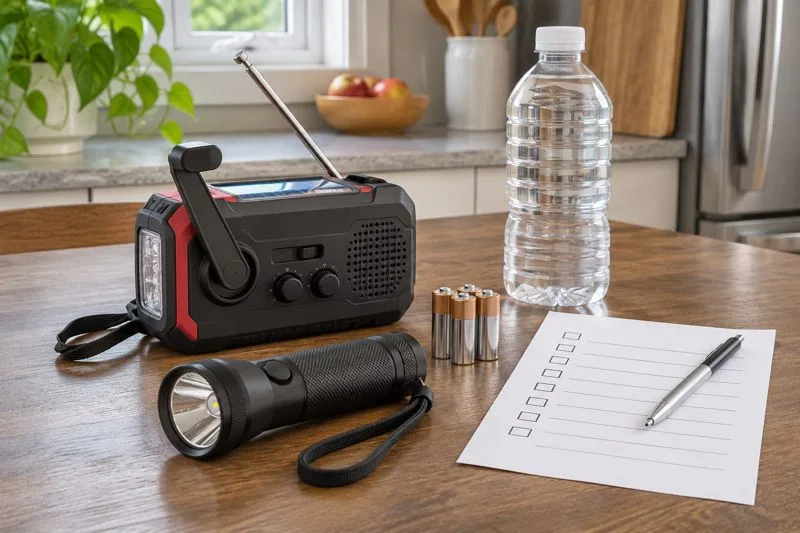
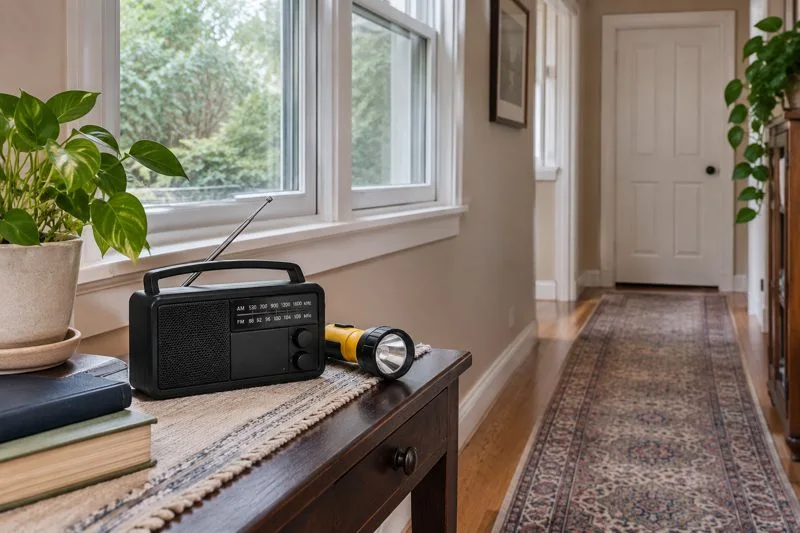
| Battery-powered or hand-crank emergency radio; charged phone and spare batteries | Lets you receive official updates if power or mobile service is disrupted. NOAA Weather Radio is an option in the United States; elsewhere, use the local equivalent if available. |
| Bottled water, sealed packaged food, essential medicines, flashlight, and batteries | Supports a household that may need to remain indoors for at least 24 hours; Ready.gov suggests storing more supplies if possible. |
| Soap, clean clothing, sealable bags, and basic pet supplies | Useful for simple decontamination if someone or a pet was outdoors. |
Estimated planning time: About 30–60 minutes to map shelter locations and review supplies already on hand; assembling a kit may take longer. Difficulty: Easy. No specialized radiation equipment is required to make a basic household plan.
Choose the best available shelter near places where your household spends time. Ready.gov recommends underground locations or the middle of larger buildings. At home, work, and school, identify a basement or interior room away from windows. Also note what building you could enter along a regular commute. A car is not good radiation shelter, and outdoor areas and mobile homes do not provide adequate protection. In an emergency, an accessible building is safer than remaining outside while traveling toward a theoretically better one.
Write down how household members will get local instructions and check in with one another. Keep a battery-powered or hand-crank emergency radio; NOAA Weather Radio is one option in the United States. If mobile networks are congested, CDC recommends trying text messages rather than calls. If family members are at a school, hospital, or care facility during a warning, CDC advises staying where you are instead of traveling outside to collect them. Follow instructions for those facilities and wait for official updates.
Store bottled water, packaged food, prescription and other essential medicines, a flashlight, spare batteries, and a radio where you can reach them. Ready.gov advises keeping enough supplies for a 24-hour stay at places you frequent and, if possible, supplies for three or more days. Keep pet supplies with the kit and know how you will bring pets inside. The objective is to shelter and listen for updates, not to improvise a long-distance evacuation.
If officials warn of a radiation emergency, enter the nearest suitable building. If you are already indoors, stay there and move to a basement or the center of the building, as far as practical from exterior walls and the roof. Close and lock windows and doors. If you can do so safely, turn off fans, air conditioners, and forced-air heating that draw outdoor air, and close the fireplace damper. CDC guidance for a fallout cloud says to keep ventilation systems off and seal openings until the cloud has passed; afterward, unseal doors and windows for some air circulation. Do not go outside to look at a plume or to find supplies.
Once inside, remove your outer layer of clothing carefully; CDC says this can remove up to 90% of radioactive material. Avoid shaking the clothing. Put it in a sealable plastic bag or container and place it away from people and pets. Wash exposed skin with warm water and plenty of soap, and wash your hair with shampoo or soap. Do not scald, scrub, or scratch your skin. Keep cuts covered while washing. If no shower is available, use a sink or a clean damp cloth or wipe, paying attention to your hands and face, then put on clean clothes. CDC says tap water can be used for washing even if officials advise against drinking it. Help exposed pets by gently washing their coat with soap and water if available; use waterproof gloves and a dust mask if you have them, then wash your hands and face.
Plan to stay inside for at least 24 hours unless emergency officials tell you to evacuate or take another action. Officials decide whether and where evacuation is appropriate based on conditions such as wind, radiation readings, damage, and safe routes. Listen to local radio, television, and verified official channels. Use bottled water for drinking until authorities confirm other sources are safe. Eat sealed food or food that was stored indoors; do not eat uncovered items that were outside or drink from open water sources. Boiling water does not remove radioactive material.
Do not take potassium iodide (KI) unless public-health or emergency officials or a healthcare provider tell you to. KI protects only the thyroid from radioactive iodine; it does not protect the rest of the body or against other radioactive materials in fallout. Do not substitute table salt or iodine supplements, and do not leave shelter to find KI. CDC explains these limits in its KI guidance.
CDC advises staying sheltered for at least 24 hours, then continuing to follow official instructions. Leave sooner only for a life-threatening emergency or when officials direct you to move.
No. A car is not good shelter from fallout. A cloth or mask over your nose and mouth may reduce the amount of radioactive material you breathe if you are outside, but it does not shield you from radiation outside your body. Get indoors as quickly as possible.
No. Take KI only when public-health or emergency officials or a healthcare provider instruct you to do so. It is not a general radiation antidote.
Official sources: CDC: Get Inside; CDC: Self-Decontamination; Ready.gov: Nuclear Explosion Information Sheet.
Explore six steps to understand UN diplomacy, Security Council powers, vetoes and the limits of preventing nuclear use.
Understand six steps about tactical and strategic nuclear weapons, civilian harm, escalation risk and international humanitarian law.
Use this 5-step guide to separate Russia and China’s documented 2026 diplomacy from uncertain responses to hypothetical nuclear escalation.
Use these 5 steps to assess a hypothetical nuclear strike on Tehran, verify claims, map humanitarian needs, and avoid unsupported casualty forecasts.
Learn six steps for outage readiness, backups, shielding limits, safe power and shelter priorities in a hypothetical EMP emergency.
Learn six protective steps after a hypothetical nuclear detonation, from immediate shelter and decontamination to official updates.
Use this 5-step guide to check local fallout shelter plans, verify nearby options, and prepare a household response.
Use this 5-step guide to trace supply risks, market reactions, and inflation channels in a hypothetical Iran-related strike.
Use this 5-step guide to understand fallout distance, why it varies, and how to follow official safety instructions.
Use 5 steps to manage fear about WW3, set news boundaries, regain routine, and know when to seek mental-health support.