Would Europe Be Drawn into a Hypothetical U.S.-Israel-Iran Nuclear War? NATO Rules Explained

A guide to NATO Articles 4 and 5, UN self-defense rules, and why consultation does not mean automatic European entry into war.
Whether you’re creating Reels or editing videos for YouTube, Canva is a great mobile app for putting together footage on your smartphone. Today’s article will walk you through the entire process of creating and editing videos using the tool. You can follow along with a free or paid subscription.
Table of Contents
To successfully create anything in Canva, you need the right foundation. You can use templates if you want to add an artistic touch to your content. If you want to start from scratch, you can use custom dimensions instead.
If you’re posting to a specific platform, you should check the dimensions first. Canva can help with this; you’ll find presets for Reels, TikTok videos, etc., just use the search bar to find what you need. In this case, I’m using the Video size template (1080p) and starting from scratch.
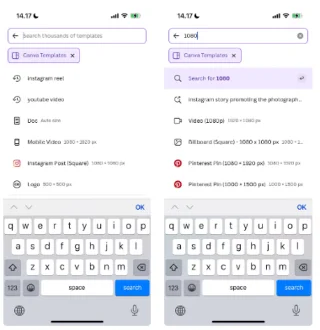
As a general rule, use 1920 x 1080 for landscape videos and 1080 x 1920 for portrait videos. It's also a good idea to learn about video aspect ratios.
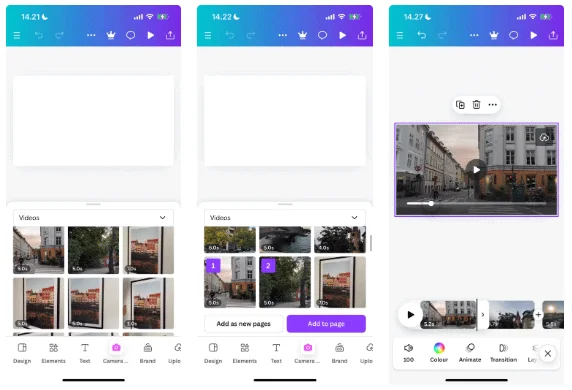
Once you’ve chosen a starting point for your video, the next step is to import the clips you plan to use. All of the footage you’ll be using should already be on your smartphone, which makes adding it easier. However, if you want to edit clips from your DSLR camera using Canva for mobile, import them to your computer first, then open the Canva app on your smartphone.
Here's how to add a clip to your Canva project:
Once you import your video clip, you'll see an editing timeline at the bottom. You can use Canva to edit video content, but you can also create videos from images.
The majority of editing time in Canva will be spent on color correction for your video and other parts of your content. Since this is often quite complex, we’ll break it down into two parts. Let’s look at color correction first before moving on to the rest of your content.
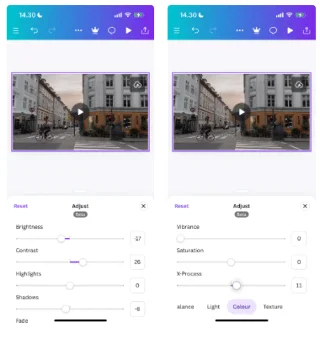
While Canva doesn’t have the advanced color editing tools you’ll find elsewhere, it does have a range of tools that are useful for beginners. For example, you can add filters and adjust saturation. Likewise, you can change different aspects of lighting.
Here's how to use these tools:
Besides using Canva to edit video color, you can also change the color of images, graphic elements, and text in Canva.
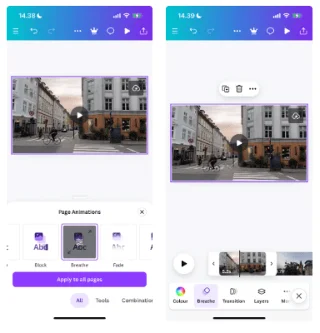
After color correction, you should move on to changing the content of your video. For example, you can add transitions and animations. These include fades, zooms, and flips. In some cases, you may also benefit from using blends.
You'll see the different animation options split into subsections, while all the transitions are in the same row. You can also choose whether to apply these changes to all pages or just one, along with adjusting their intensity (you need Canva Pro to customize animations; no paid plan is required for transitions).
The article recommends making these changes in the following order:
If you're editing videos for YouTube, you might consider looking into ways YouTubers can use Canva for graphics and branding.
You’re almost ready to export your video project, but before you do, you should add a few finishing touches. For example, Canva allows you to change the speed of your video. You can also decide whether you want your content to play automatically or on a loop. Do this by selecting Playback and adjusting these categories as needed.
You can also change the length of your clip by dragging either edge in/out. And if you want to delete any clip, just tap on it and select the trash icon.
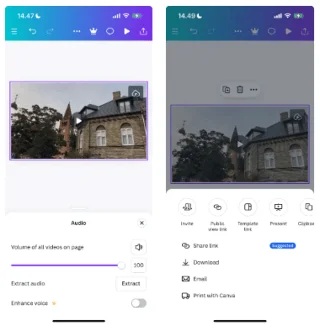
Before exporting, you should change the audio in your Canva projects. Honestly, there’s not much to do here other than change the volume. You can use the slider to lower the volume or tap the icon to mute it completely.
To add music to your content, you shouldn't use Canva. Instead, use one of these other ways to add music to your videos on iPhone and Android .
When you're ready to export your video, select the download icon in the upper right corner and hit Download .
Editing videos in Canva is super simple, and you can make lots of simple changes like adjusting colors and adding filters. While it’s not the best place to add music, you can easily do that elsewhere. You can use Canva to edit Reels, YouTube videos, TikTok posts, and more.
A guide to NATO Articles 4 and 5, UN self-defense rules, and why consultation does not mean automatic European entry into war.
Assess claims about Iran in six steps, distinguishing uranium enrichment, weapons development and verified possession.
Understand nuclear decision authority in six steps, including US civilian control and the limits of public information about Israel.
A guide to official 2026 evidence on Hormuz shipping disruption, Iran-related claims, confirmed incidents, and what remains uncertain.
A source-based guide to nuclear escalation risks, UN Charter rules and NATO Article 5 in a strictly hypothetical Iran scenario.
Use five steps to prepare for an outage; nuclear and EMP scenarios are hypothetical, and official shelter instructions come first.
Use 5 defensive steps to verify a cyber disruption, protect household accounts, and avoid mistaking an outage for war.
Use these 5 steps to assess climate effects from a hypothetical Iran strike, compare model assumptions, and avoid unsupported predictions.
Explore six steps for reading research on climate, food and ecosystem recovery after a hypothetical nuclear conflict.
Build a practical fallout preparedness kit in six steps, with sealed food and water, a radio, medical supplies and shelter guidance.