Home
» Today
»
How Volcanoes Erupt: Types, Warning Signs, and Safety Basics
How Volcanoes Erupt: Types, Warning Signs, and Safety Basics
How Volcanoes Erupt: Types, Warning Signs, and Safety Basics
Volcanoes erupt when molten rock and volcanic gases move from below Earth’s surface through a vent or crack. Some eruptions release runny lava in flows; others break magma into ash and rock fragments in violent explosions. The difference depends on magma properties, gas, water, and how material moves underground. Knowing the main hazards helps people prepare, but only observatories and emergency officials can interpret whether a particular volcano is becoming dangerous.
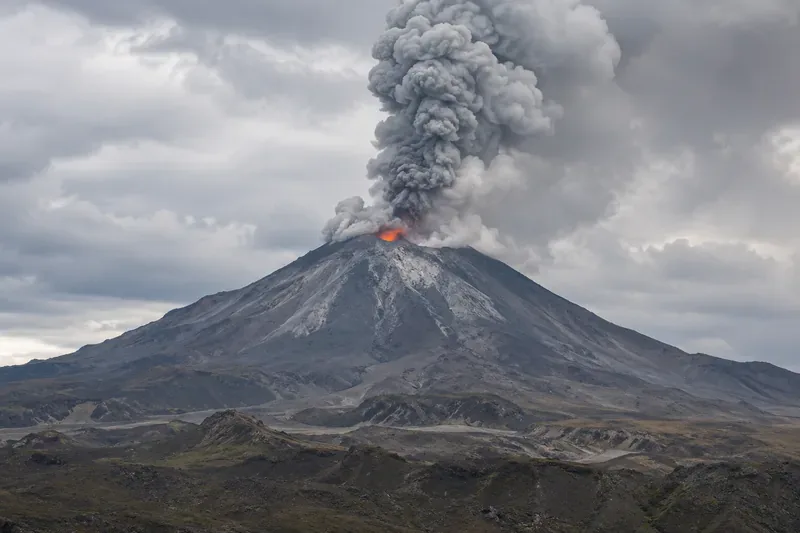
A representative eruption scene: a gray plume rises above a volcanic cone, with a small glow near the summit. Real eruptions vary in style and hazards.
What happens when a volcano erupts?
Below ground, some rock melts into magma, a mixture of molten rock, crystals, and dissolved gases. Because magma is generally less dense than the surrounding solid rock, it can rise and collect in complex storage zones. As it moves upward through cracks and conduits, pressure falls and dissolved gas can form bubbles. When magma reaches the surface, it is called lava. An eruption may come through a central vent, a side vent, or a fissure.
The magma’s viscosity—how easily it flows—is one important factor. Hot, fluid magma lets gas escape more readily, so it often produces lava flows or fountains. Thicker, stickier magma can trap gas; pressure then builds until the magma fragments and blasts out as ash, pumice, and larger pieces of rock called tephra. Water can change the process too: groundwater or a lake can flash to steam when heated, or water can interact directly with magma and help fragment it. No single feature, such as a plume or a glowing vent, tells an observer exactly how large an eruption will become.
Common eruption styles
Style
What it means
Hazards to remember
Effusive
Mostly lava flows or fountains; relatively fluid magma lets gas escape.
Lava, hot spatter, volcanic gases, and routes cut off by advancing flows.
Explosive
Gas-rich magma fragments and sends ash, pumice, and other tephra into the air.
Ashfall, flying rocks near the vent, eruption columns, and possible pyroclastic flows.
Phreatic, or steam-blast
Superheated water flashes to steam; an explosion can occur with little or no new magma reaching the surface.
Steam, ash, and rocks may be ejected, sometimes with little warning.
Phreatomagmatic
Water and magma interact, fragmenting material and producing an explosive eruption.
Ash and hot fragments can spread around the vent; local hazards depend on the eruption.
These are broad descriptions, not a forecast for a particular volcano. The U.S. Geological Survey (USGS) describes effusive eruptions as producing mainly lava flows or domes, while explosive eruptions produce mainly ash, pumice, and fragmented debris. A volcano can also change style over time or produce more than one kind of activity during an eruptive episode. Check the observatory’s latest notice instead of inferring the hazard from a volcano’s appearance.
Volcano shapes are different from eruption styles
People also use “volcano types” to describe landforms. Those labels describe how a volcano is built and shaped; they do not guarantee one eruption style.
Cinder cones are usually small, steep-sided cones built from loose volcanic fragments around a vent.
Composite volcanoes, often called stratovolcanoes, are built through repeated eruptions and can contain layers of lava and fragmented deposits.
Shield volcanoes are broad, gently sloping structures formed largely by repeated outpourings of fluid lava.
Lava domes, calderas, maars, and fissure systems are other volcanic forms; not every volcano has a classic cone.
The National Park Service notes that magma composition, gas content, and eruption rate all affect how an eruption behaves. A steep cone does not by itself tell you what is happening underground. Learn the name and hazard map for the specific volcano near you rather than relying on a general category.
Warning signs scientists monitor
Many magma-driven eruptions are preceded by measurable unrest. Scientists may watch for more frequent or stronger earthquakes, subtle ground swelling, changes in heat flow, new or increased steaming, and shifts in volcanic-gas composition. Monitoring networks combine instruments, observations, and satellite data; the meaning comes from patterns over time, not from one isolated sign.
There are important limits. The USGS says these changes can continue for weeks, months, or years, subside without an eruption, and do not by themselves reveal the eruption’s size or style. Steam-blast eruptions can occur with little or no warning. Do not approach a crater, fumarole, new crack, or restricted area to investigate. Instead, read notices from the local volcano observatory and emergency-management agency.
In the United States, the USGS uses ground-focused alert terms—Normal, Advisory, Watch, and Warning—and separate aviation color codes for airborne ash hazards. The two systems answer different questions. A pilot-facing color code is not a substitute for ground-hazard instructions. Read the full notice, the affected area, and the recommended action; sign up for USGS volcano notifications or use the observatory responsible for your region.
Hazards that can reach beyond the crater
Ashfall: Volcanic ash is made of tiny abrasive rock and glass fragments. It can irritate breathing and eyes, reduce visibility, contaminate equipment, and disrupt transport. Wind may carry ash far from the volcano.
Pyroclastic flows: Hot mixtures of gas, ash, and rock can move rapidly down slopes. They are among the most dangerous ground hazards; do not try to outrun or watch one from a nearby valley.
Lahars: These fast-moving slurries of water, mud, and volcanic debris follow valleys and river channels. They can occur during or after an eruption, and heavy rain can remobilize loose volcanic material.
Lava and gases: Lava can burn or bury anything in its path and may cut roads. Volcanic gases can be hazardous; low spots and enclosed hollows may allow some gases to collect.
Hazards vary by volcano, wind, terrain, and eruption. A community can face ash or lahars even when it is not near the vent. Consult the volcano’s official hazard map and learn which evacuation routes lead away from valleys and other mapped danger zones.
Volcano safety basics
Before unrest
Find your local volcano observatory, emergency-alert system, hazard map, and designated evacuation routes.
Make a household plan for both evacuation and sheltering. Include children, older adults, pets, essential medicines, a battery-powered radio, sturdy shoes, eye protection, and a properly fitted NIOSH-approved N95 respirator for ash exposure.
Keep important documents and supplies where they can be reached quickly. Know more than one route in case ash, a lahar, or a closure blocks the usual road.
During an eruption or ashfall
Follow evacuation orders immediately. Do not wait for a personal view of the volcano. Use official routes and take pets if the plan allows.
If officials advise sheltering and you are outside mapped flow or lahar zones, stay indoors, close windows and doors, and turn off fans and heating or cooling systems that draw in outdoor air. If heavy ash continues falling, keep monitoring official instructions: prolonged accumulation can strain roofs, so shelter may not remain safe.
If ash is in the air and you must go outside or clean ash indoors, use a NIOSH-approved N95 respirator and goggles. A particulate respirator does not filter toxic gases, so move away from gas or fumes and follow local health instructions.
Avoid driving in heavy ash. It reduces visibility, makes roads slippery, and can damage vehicle engines and filters. If a lahar warning applies, move to high ground away from valley floors and river channels; follow signed local routes.
After the immediate danger
Wait for authorities to say an area is safe before returning. Ash can be stirred back into the air by wind and cleanup, and wet ash can add heavy weight to roofs. Do not climb onto a roof or begin major cleanup without following local guidance; use respiratory and eye protection when cleanup is authorized. For practical steps during and after an eruption, consult the CDC preparation guidance and its safety guidance during an eruption.
Where to get reliable updates
For U.S. volcanoes, use the USGS Volcano Updates, the relevant regional observatory, and local emergency-management alerts. For volcanoes outside the United States, follow the national geological agency or volcano observatory and local emergency services. General science pages explain how eruptions work; only current, location-specific notices can tell you which hazards are active and what action is needed.
For background, see the USGS explainers on how volcanoes erupt and how scientists assess warning signs, plus the National Park Service overview of volcano landform types. For safety, the most useful next step is to identify the official alert source and evacuation map for the volcano closest to your home, workplace, or travel route.