Autoplay of videos is a frustrating element of the modern web experience. You open a web page, just start reading the title, then you hear the sound coming from a video and often promotional videos. Sometimes autoplay videos are hard to find or the play stop button doesn't seem to work.
Therefore, to eliminate this hassle, the following article will guide you how to disable autoplay videos in Safari , Chrome , Firefox and Facebook on Mac.
1. Safari (macOS Sierra and earlier)
Safari has a troubleshooting menu that can be used to stop autoplaying videos, but first you need to activate this troubleshooting menu using Terminal.

Exit Safari (press Cmd + Q or click Safari> Quit Safari ) and then open the Terminal application (you will find it in Applications> Utilities ). Enter the following text and press back:
defaults write com.apple.Safari IncludeInternalDebugMenu 1
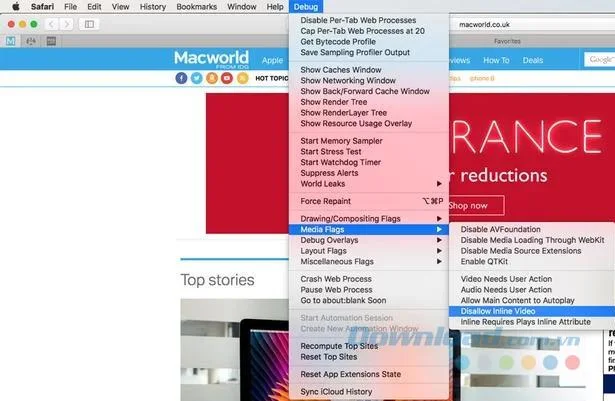
Close Terminal and open Safari again. You will see a new option on the right side of the top menu bar labeled Debug . Click that and select Media Flags> Disallow Inline Video.

If you want to exit the Debug menu option , return to Terminal and enter:
defaults write com.apple.Safari IncludeInternalDebugMenu 0
Download Safari for Mac
2. Safari (macOS High Sierra)
A new feature on macOS High Sierra 10.13 makes it easy to block videos from playing automatically in Safari. When on a website with autoplay videos, click Safari in the top menu bar and select Settings for This Website . Or, you can right-click in the URL box and select Settings for This Website.
When you access this option, a dialog box appears below the URL box. Hover over Auto-Play , the last option in the list and it will become a menu with three options, namely Allow All Auto-Play, Stop Media with Sound or Never Auto-Play.

After you have made your selection, click anywhere to make the dialog box disappear.
3. Google Chrome
Perhaps because the business model is ad-based, Google tends to have fewer options to block autoplaying videos on Chrome than Macs. Fortunately, the company's user-friendly approach allows you to easily install a third-party tool to do the same thing.
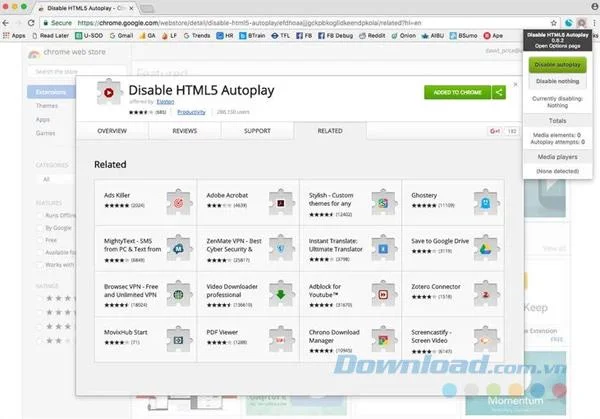
Your best option is probably to install a free Chrome extension called Disable HTML 5 Autoplay . You click on Add to Chrome , then when the dialog box asks Add Disable HTML5 Autoplay? , select Add extension .

You should see a small icon (A red octagon with a white triangle in it) appears to the right of your URL bar. Click that and select Disable autoplay.
Download Google Chrome for mac
Disable flash video on Chrome
Because this extension handles HTML5, flash videos may still autoplay. Therefore, if you are still having this problem then you probably want to disable flash in Chrome settings.
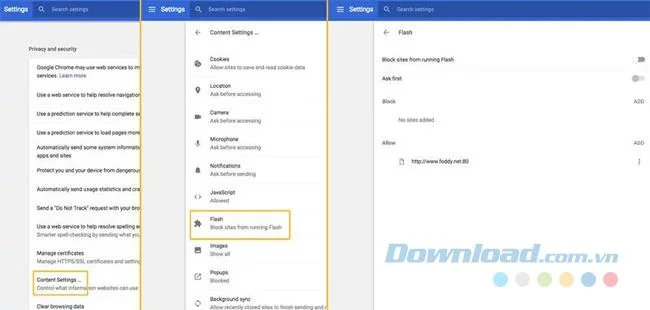
In the upper menu, click Chrome> Preferences to open the Settings menu . Scroll down and click on Advanced at the bottom, then in the Privacy and security section , select Content Settings and Flash .

In this section you can click on the first option and select Block sites from running Flash, but it can delete some content you want to access and even the video you want to play when needed. Therefore, for better control, you can add sites to the special black or white list.
4. Firefox
If you are using Firefox with lots of Flash blockers available, you can find it by selecting Tools> Add-ons or searching on the extension page. Flashblock should be the first choice.
Here's how to block HTML5 websites from automatically playing in Firefox:
- Enter about: config in the address bar of the browser. Press Enter and then click I accept the risk if you get the warning.
- Use the search field at the top to find media.autoplay.enabled.
- Next double click on it and the entry for Value will change from True to False . Double click again to redeem it.

Download Firefox for Mac
5. Facebook
One of the addresses where you see the most autoplay videos is on Facebook. It is designed in such a way that videos start playing as soon as you flip through them. You can disable this in your account settings.
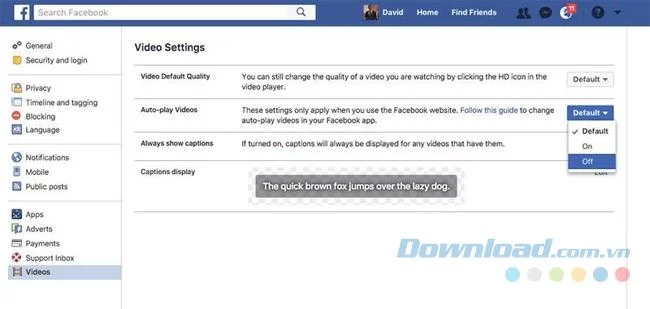
Click the down arrow at the right of the menu bar at the top of the page and click Settings from the drop down menu that appears. Select Video (option on the left) and next to Autolay Videos , change the option to Off .

Note that like the warning settings page, this only applies when you view Facebook online. To disable automatic video playback in the iOS app, touch the three dashes icon in the bottom right corner of the screen, then go to Settings> Account Settings> Video and Photos> Auto-play . You can choose On Mobile Data and Wi-Fi Connections , On Wi-Fi Connections Only or Never Autoplay Videos.
So the above article has shown you how to disable the autoplay videos of popular browsers and Facebook social networks on Mac. This will help you get rid of the hassle, especially if you just want to browse the web silently.