Would Europe Be Drawn into a Hypothetical U.S.-Israel-Iran Nuclear War? NATO Rules Explained

A guide to NATO Articles 4 and 5, UN self-defense rules, and why consultation does not mean automatic European entry into war.
Phison is introducing a series of new products at CES 2025 today that will play a key role in its future business strategy. Among them is a very special new NAND controller, as it is the world's first PCIe Gen5 SSD controller without DRAM (NVMe PCIe 5.0 DRAM-less).
For those who don’t know, most SSDs on the market today come with a dedicated DRAM chip that acts as a buffer for metadata between the controller and the NAND flash memory. The presence of this DRAM cache improves write caching and often reduces random access times. NVME SSDs without a DRAM cache typically support HMB technology, which allows the controller to access system memory via Direct Memory Access (DMA).
Until now, all NVMe Gen5 drives have included a DRAM chip for caching, but Phison's new PS5031-E31T model does away with that in an effort to make PCIe 5.0 SSDs a little more affordable.
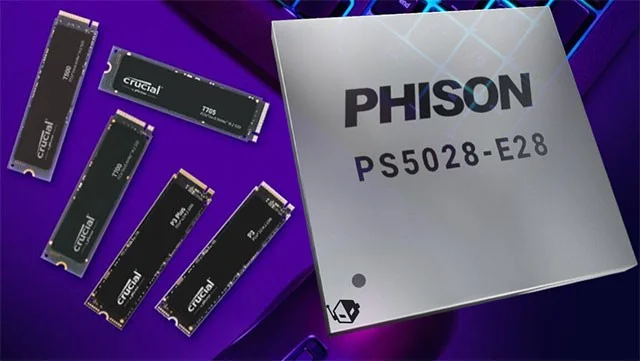
The new E31T has been integrated into Micron's Crucial P510 SSD based on G9 (9th generation) NAND flash memory. However, it is not yet clear how the actual price compares to other NVMe Gen5 drives equipped with DRAM cache.
Designed for the mainstream market, the E31T is the world's first DRAM-free PCIe Gen5 SSD controller to deliver over 10GB/s performance. This cost-effective solution delivers premium-level performance for cost-conscious consumers.
.. the Phison E31T controller will debut in the Crucial P510 SSD, a brand new consumer SSD that Micron announced at CES 2025. The Crucial P510 delivers blazing-fast Gen5 performance of up to 11,000/9,500 megabytes (MB) per second, while still supporting reduced system power consumption.
Alongside the E31T NAND controller, Phison is also launching the U21, the world’s first native USB4 SoC today. Here’s what it says:
As the world's first native USB4 SoC, the U21 delivers sequential read and write speeds of up to 4GB/s, providing a high-performance, power-efficient solution for mobile devices with compact form factors.
You can find more details on Phison's official website.
A guide to NATO Articles 4 and 5, UN self-defense rules, and why consultation does not mean automatic European entry into war.
Assess claims about Iran in six steps, distinguishing uranium enrichment, weapons development and verified possession.
Understand nuclear decision authority in six steps, including US civilian control and the limits of public information about Israel.
A guide to official 2026 evidence on Hormuz shipping disruption, Iran-related claims, confirmed incidents, and what remains uncertain.
A source-based guide to nuclear escalation risks, UN Charter rules and NATO Article 5 in a strictly hypothetical Iran scenario.
Use five steps to prepare for an outage; nuclear and EMP scenarios are hypothetical, and official shelter instructions come first.
Use 5 defensive steps to verify a cyber disruption, protect household accounts, and avoid mistaking an outage for war.
Use these 5 steps to assess climate effects from a hypothetical Iran strike, compare model assumptions, and avoid unsupported predictions.
Explore six steps for reading research on climate, food and ecosystem recovery after a hypothetical nuclear conflict.
Build a practical fallout preparedness kit in six steps, with sealed food and water, a radio, medical supplies and shelter guidance.