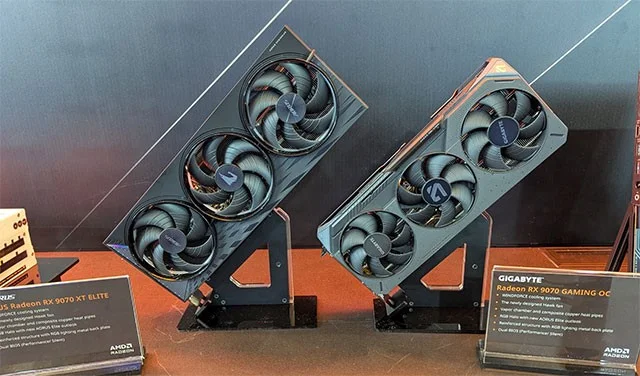
RX 9070 XT performance gradually revealed, is it enough to make Nvidia fear?

At CES 2025 this year, AMD refrained from revealing details about its long-awaited new flagship Radeon RX 9070 XT GPU, which is based on the RDNA 4 architecture. The Red team is changing the naming scheme for its Radeon GPUs (again), with the flagship now being the new Radeon RX 90_0 instead of the previous RX 7_00. However, there are no concrete details on pricing and performance, so we'll have to rely on leaks to judge the situation.

IGN sneakily tested the RX 9070 (not the XT) at CES with Call of Duty: Black Ops 6, and it seems to perform really well compared to the RX 7900 XTX, 7800 XT, and 6950 XT we’ve seen before. The test was performed at the 4K preset without any upscaling/sharpening or framerates. The RX 9070 averaged 99 FPS with a 5% low of 76 FPS and a 1% low of 60 FPS. The benchmark also confirms that the Radeon 9070 has 16GB of VRAM. For comparison, a Reddit user named RevolutionaryCarry57 tested the RX 6950 XT (the RDNA 2 flagship) with identical settings and achieved 80, 62, and 59 FPS respectively.

Following that, the 9070 XT's 3DMark DirectX 12 and Ray Tracing benchmark results were also allegedly leaked and once again, the RDNA 4 architecture seems to be delivering very respectable performance.
RX 9070 XT performance gradually revealed, is it enough to make Nvidia 'fear'?

In an interview with PCWorld, AMD’s Chief Gaming Solutions Architect Frank Azor stated that the Radeon team plans to reveal more details about its new cards in just a few weeks. So it seems likely that AMD will hold a separate launch event for RDNA 4, and also added that it wants to see what Nvidia is doing with the new RTX 5000 series GPUs.

Once again, Frank Azor reiterated that AMD's strategy this time around is to build a mid-range product with RDNA 4 and that this will not be a "$1,000 graphics card." AMD would be foolish enough to price it that high, with the RTX 5070 and 5070 Ti starting at $549 and $749, respectively.

Azor also revealed some details about how the Radeon team achieved this level of performance. Most of the development effort in RDNA 4 is around increasing AI compute throughput. Ray tracing will also see some major improvements. This is something to expect from an AMD card when Nvidia and even Intel are doing so well.

AMD explains that AI is a key component with its upcoming ML-based FSR 4 upscaler that will compete directly with Nvidia DLSS and Intel XeSS.

Finally, AMD has pledged that this time around they are taking the criticism and feedback from their previous generation products (the RX 7000 series) seriously and are trying to get the price/performance right for their 9000 series GPUs. If you recall, while the 7900 XTX was praised by reviewers, its cut-down sibling, the 7900 XT, didn't impress as much because it was priced too close to the XTX.

As AMD has stated, if the 9070 XT and 9070 are priced appropriately for their performance and value, then we could finally see a real "Nvidia challenger" from the Radeon brand, not in terms of raw performance but from the core value.

Leave a Comment

Side Hustles That Actually Pay in 2026: 7 Realistic Options and the Tradeoffs to Know

Side Hustles That Actually Pay in 2026: 7 Realistic Options and the Tradeoffs to Know

Compare realistic side hustles for 2026 by startup cost, fees, flexibility, and income control, with current tax and scam guidance from official sources.

Remote Work Ergonomics in 2026: Upgrade Your Home Office Without Overbuying

Remote Work Ergonomics in 2026: Upgrade Your Home Office Without Overbuying

Upgrade your home office ergonomics with current OSHA and NIOSH guidance on chair fit, monitor height, laptop setup, lighting, and movement.

Why Emotional Intelligence Matters in Leadership—and How to Build It

Why Emotional Intelligence Matters in Leadership—and How to Build It

Learn why emotional intelligence matters in leadership, where it helps most, how to strengthen it, and how to tell whether your approach is working.

How to Transition to a Tech Career Without a Degree: A Results-First Roadmap for 2026

How to Transition to a Tech Career Without a Degree: A Results-First Roadmap for 2026

A practical roadmap for moving into tech without a degree: choose an accessible role, build job-ready skills, prove them with projects, and use hiring feedback to improve.

Building a Personal Brand on LinkedIn in 2026: What Still Works, What Changed, and What to Ignore

Building a Personal Brand on LinkedIn in 2026: What Still Works, What Changed, and What to Ignore

Build a credible LinkedIn personal brand in 2026 with current profile, content, newsletter, analytics, verification, and visibility guidance from LinkedIn.

Quiet Quitting vs. Quiet Firing in 2026: What’s Really Changing at Work

Quiet Quitting vs. Quiet Firing in 2026: What’s Really Changing at Work

Quiet quitting and quiet firing are catchy labels, not diagnoses. Learn what is verified, what depends on context, and what employees and managers can do next.

The Rise of the Fractional Executive: When Part-Time C-Suite Leadership Makes Sense

The Rise of the Fractional Executive: When Part-Time C-Suite Leadership Makes Sense

Fractional executives offer senior leadership without a full-time hire. Learn when the model works, what to ask, and the risks to manage.

How to Negotiate a Raise During Q4 Performance Reviews: A Practical 2026 Decision Guide

How to Negotiate a Raise During Q4 Performance Reviews: A Practical 2026 Decision Guide

Prepare a stronger Q4 raise request with current wage data, timing options, compensation tradeoffs, and scripts for yes, partial, or no outcomes.

6 High-Income Skills You Can Start Learning Before 2026 Ends

6 High-Income Skills You Can Start Learning Before 2026 Ends

Choose a high-income skill you can realistically start before 2026 ends, with current pay data, learning priorities, and a practical self-check.

Mastering the Hybrid Work Schedule: A Practical Framework That Actually Holds Up

Mastering the Hybrid Work Schedule: A Practical Framework That Actually Holds Up

Build a hybrid work schedule around tasks, team overlap, and measurable outcomes. See sample patterns, warning signs, and when to adjust your plan.