Would Europe Be Drawn into a Hypothetical U.S.-Israel-Iran Nuclear War? NATO Rules Explained

A guide to NATO Articles 4 and 5, UN self-defense rules, and why consultation does not mean automatic European entry into war.
The A18 Pro will serve as the successor to the A17 Pro, and is expected to power the iPhone 16 Pro and iPhone 16 Pro Max, which are expected to launch later this year. Recent rumors suggest that the SoC will still feature a six-core GPU, with the core configuration remaining unchanged from previous A-series chipsets. That means we probably won't see a noticeable difference between the two generations of Apple silicon, at least structurally.
Similar to the A17 Pro, both the A18 and A18 Pro are rumored to feature a six-core CPU. Blogger @Negativeonehero has said that the two SoCs are expected to feature two high-performance cores and four efficiency (power-saving) cores. This could be a response to YouTuber Vadim Yuryev's earlier prediction regarding the core count of the A18 and A18 Pro. Yuryev suggested that the A18 Pro will feature a '2+6' configuration. Additionally, the fact that the SoC only has a six-core CPU is also disappointing as it could sacrifice multi-threading performance.

Even with the six-core configuration, however, the single-core and multi-core performance improvements of the A18 and A18 Pro will still be impressive. Although both are manufactured on TSMC's 3nm process, the A18 Pro uses TSMC's second-generation 3nm process called N3E, while the A17 Pro is manufactured on the first-generation 3nm process called N3B.
The A18 Pro's Geekbench 6 benchmark results show up to 22% faster single-core performance and 28% faster multi-core performance than the A17 Pro. In terms of single-core performance, the A18 Pro is completely unrivaled and is actually competing with Apple's own M3 chipset series.
Additionally, with the A18 and A18 Pro, Apple could use a larger die size, which would increase cache and the Neural Engine, allowing for more transistors and dedicated AI components. This could mean the A18 Pro is also an AI-focused chip. However, experts are concerned that this could also lead to performance and heat dissipation issues.
In parallel, the upcoming iOS 18 will be optimized by Apple to run better with the A18 Pro. Some rumors also say that Apple is pushing the production of the A18 Pro chip earlier than every year.
A guide to NATO Articles 4 and 5, UN self-defense rules, and why consultation does not mean automatic European entry into war.
Assess claims about Iran in six steps, distinguishing uranium enrichment, weapons development and verified possession.
Understand nuclear decision authority in six steps, including US civilian control and the limits of public information about Israel.
A guide to official 2026 evidence on Hormuz shipping disruption, Iran-related claims, confirmed incidents, and what remains uncertain.
A source-based guide to nuclear escalation risks, UN Charter rules and NATO Article 5 in a strictly hypothetical Iran scenario.
Use five steps to prepare for an outage; nuclear and EMP scenarios are hypothetical, and official shelter instructions come first.
Use 5 defensive steps to verify a cyber disruption, protect household accounts, and avoid mistaking an outage for war.
Use these 5 steps to assess climate effects from a hypothetical Iran strike, compare model assumptions, and avoid unsupported predictions.
Explore six steps for reading research on climate, food and ecosystem recovery after a hypothetical nuclear conflict.
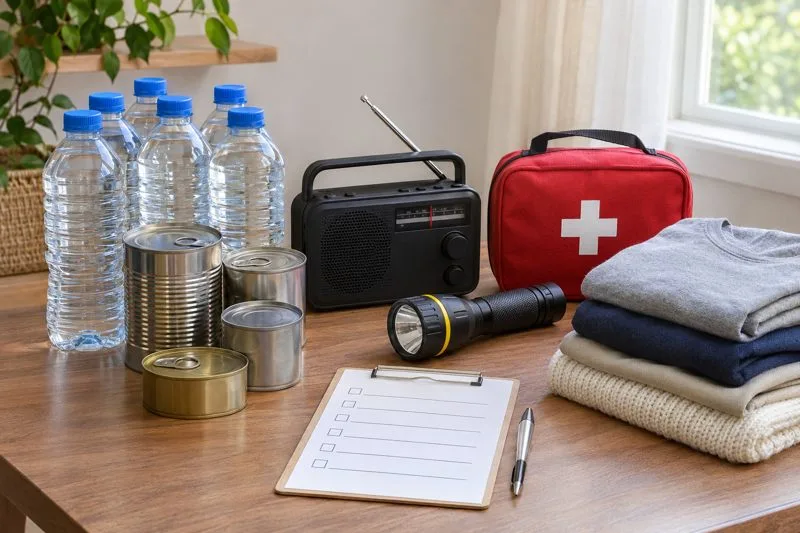
Build a practical fallout preparedness kit in six steps, with sealed food and water, a radio, medical supplies and shelter guidance.