Would Europe Be Drawn into a Hypothetical U.S.-Israel-Iran Nuclear War? NATO Rules Explained

A guide to NATO Articles 4 and 5, UN self-defense rules, and why consultation does not mean automatic European entry into war.
The Hubble Space Telescope has continued to demonstrate its irreplaceable importance in the field of astronomical research, bringing back to humanity a unique photo showing the rare beauty of the Tarantula Nebula.
The universe is constantly evolving, revealing new and wonderful things that we have yet to see. This stunning image from the Hubble Space Telescope shows a bustling star-forming region called the Tarantula Nebula. Named for its intricate, web-like internal structure, the nebula is located in a satellite galaxy of the Milky Way called the Large Magellanic Cloud, and is often considered by astronomers to be a prime study of how stars form and evolve.
This new image shows the edges of the nebula, farther away from the central region. In the center of the nebula are giant stars with masses 200 times that of the Sun, but in these “outskirts,” the scene is a bit quieter.
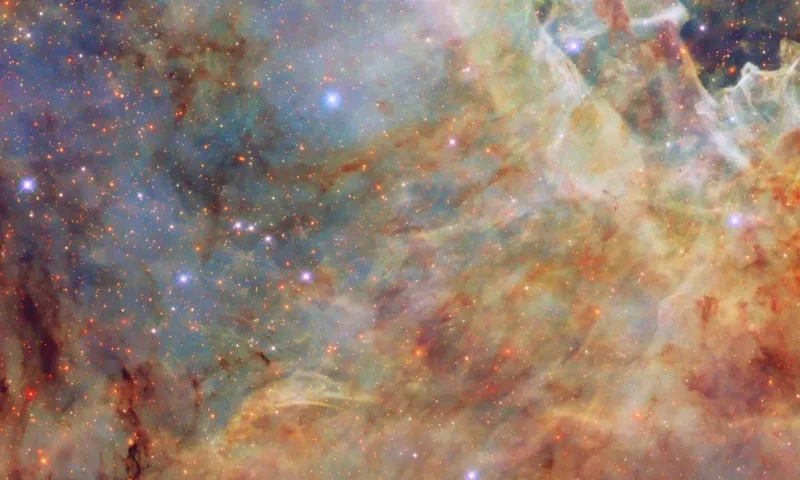
“The nebula shown here has blue gas, patches of orange-brown dust, and scattered multicolored stars. Stars inside and behind the dust clouds appear redder than those not obscured by dust. Dust absorbs and scatters blue light more than red light, allowing more red light to reach the Hubble telescope’s sensor, making the stars appear redder than they actually are. This image combines ultraviolet and infrared light as well as visible light.
By analyzing Hubble observations of dust nebulae in the Large Magellanic Cloud and many other galaxies, researchers can study these distant dust grains, helping to better understand the role of cosmic dust in the formation of new stars and planets.
When stars are young, they emit large amounts of radiation and shine brightly, even more so than older stars, such as our sun. Star formation occurs when there is enough dense dust and gas in one area to form clumps, which attract more material over time due to gravity, eventually forming knots that become the cores of young stars, called protostars.
While there is some debate about the exact rate of star formation in the Milky Way, it is generally known that our galaxy produces far more stars than its neighbor, the Andromeda Galaxy. However, the Large Magellanic Cloud, a much smaller galaxy, has a high star formation rate and is also located nearby, making it an ideal “laboratory” for studying star formation. Advanced space telescopes such as the Hubble and James Webb telescopes are revealing new information about how stars form in this busy neighbor galaxy.
A guide to NATO Articles 4 and 5, UN self-defense rules, and why consultation does not mean automatic European entry into war.
Assess claims about Iran in six steps, distinguishing uranium enrichment, weapons development and verified possession.
Understand nuclear decision authority in six steps, including US civilian control and the limits of public information about Israel.
A guide to official 2026 evidence on Hormuz shipping disruption, Iran-related claims, confirmed incidents, and what remains uncertain.
A source-based guide to nuclear escalation risks, UN Charter rules and NATO Article 5 in a strictly hypothetical Iran scenario.
Use five steps to prepare for an outage; nuclear and EMP scenarios are hypothetical, and official shelter instructions come first.
Use 5 defensive steps to verify a cyber disruption, protect household accounts, and avoid mistaking an outage for war.
Use these 5 steps to assess climate effects from a hypothetical Iran strike, compare model assumptions, and avoid unsupported predictions.
Explore six steps for reading research on climate, food and ecosystem recovery after a hypothetical nuclear conflict.
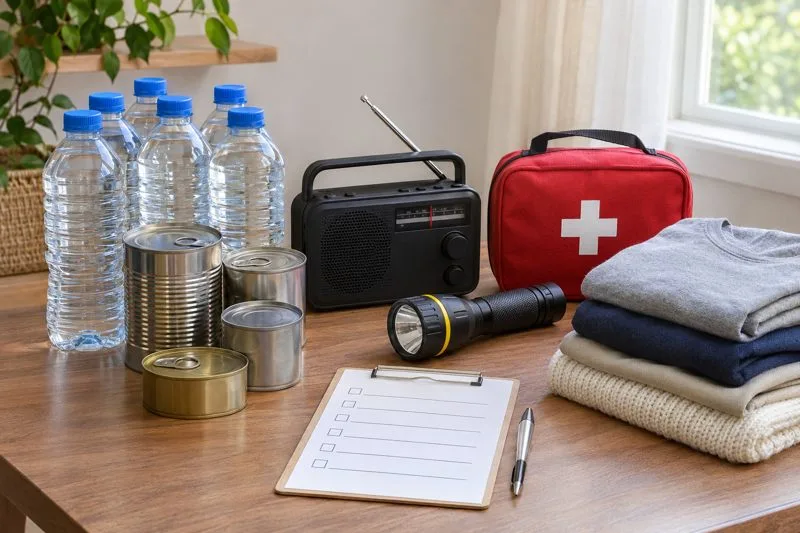
Build a practical fallout preparedness kit in six steps, with sealed food and water, a radio, medical supplies and shelter guidance.