Home
» Wiki
»
Admire the beautiful star cluster through 80 million pixel photo
Admire the beautiful star cluster through 80 million pixel photo
A stunning image of the RCW 38 star cluster was captured by the Visible and Infrared Survey Telescope for Astronomy (VISTA) in Chile, revealing stunning detail of the object, which is located 5,500 light-years away. Located in the constellation Vela, the cluster is filled with dust and gas, creating a fertile environment for the formation of new stars.
This cluster contains about 2,000 stars, most of which are much younger than our Sun and therefore more energetic. Many of the colorful dots in the image are created by hot, young stars that emit large amounts of radiation, causing the dust around them to glow brightly.
You can view the full-size version of the photo HERE . Zoom in as far as you can and admire the incredible details captured in this incredibly valuable photo.
“The image was taken with the European Southern Observatory’s (ESO) Visible and Infrared Survey Telescope for Astronomy (VISTA), located in the Atacama Desert, Chile. It shows a mix of gas, dust and stars, creating a scene that is both majestic and breathtaking. Because VISTA observes in infrared light, it can see through much of the dust in this region, which would otherwise obscure our view with visible light. Behind the dust, VISTA reveals young stars in dusty cocoons and cold ‘failed’ stars called brown dwarfs, revealing the secrets of these young stellar nurseries.”
In addition to the infrared image, ESO also shared an image of the same cluster, but taken in visible light, which corresponds to the part of the spectrum that the human eye can see. Because dust is opaque in visible light, and there is a lot of it in this cluster, most of the details of its structure are obscured.
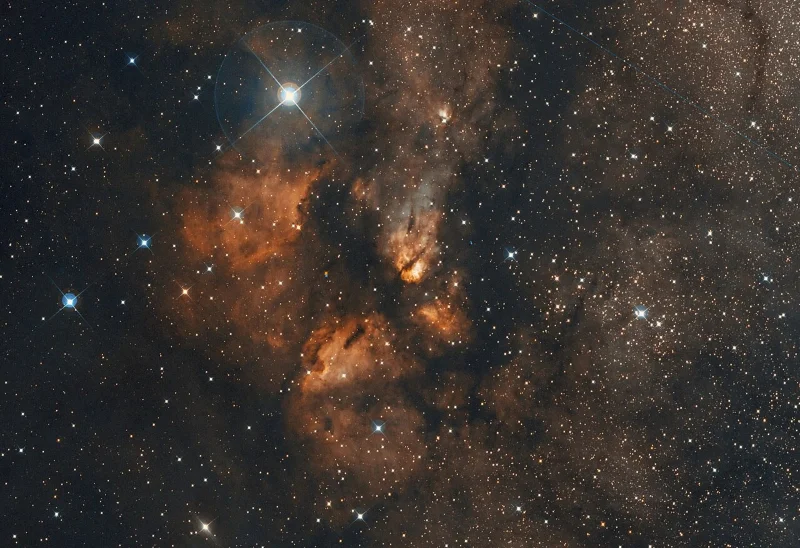
This image shows the star cluster RCW 38 in visible light. Dust absorbs most of the light at these wavelengths, obscuring large areas of the cluster.
The infrared image was taken as part of a survey by the VISTA telescope, which recently produced the most detailed infrared map of the Milky Way ever, revealing the wonders of our galaxy visible in the infrared. Modern space telescopes such as the James Webb Space Telescope are also equipped with infrared instruments, allowing us to peer through dust clouds and track hard-to-see asteroids.