Home
» Wiki
»
How to save Adobe Illustrator files in formats other than AI
How to save Adobe Illustrator files in formats other than AI
Video How to save Adobe Illustrator files in formats other than AI
By default, Adobe Illustrator saves files in AI format. This is the ideal format when you are working on a project or saving a copy of your main job. But if you have to print, share, post online or import your finished product to other programs, you'll need to save it in popular formats like jpeg, png, svg ...
Adobe Illustrator gives you lots of file format options. The best choice depends on how you want to use the resulting image. Join us to find out the best image formats and how to use them offline.
Before you learn how to save files in a specific format, it's important to know how Adobe Illustrator handles artboards and how to save them as separate files.
Artboard is like different pages in an Adobe Illustrator file. You can easily combine them into a single image, but you can also save them individually.
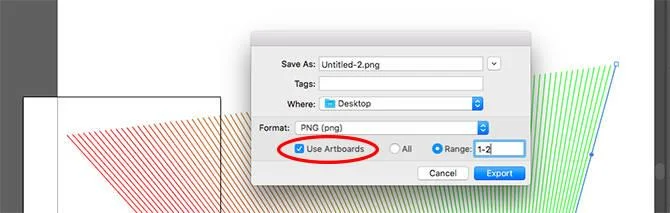
Most ways to save Adobe Illustrator files allow users to choose an artboard processing method. This affects the final output. In most cases, you need to select the action in the Export screen .
If you want to save multiple artboards as a separate file, check Use Artboards . Then select All to save the entire artboard or enter Range (like 2-4) to specify the artboard to be saved.
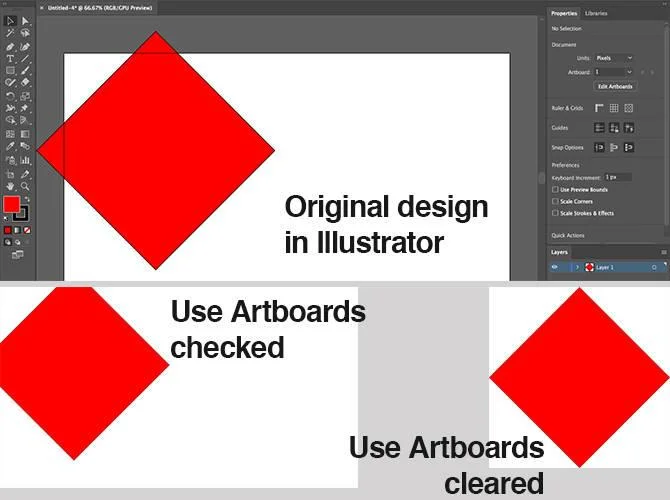
When you place objects outside the artboard (such as overlapping edges), check Use Artboards . This ensures that the final image will only contain the content inside the artboard, and the rest will be cut off.
If all the artworks are on the artboard and you only have one of them, uncheck Use Artboards . In this case, the image will be cut to the outer edge of the object in the image, all white space will be removed. This feature is especially useful when exporting square or rectangular objects.
Save high-resolution jpeg images in Adobe Illustrator
For illustration, infographic, or anything else that you need to print, such as a business card, it's best to export the file as a high-resolution jpeg file.
Ideally, you should design the work to the most realistic size. Although it's easy to resize an AI file without losing quality, you'll find that the size between objects, especially the content in the text - needs to be tighter at large sizes.
If you haven't done it this way, create a new document, paste it in the image, and then tweak it as you like. Now the image is ready to be saved in high resolution jpeg.
Go to File> Export> Export As . Type a file name and put JPEG in Format .
Choose how you want to save the artboard, then click Export to continue.
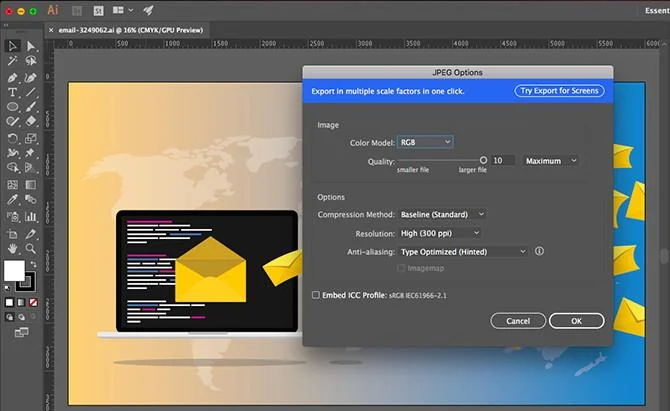
In the JPEG Options screen , change the Color Model as needed and select the desired quality.
In Options , select the output resolution, Screen (72dpi) will export the file the same size as the original and use the web well. High image resolution (300dpi) suitable for printing.
Click OK to save the file.
Save the Adobe Illustrator file in PNG format
When you need to save images as logos or icons for use on the web, especially if you have a transparent background image, you probably want to save it as a PNG file.
To meet standard and high resolution screens, export files in different sizes. You can do this automatically.
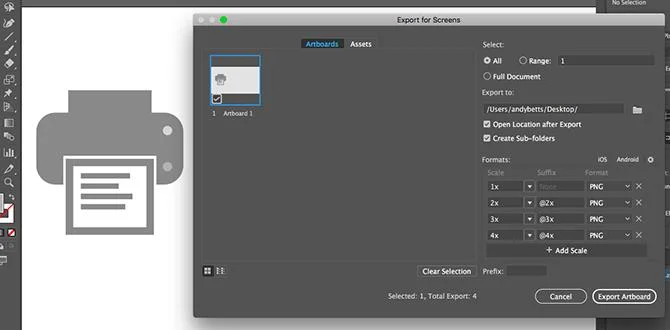
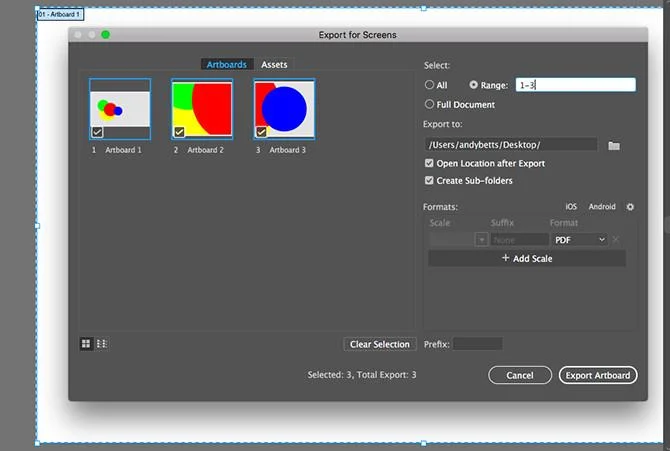
Go to File> Export> Export for Screens .
Select the Artboards tab . If there is more than one artboard in the image, select the image you want to export.
In Formats, set Format is PNG and Scale is 1x .
Click Add Scale . This will create a setting for the second image, so set the Scale option to a new proportioned size. For example, 3x will export images 3 times higher and wider than the original image.
Add more dimensions as needed.
Click Export Artboard to save the image.
Save Adobe Illustrator file in SVG format
The best and most modern way to export icons, web logos is to use SVG (Scalable Vector Graphics) format. SVG is actually an XML markup language. While you can export the file to a web page, you can also save the image as a code snippet paste directly into the HTML file. You can then edit it with CSS. It is an effective way to add effects and motion to an image.
Saving AI files to SVG also has many other benefits: low size images, easy resizing because they are vector. You do not need to export multiple images in size to meet the different resolution screens as time consuming anymore.
There are several ways to create SVG. Use Save As to create a larger file to work with. To create the final image used in the project, use the Export option .
Go to File> Export> Export As.
Set SVG in Format , then click Export .
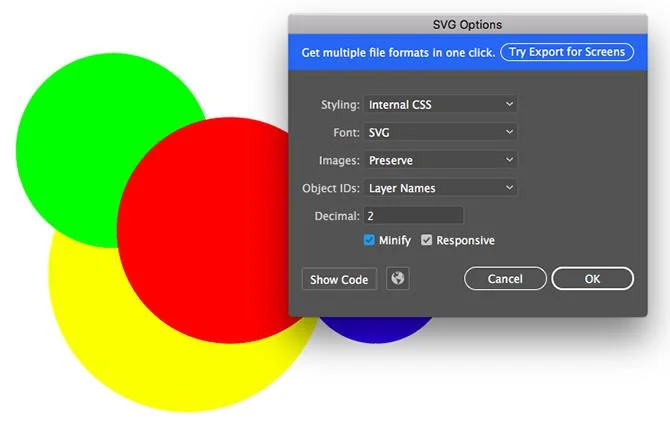
Select Internal CSS in Styling . This will put all the style information in the <style> block, which you can easily change with CSS.
For Font , select SVG to select the text. Only select Outlines if using custom matte font. Select Preserve for Images .
Make sure that Minify and Responsive is checked for maximum performance and compatibility.
Now click Show Code to open the code in the text editor. You can copy and paste it into an HTML file or click OK to export the image as an SVG file .
Save the Artboard as a PDF file in Adobe Illustrator
The simplest way to save Adobe Illustrator files to PDF is via the Save As option . However, if you are using more than one artboard, it will combine them into a multi-page PDF.
Here is a simple trick to save the artboard into a separate PDF file:
Go to Export> Save for Screens .
In the dialog box that opens, click the Artboards tab and select what you want to save.
In the right-hand column, place the PDF in the Format box , and then click Export Artboards . It takes a few seconds to export a large or complex image file.
When done, by default, your file will be saved to its own sub-directory.
Save objects from Adobe Illustrator images
Sometimes, you need to save or export only selected objects from a large work. For example, if you designed your logo, you might want to save its text or icon as a separate file.
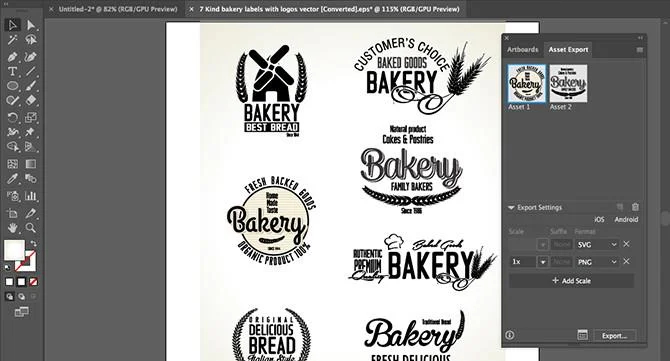
You can do this by turning objects into Assets .
Go to Window> Asset Export .
Select the Selection Tool from the Toolbar, or press V on the keyboard. Now drag the object you want to save to the Asset Export panel .
Now choose Asset . Press Ctrl or Cmd to select more than one.
In Export Settings , click Format . You can choose PNG, JPEG, SVG or PDF.
If you save in PNG or JPEG format, you can export in different sizes. Set 1x for Scale, then click Add Scale and set the Scale (example: 2x). You can also use this option to export "assets" in various formats.
Click Export and choose a location to save the new file.
How to use Adobe Illustrator files in other applications
There are actually many ways you can use Adobe Illustrator files in other programs. For example, Photoshop can open an AI file directly, but only as a flat image and cannot be edited. Use Export As instead of saving the file in PSD format, to retain the entire layer when opening it in Photoshop.
You can use AI files in Adobe applications and products like InDesign. Although not editable here, the image retains all the elements as transparent background ...