Home
» Today
»
Can Electric Vehicles Cut Driving Costs During Inflation? A Practical Cost Comparison
Can Electric Vehicles Cut Driving Costs During Inflation? A Practical Cost Comparison
Electric vehicles can reduce the cost of driving during high inflation, particularly for households that can charge at home and drive enough miles to benefit from lower energy and routine-maintenance costs. But lower cost per mile does not automatically mean a lower monthly bill. The purchase price, loan interest, insurance, depreciation, charging access, and how long you plan to keep the vehicle can outweigh fuel savings.
For U.S. shoppers in October 2026, there is another important change: federal clean-vehicle purchase tax credits generally are not available for vehicles acquired after September 30, 2025, according to IRS clean vehicle tax-credit guidance. State, utility, or local programs may still exist, but buyers should verify them individually rather than assuming a federal discount.
How much cheaper is it to drive an EV instead of a gasoline car?
Compare the energy cost of traveling the same distance, not the price of a full tank against the price of a full charge. An electric vehicle's energy consumption is expressed as kilowatt-hours (kWh) per 100 miles. A gasoline car's efficiency is usually expressed in miles per gallon (mpg).
The formulas are straightforward: EV electricity cost per 100 miles = kWh per 100 miles × electricity price per kWh; gasoline cost per 100 miles = 100 ÷ mpg × gasoline price per gallon. For charging at home, consider charging losses: electricity drawn from the wall can exceed the energy delivered to the battery.
Illustrative comparison: same annual mileage, different prices
Consider two hypothetical vehicles driven 12,000 miles annually. Assume the EV consumes 30 kWh per 100 miles as measured at the wall, while the gasoline car averages 30 mpg. These are illustrative assumptions, not measured outcomes for specific models. Assume gasoline costs $3.50 per gallon and home electricity costs $0.17 per kWh.
Annual energy cost
Gasoline car
EV charged at home
EV using public charging
Assumed energy price
$3.50/gallon
$0.17/kWh
$0.45/kWh
Energy needed for 12,000 miles
400 gallons
3,600 kWh
3,600 kWh
Annual energy spending
$1,400
$612
$1,620
Difference versus gasoline
Baseline
$788 less
$220 more
The public-charging price is a hypothetical blended rate, not a national average. It demonstrates why an EV that saves money at home might not save money when fast charging is the main option. Actual rates, charger idle fees, gasoline prices, efficiency, weather, driving style, and fees can change the result. The DOE home-charging guidance explains electricity-based cost calculations; the DOE public-charging guidance explains public charging arrangements.
Why can EV running costs be less sensitive to gasoline inflation?
Battery-electric vehicles do not buy gasoline for daily driving. This removes direct exposure to spikes at the pump, although electricity rates can increase too, and both fuels are affected by broader energy markets. Some utilities offer time-of-use plans with lower prices at specified hours, making it easier to schedule home charging. Always check the full household bill: a time-of-use plan may charge more for electricity consumed during peak periods.
Electric vehicles also eliminate several conventional engine-related maintenance tasks such as engine-oil changes and exhaust-system repairs. DOE's DOE Alternative Fuels Data Center consumer guide reports illustrative average maintenance costs of roughly 6.1 cents per mile for all-electric cars versus 10.1 cents per mile for gasoline cars, based on its cited analysis. These figures are not a promise for any model, and tires, brakes, cabin filters, cooling systems, suspension, and unexpected repairs still cost money.
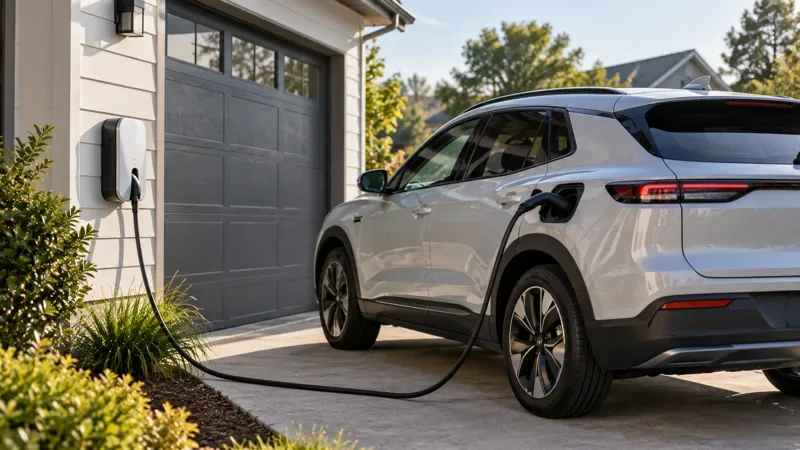
A silver electric crossover charging beside a home garage illustrates the overnight-charging access that can make electric driving less expensive.
Which costs can erase the savings?
Vehicle price, financing, and depreciation
A $5,000 higher purchase price is not canceled out by saving $60 per month on fuel. At that rate, it would take more than six years just to offset the price gap, before financing, charging installation, insurance, depreciation, and differences in maintenance. Calculate the total cost of ownership—all costs of buying, operating, and eventually selling the vehicle—rather than just the energy bill.
Inflation may put pressure on household budgets while borrowing costs make new financing expensive. Compare the actual annual percentage rate (APR), loan term, total interest, down payment, and out-the-door purchase price. A smaller payment from a longer loan does not mean a lower total cost. Depreciation and resale prices vary by model, battery condition, competition, and changing vehicle prices, so use local used-vehicle offers rather than assuming EVs universally depreciate faster or slower.
Home charging installation
Level 1 charging uses an appropriate standard 120-volt outlet and may work for short daily commutes. Level 2 charging generally uses 240-volt equipment and is faster, but may require a dedicated circuit, electrician, permits, or electrical-panel changes. The DOE home-charging guidance outlines practical safety considerations; the DOE charging equipment and installation guidance shows why equipment and installation expenses vary. Get an electrician's quote before deciding a specific EV fits the budget.
Insurance, tires, repairs, and batteries
Obtain insurance quotes for the exact vehicle identification or trim before buying. Repair costs can vary based on parts, technician availability, sensors, and collision severity. Some EVs have high-performance tires or additional vehicle weight that can affect tire spending. Batteries generally have manufacturer warranties with time and mileage limits, but eventual out-of-warranty repair costs depend on the model and failure. For a used EV, inspect battery-health information, remaining warranty, recall status, charging operation, and service history.
Should you buy a new EV, used EV, hybrid, or keep your current car?
Option
Potential financial advantage
Main trade-off
Reasonable fit
New battery EV
Lower home-charging and routine service spending
Higher acquisition cost on some comparable models and uncertainty about resale
High-mileage drivers with affordable charging and sufficient budget
Used battery EV
Can reduce upfront price and ongoing energy expense
Battery condition, warranty, insurance, and charging compatibility require inspection
Value-focused shoppers who can research a specific car
Regular hybrid
Improved fuel efficiency without plugging in
Still pays for gasoline and engine-related service
Apartment residents or drivers without dependable charging
Keep current efficient car
Avoids new purchase, sales tax, and financing costs
Higher fuel use or repair needs may continue
Low-mileage households with a reliable paid-off vehicle
Plug-in hybrids are another middle ground: they can cover some trips electrically but need regular charging to realize those savings. If a plug-in hybrid is rarely charged, much of the economic rationale disappears. Treat the choice as a comparison between actual vehicles, not powertrain labels.
How does charging access change the decision?
Homeowners with reliable overnight parking: A cost-efficient EV can make sense, especially if they commute frequently and can use a favorable utility plan. Estimate charging equipment and labor first. A basic outlet may be enough for some mileage patterns, but an electrician should assess suitability.
Apartment renters: Compare the availability and real price of parking-lot or workplace chargers before selecting an EV. Network coverage alone is not enough; check whether chargers are accessible during your hours, their connector type, parking fees, and how consistently they work. If most sessions will be expensive DC fast charging, a hybrid may be a less financially risky choice.
Frequent highway travelers: Use the vehicle's realistic highway range, charging curve, battery-preconditioning behavior, and routes to estimate both costs and time. Fast charging can cost substantially more than residential electricity and sometimes makes energy cost parity with gasoline possible.
Low-mileage drivers: Energy savings accrue slowly. Keeping an existing reliable car may save more money than taking on a new loan solely to reduce gasoline spending.
What should you calculate before signing?
Annual miles: Use your odometer records or commute distances, including weekend travel.
Comparable vehicles: Compare similarly sized and equipped cars, including a used option.
Actual energy rates: Use recent gas receipts, a home electricity bill, and public charging app prices in the areas you travel.
Charging mix: Estimate what share of charging is home, workplace, Level 2 public, or DC fast charging.
Upfront costs: Add out-the-door price, taxes, charger, installation, down payment, and interest.
Ownership period: Estimate likely resale value and calculate costs over three, five, and eight years instead of relying on a single optimistic scenario.
A useful break-even test is: extra upfront cost ÷ annual net operating savings = years required to recover the difference. This simplified result omits financing and resale-value differences, so the full ownership comparison is still necessary. If operating savings are zero or negative, there is no energy-driven break-even under those assumptions.
What if gasoline or electricity prices rise again?
Stress-test the budget instead of predicting inflation. Recalculate using gasoline at $3, $4, and $5 per gallon and electricity at $0.15, $0.25, and $0.45 per kWh. Be sure the assumed rates reflect your location and charging mix. If an EV works financially only when gasoline is unusually expensive, the case is fragile. If it works even under less favorable fuel-price assumptions, the decision is more resilient.
Also avoid treating outdated incentives as guaranteed discounts. As of October 2026, the IRS states that the federal new, previously owned, and qualified commercial clean-vehicle credits do not apply to vehicles acquired after September 30, 2025. The separate federal charging-property credit has its own eligibility and expiration provisions. See IRS clean vehicle tax-credit guidance and confirm any active state or utility incentive directly with the responsible agency before counting it.
The bottom line: choose the lowest total cost, not just the cheapest fuel
An EV is especially compelling when home charging is inexpensive, annual mileage is substantial, the vehicle is competitively priced, and the owner plans to keep it long enough to benefit from operating savings. A used EV may improve the economics if its condition and warranty check out. A conventional hybrid may be the more practical inflation hedge when charging access is poor. And keeping a reliable, paid-off car can be financially sensible for people who drive little.
Compare the same driving needs under realistic assumptions and get live local quotes. The right answer is the option that lowers your total transportation cost without compromising charging access, reliability, or household cash flow.