Citroën 2CV Electric Car: What We Know About the New EV
Citroën’s 2 CV Concept previews an affordable electric car due by 2028. See the confirmed price target, size, design, and unanswered specs.
There is finally something concrete behind the Citroën 2CV electric-car rumors. On October 11, 2026, Citroën unveiled the 2 CV Concept at the Paris Motor Show and said it previews a production model expected to join the brand’s range by 2028. This is no longer just a retro-themed design exercise: Citroën is positioning it as a compact, affordable battery-electric car built in Europe.
The important caveat is in the name. The vehicle shown is a concept, and Citroën has not published final production specifications. That means there are still no official figures for battery capacity, driving range, motor output, charging time, trim levels, or country-by-country availability. For shoppers, the 2CV story is promising—but it is still an early one.
Citroën first confirmed in May 2026 that it would add a new model inspired by the spirit of the original 2CV. Its October reveal gives that plan a physical form. The company describes the 2 CV Concept as electric, minimalist, compact, and engineered around accessibility rather than a literal recreation of the old car. The intended production version is slated for the Citroën lineup by 2028.
That distinction matters. This is not an announcement that a 1948 2CV has been fitted with a battery and put back on sale. Citroën says the project is meant to reinterpret the qualities that made the original useful: simplicity, affordability, lightness, practicality, versatility, and a distinctive personality. The brand’s official May 2026 announcement framed the future model as an accessible small EV rather than a nostalgia product.
| Item | What is official so far |
|---|---|
| Status | 2 CV Concept; it previews a future production vehicle. |
| Timing | Citroën says the production model is due to join its range by 2028. |
| Powertrain direction | Battery-electric. |
| Positioning | A small, affordable EV positioned between the Ami and C3 in Citroën’s lineup. |
| Length | 3.76 meters (about 12.3 feet) for the concept. |
| Price target | About €15,000 as a target starting price, not a final market price. |
| Manufacturing | Citroën says the future model will be made in Europe. |
| Mass target | The concept aims for one metric ton. |
Those points come from Citroën’s detailed October 11, 2026 2 CV Concept release. The approximately €15,000 figure should be read carefully: it is a stated target for the eventual European car, not a confirmed price in dollars or pounds, and it does not establish prices in any particular country.
Citroën’s most revealing technical statement is its effort to control mass at roughly one metric ton. In an EV, a lighter body can allow a smaller, less costly battery for a given everyday-use target. Citroën explicitly links the weight goal to a more cost-effective battery, lower running costs, and a range designed around daily travel.
That does not tell us the car’s actual range. It does, however, explain the program’s philosophy. The 2 CV Concept is intended to push against the trend toward larger, heavier, more complicated electric vehicles. Citroën also points to flat body panels, air intakes beneath the windshield, and separately replaceable bumpers as examples of design choices that could support manufacturing and repair.
For a buyer, that could be more meaningful than a novelty badge. A genuinely light, modest-sized EV may be easier to park, potentially less expensive to insure and repair, and less demanding in urban use. Whether those benefits survive the transition from concept to production will depend on the final battery, safety equipment, and regional specification.
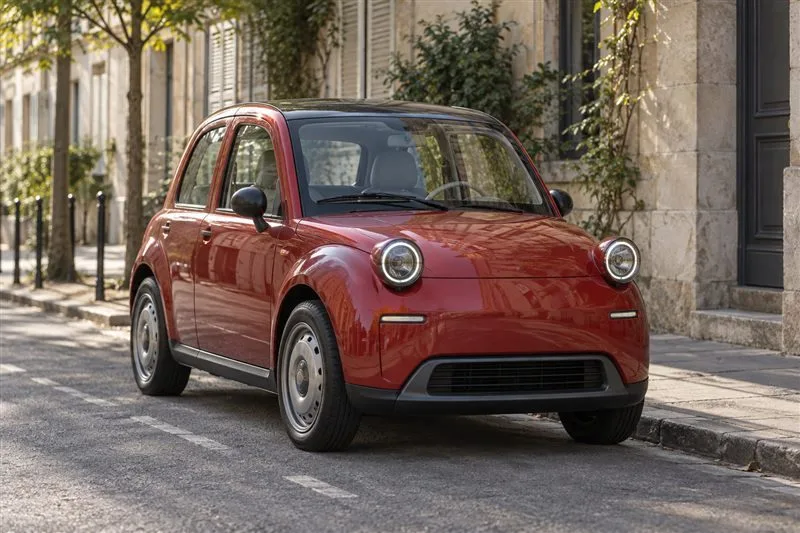
The concept is clearly related to the historic 2CV without trying to be a duplicate. Citroën has used a rounded roof, upright sides, separated round headlamps, exposed windshield wipers, and a curved overall silhouette. At 3.76 meters long, it is deliberately compact; Citroën says it is even shorter than the original 2CV.
The cabin is more experimental. Citroën describes wide seats using its Advanced Comfort approach, a fabric sunroof, strap-style door pulls, a removable storage basket in place of a conventional center console, and an 8-inch square touchscreen. It also features a detachable “Radioën” audio unit that can double as a portable speaker. These details show the concept’s intent, but buyers should not assume every one will reach showrooms unchanged.
The missing specification sheet is substantial. Citroën has not confirmed the battery’s usable capacity, official WLTP or EPA range, motor power, torque, acceleration, top speed, charging connector, AC charging rate, DC fast-charging capability, seating capacity, cargo volume, warranty, or safety rating. It also has not named production trims, reservation timing, or exact launch markets.
Citroën says the future vehicle is designed to meet future E-Car regulations, but it has not published the homologation details or explained how those rules will affect final equipment. Likewise, the “by 2028” wording gives a destination rather than a precise order-book or delivery date.
For readers in the United States, there is an additional limitation: Citroën’s announcement does not promise U.S. sales. The company’s price target is in euros and its manufacturing statement is European. Until Citroën names markets, it is safest to treat a U.S. launch as unconfirmed rather than assumed.
Citroën places the 2CV project between the tiny Ami and the larger C3. That should help set expectations. It is meant to offer more freedom and broader everyday usability than a micro-mobility vehicle, while staying below the size, complexity, and cost associated with mainstream small cars. The company’s goal is a vehicle that works in both cities and rural settings without losing the cheerful, practical character that made the original memorable.
That is a credible lane for an EV, but the final proof will be in the production car’s compromises: enough real-world range, convenient charging, usable space, and a price that remains accessible after taxes and local incentives. The October concept answers the question of whether Citroën intends to revive the 2CV idea. It does. The next two years need to answer the buyer’s questions: exactly where it will be sold, what it will cost, and how far it will go on a charge.
The Citroën 2CV electric car is now a confirmed program, represented by the 2 CV Concept and aimed at a production arrival by 2028. Its strongest confirmed ingredients are a 3.76-meter footprint, European production, a roughly €15,000 target entry price, and a deliberate push for lower weight and everyday practicality. Its most important numbers—battery size, range, charging performance, and final pricing—remain unannounced. Until Citroën releases them, the 2CV is best viewed as one of the more interesting affordable-EV projects to watch, not as a fully specified car shoppers can compare today.
Citroën’s 2 CV Concept previews an affordable electric car due by 2028. See the confirmed price target, size, design, and unanswered specs.
Citroën has revealed a 2 CV electric concept targeting a 2028 lineup debut and a roughly €15,000 starting price. Here’s what is confirmed, what remains unknown, and how to decide whether to wait or buy an EV now.
IKEA’s STENGRÖNSKA alarm clock adds wireless phone charging, three alarms, adjustable lighting, and temperature and humidity readings. Check compatibility, power, and availability before buying.
A practical guide to Japan’s recent company data-breach notices: what Lawson confirmed, how to secure reused accounts, spot phishing, and monitor your finances.
Compare Samsung Galaxy A, S, and Z phones by budget, size, cameras, foldable design, storage, and software support before choosing your next phone.
The Cash App security settlement is approved, claims are closed, and payments are scheduled for October 2026. Learn what was exposed and what to do next.
Plan an aurora australis outing with realistic forecast checks, location trade-offs, camera settings, smartphone options, and safety tips for southern skies.
Explore NASA Curiosity’s newly released Mars dawn panorama, its mysterious yardangs, unusual blue tones, and what scientists still need to learn.
Learn what a hurricane watch means, how it differs from a warning, and what to do next to protect your household, prepare to evacuate, or shelter safely.
Learn how to read NOAA aurora forecasts, choose a dark and clear viewing spot, time your outing, and decide when to wait or change plans.