Home
» Today
»
What Micron Technology Makes—and Why Its Memory Matters for AI
What Micron Technology Makes—and Why Its Memory Matters for AI
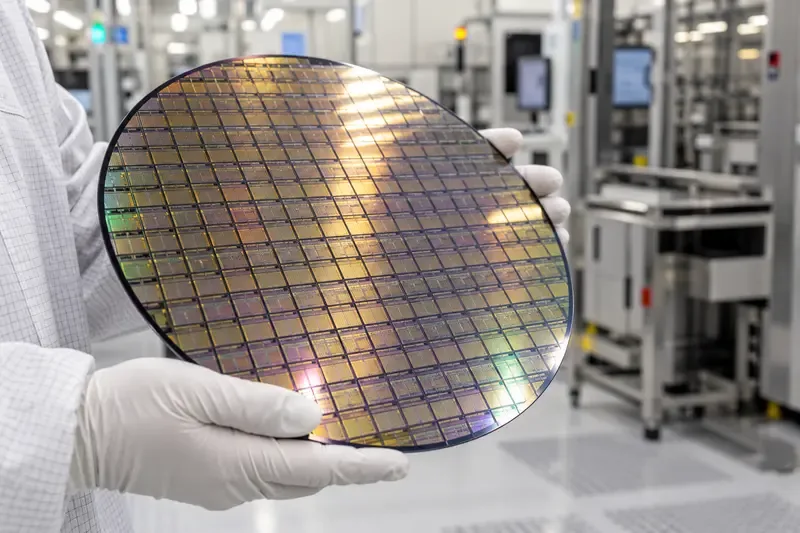
A patterned silicon wafer in a cleanroom represents the fabrication work behind memory and storage chips.
Micron Technology designs and manufactures semiconductor memory and storage products. Its best-known categories are DRAM, NAND flash, and NOR flash, used in data centers, PCs, phones, vehicles, and other systems. Its connection to artificial intelligence is especially visible in high-bandwidth memory (HBM): a fast, compact form of DRAM placed close to powerful processors to keep data moving during AI training and inference.
The useful takeaway is that AI performance depends on more than the processor. A model can only run efficiently when data, model parameters, and intermediate results reach the processor quickly enough. Micron supplies several layers of that memory hierarchy. Which layer matters most depends on the workload, and buying faster memory will not fix every AI bottleneck.
What does Micron Technology make?
Micron is a semiconductor memory and storage company, rather than an AI model maker or cloud-computing provider. It develops and manufactures chips and modules sold into many kinds of electronics and infrastructure. Its product portfolio includes:
DRAM: Fast, temporary working memory used by processors. Mainstream server DRAM often appears as DDR5 modules; HBM is a specialized DRAM architecture optimized for very high bandwidth.
NAND flash: Nonvolatile storage used in solid-state drives (SSDs) and other devices. NAND keeps data when power is off, making it suitable for model files, datasets, and checkpoints.
NOR flash: A type of nonvolatile memory commonly used for firmware and other code that must be read reliably.
Micron's products carry different roles and tradeoffs: working memory is designed for fast access, while storage preserves much larger volumes of information at lower cost per bit but usually with higher access latency. The company’s official product catalog and its latest fiscal 2026 Form 10-K describe its memory and storage businesses.
Why does memory matter so much for AI?
AI accelerators perform large numbers of calculations, but calculations require data. During model training, the system repeatedly reads model weights and training examples and writes intermediate results. During inference, it reads weights and processes each user request, while retaining context and other temporary data. If data arrives more slowly than the processor can use it, the processor spends time waiting.
Memory therefore affects several practical limits: how much data can remain near a processor, how quickly it can be supplied, how many requests can run together, and how much power the system uses moving that data. A higher memory bandwidth can help a workload that is data-movement limited. Capacity matters when the model, context, or batch of requests must fit in a specific memory tier. Neither automatically makes a system faster if the limiting factor is elsewhere.
Where HBM, server DRAM, and SSDs fit
Memory or storage
Typical AI role
What to evaluate
HBM
Very high-bandwidth memory close to an AI accelerator
Capacity per accelerator, bandwidth, power, and platform compatibility
DDR5 server DRAM and other modules
System memory for CPUs and server workloads; supports data preparation and broader processes
Capacity, latency, bandwidth, power, and supported module type
NAND-based data center SSDs
Persistent storage for datasets, model files, checkpoints, and selected data-serving tasks
Capacity, read/write behavior, endurance, latency, and total cost
HBM is built by stacking DRAM dies and connecting them through a very wide interface. Its position beside the processor shortens the route data takes and allows many bits to move in parallel. Micron currently lists HBM4 36GB 12-high as being in high-volume production and says the product delivers more than 2.8 terabytes per second of bandwidth per stack. Those are Micron’s published product specifications, not a guarantee that every AI server will achieve a given application speed. See the company’s HBM product information for the current portfolio and qualifications.
Server DRAM provides a larger working area for CPUs and system processes. SSDs sit farther down the hierarchy: they can hold much larger datasets and persist them without power, but they do not replace HBM as the accelerator’s fastest memory. Micron also sells lower-power DRAM modules aimed at data centers. The best balance depends on where data waits in the particular system.
What does Micron’s current AI activity tell readers?
Micron’s fiscal 2026 report, released September 30, 2026, described record annual results and said AI-driven data-center demand was increasing the need for memory and storage. Its 2026 Form 10-K says demand growth had outpaced the industry’s ability to increase supply and that Micron shifted some DRAM supply toward data-center and hyperscale-cloud customers. This gives context to Micron’s visibility in AI infrastructure: it sells key components that platform builders need, while actual performance and demand still depend on system design and customer adoption. The company’s September 30, 2026 results release and SEC filing are the primary sources for those statements.
Those disclosures are not a forecast that shortages or high prices will continue indefinitely. Micron itself describes memory as a cyclical industry: supply, demand, product mix, and prices can change, while building and qualifying production capacity takes time. Its filing also notes that HBM can require more wafer and cleanroom capacity per bit than conventional DRAM. AI demand can be commercially important while the business remains exposed to manufacturing costs, competition, customer timing, and market cycles.
How can you tell whether memory is the bottleneck?
For a team sizing an AI system, start with the workload and its measured behavior, not a product label. Useful indicators include:
Accelerator utilization and stalls: Low utilization alongside evidence that data is not arriving fast enough can point to a memory or data pipeline issue. Low utilization alone does not prove HBM is the cause.
Memory occupancy and out-of-memory events: If weights, context, or concurrent requests exceed available capacity, teams may need a smaller model, reduced batch size, partitioning, or another memory tier.
Throughput and latency: Measure tokens per second, request latency, and throughput under the actual mix of prompts and concurrency. Compare before and after a controlled configuration change.
Power and total system cost: Faster components can raise purchase and operating costs. Evaluate cooling, server power, networking, software, and memory together.
If more bandwidth improves measured throughput or tail latency at an acceptable cost, memory was likely a meaningful constraint. If the same upgrade changes little, investigate compute limits, kernel efficiency, communication between accelerators, data loading, software scheduling, or power and cooling. This check helps avoid paying for capacity that the workload cannot use.
What should buyers compare before choosing an AI memory configuration?
Compare the complete platform rather than memory specifications in isolation. Check how much HBM is available per accelerator, whether the target model and context fit, the supported memory generation, server DRAM capacity, SSD behavior for the storage tasks involved, and the vendor’s supply and qualification details. Then benchmark the workload you intend to run, including realistic concurrency and data sizes.
Micron matters because memory is a foundational input to AI infrastructure, and its portfolio spans multiple layers from HBM to server DRAM and SSDs. That does not mean every AI deployment needs the most advanced memory or that a single supplier determines system performance. The useful result is a configuration that meets the model’s capacity and throughput needs within power, availability, and cost limits. Change the design when measurements show a different constraint—not simply because a newer memory generation exists.