Home
» Wiki
»
External monitors can have a negative impact on laptop batteries.
External monitors can have a negative impact on laptop batteries.
Using a laptop with an external monitor is a great combination for productivity and getting work done. But over time, you may find that your laptop suddenly runs out of battery quickly and the battery life starts to decrease.
Anyone who has ever owned an Apple silicon MacBook knows that long battery life is one of its best features, so imagine the surprise when you return to your desk each morning to find that your MacBook has run out of battery overnight while in sleep mode.
The main reason is that the external screen has a negative impact on the laptop battery.
Why do external monitors have a negative impact on laptop batteries?
The science behind the extra power draw is relatively simple; rendering images for another screen requires additional power from your laptop’s GPU . The amount of power used depends on what you’re doing on the second screen and what kind of setup you have. For example, a laptop with a dedicated GPU uses more power than one with an integrated GPU. Likewise, a 4K HDR display requires more power from your laptop than a regular HD display.
Of course, this seems obvious. An external display will use more processing power and drain your battery faster. The problem, however, is that this happens even when your laptop is in sleep mode. In our testing, as long as the operating system detects a second display, it will try to process it—even when it’s asleep or the display is powered off. Additionally, using an external display to work, watch videos, or play games will drain your battery faster or force you to use your laptop while it’s plugged in, which can be a serious drain on a lithium-ion battery.
For those who don’t know, lithium-ion batteries have a limited number of cycles before they’re considered unusable (usually around 1,000 cycles for laptops). A cycle passes every time your laptop goes from zero to 100% charge. So using a secondary display will drain the battery faster, causing it to run out of cycles sooner. You can check how many cycles your laptop battery has completed to get an idea of its overall battery health.
Another thing that is really bad for the battery is heat and all that constant image processing and charging creates a lot of heat. As you can see, it's a vicious cycle of drain, charge, and heat.
In short, constantly using an external monitor with your laptop will negatively affect battery life.
Why are MacBook users worse off?
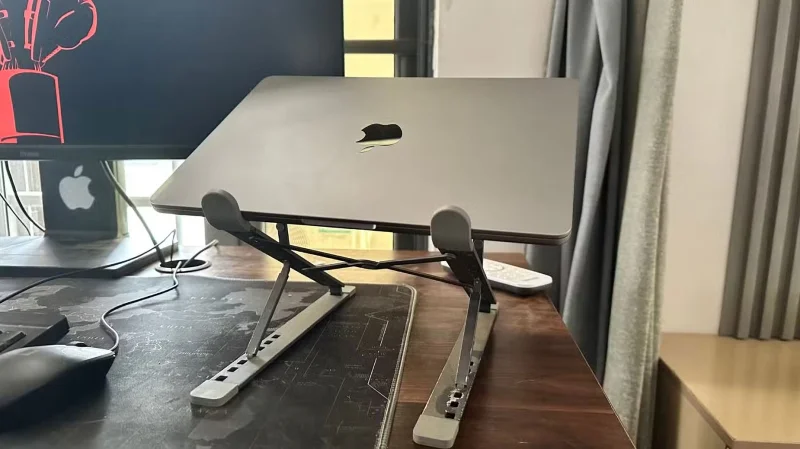
MacBook on laptop stand next to monitor
If you’ve ever plugged your MacBook into a monitor with the lid closed, you may have noticed that it won’t turn on unless it’s charging. Remember how I said earlier that charging a laptop generates heat, and that the GPU processing in the display generates heat? Apple forces you to do this when the lid is closed. Not sure why they designed the MacBook this way, but it’s true.
You see, Apple laptops are built to dissipate heat through the keyboard. Closing the lid doesn’t allow the laptop to cool effectively. Like it or not, this will impact the long-term health of the battery—despite Apple’s excellent thermal management system—because the negative effects tend to accumulate over time.
Worse yet, despite what you may have heard, constantly charging your MacBook is not a good idea. Keeping a lithium-ion battery at 100% will strain it and wear it out faster. You’ll find that your MacBook may struggle to hold a charge after a while like this.
How to prevent external monitors from damaging your laptop battery
Honestly, the best way to prevent an external monitor from killing your laptop battery is to not use your laptop with an additional monitor. If you do, use it sparingly unless absolutely necessary. The solution is to use your desktop for all the right things and switch to your laptop when you want to work somewhere else.
However, there are some tips that can be applied if the above mentioned are not options for you:
Use a laptop stand. It may seem small, but the airflow underneath your laptop will help keep it cool.
Physically disconnect the monitor from the laptop when not in use. Once your session is over, make sure there are no wires connecting the laptop to the monitor.
With all the smart battery-saving features of newer laptops, like Apple’s Optimized Battery Charging or Windows Smart Charging, it’s best to leave your laptop plugged in. These features try to prevent your laptop from reaching 100%, but even if it does reach 100%, it will minimize the negative effects. So you may want to invest in a monitor and a USB-C cable to display video and charge your laptop.
Use a less power-hungry display setting. Change the resolution to a lower setting or just use a small laptop monitor.
Combine these tips with good laptop charging habits to keep your laptop battery healthy longer and save you from costly and inconvenient battery replacements.