Home
» Technology
»
From Sci-Fi to Reality: How BCI Technology Is Restoring Mobility and Speech
From Sci-Fi to Reality: How BCI Technology Is Restoring Mobility and Speech
The most important recent change in brain-computer interfaces is not that “mind reading” has arrived. It is that carefully designed research systems are becoming fast and precise enough to restore useful functions such as speech, cursor control, robotic movement, and, in one landmark case, thought-guided walking. In 2025, implanted speech systems moved beyond slow text output toward near-instant voice synthesis, while other teams demonstrated increasingly rich motor control. A 2026 review now describes the next research frontier as moving from decoding attempted speech toward broader language representations. These advances are real, but they are still mostly experimental and often based on only one or a few participants.
If you are new to the field, the best way to understand the progress is to follow the complete chain: what a brain-computer interface actually measures, how software turns those signals into commands, what device receives those commands, how users train with the system, and where the evidence is strong or still preliminary.
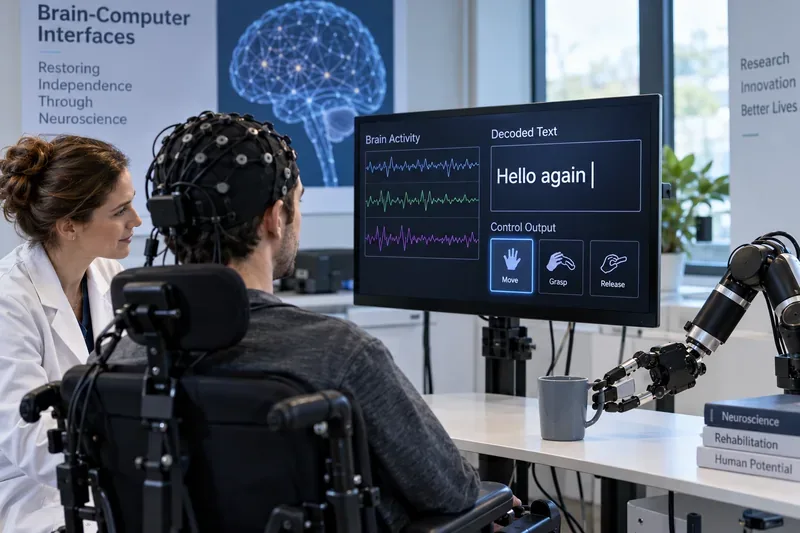
A non-invasive EEG-style research setup illustrates the basic BCI loop from neural signals to computer output and assistive movement; the highest-performing implanted speech and mobility studies discussed below use different electrode systems.
First, what is a brain-computer interface?
A brain-computer interface (BCI) is a system that measures neural activity and converts patterns in that activity into commands for an external device or software. The “computer” part may be a conventional computer, but the output could also control a communication program, robotic arm, wheelchair interface, muscle stimulator, or spinal-cord stimulation system.
The word neuroprosthesis is often used when the system is designed to replace or restore a lost nervous-system function. A speech neuroprosthesis, for example, may convert activity associated with attempted speech into text or synthesized voice.
Non-invasive versus implanted BCIs
Non-invasive BCIs record activity without surgery, most commonly with electroencephalography (EEG), which measures electrical signals through electrodes on the scalp. They avoid the risks of implantation but record signals after they have passed through tissue and skull, so spatial resolution and signal strength are more limited.
Implanted BCIs place electrodes closer to neural tissue. Some systems record from the cortical surface using electrocorticography, often abbreviated ECoG. Others use intracortical microelectrode arrays that record activity from populations of neurons within the cortex. These approaches can provide richer signals, but they involve surgery and the long-term engineering challenges of implanted medical devices.
The U.S. Food and Drug Administration has specific guidance for implanted BCIs intended for people with paralysis or amputation. The guidance covers nonclinical testing and clinical-study considerations for investigational devices. See the FDA guidance on implanted BCI devices.
What you should know before judging a BCI headline
BCI results make more sense if you ask four questions before looking at a performance number.
Question
Why it matters
What signal is being recorded?
Scalp EEG, cortical surface recordings, and intracortical recordings provide very different signal quality and require different levels of invasiveness.
What is being decoded?
A cursor direction, attempted finger movement, attempted speech, and inner speech are different tasks with different difficulty and privacy implications.
What receives the output?
A BCI may control software, a robotic device, muscles, or a spinal stimulator. “Restored movement” does not always mean the biological pathway itself has healed.
How many people were tested?
Many headline-making implanted BCI studies are early feasibility demonstrations in one or a handful of participants.
That final point is essential. A result can be scientifically important and life-changing for a participant while still being far from a treatment that has been proven across a large, diverse patient population.
How a BCI works, step by step
1. Record neural activity
The interface first captures a signal related to what the user is trying to do. For motor BCIs, researchers often record activity from areas of motor cortex involved in planning or producing movement. For speech BCIs, electrodes may record activity associated with the movements and sound patterns involved in speaking.
The BCI is not usually searching the whole brain for an abstract thought. It is exploiting repeatable neural patterns that correlate with a defined task.
2. Train a decoder
A decoder is an algorithm that maps neural activity to an intended output. During calibration, the participant may attempt movements, imagine movements, attempt to speak prompted sentences, or follow another structured task. Machine-learning models learn statistical relationships between the recorded neural patterns and the intended action.
Calibration matters because neural signals vary across people and can change over time. High-performing systems increasingly use adaptive software so the mapping can remain useful as recordings drift or the user becomes more skilled.
3. Send the command to something useful
The decoded result becomes an action. For communication, the output might be text or synthetic speech. For movement, it could be a cursor trajectory, robotic-arm command, muscle stimulation pattern, or spinal-cord stimulation pattern.
4. Close the loop with feedback
A useful BCI is usually a closed-loop system: the user sees, hears, or feels the result and adjusts their next attempt. Feedback may come from a screen, synthesized voice, vision of a moving robotic arm, or the physical sensation of standing and walking. The user and algorithm effectively adapt to one another.
How BCIs are restoring mobility
“Restoring mobility” covers several levels of function, from moving a cursor to controlling a robotic limb or reconnecting brain commands to the spinal circuits that generate walking.
Fine motor control can be decoded from attempted finger movement
A 2025 Nature Medicine study reported a high-performance implanted BCI that decoded three independent finger groups in one participant with tetraplegia from spinal-cord injury. The thumb could be controlled in two dimensions, giving four degrees of freedom in total. The participant used the system for target-selection tasks and quadcopter-game control. This matters because fine finger-like control is closer to the flexibility people expect from everyday computer interaction than a simple left-versus-right command. Read the original Nature Medicine finger-control BCI study.
The result does not mean the participant's paralyzed fingers physically regained normal movement. The BCI decoded intended finger activity and routed it to a digital control system. That distinction—between restoring control and repairing the original biological pathway—is one of the most important concepts for newcomers.
A brain-spine interface can bypass an injured pathway
A more direct example of physical mobility came from a 2023 Nature study. Researchers created a brain-spine interface, a digital bridge that recorded movement intentions from the brain and used them to control epidural electrical stimulation of the spinal cord below an injury. In one participant with chronic tetraplegia, the system supported standing, walking, stair climbing, and movement over more complex terrain. The study reported stable use over a year, including independent home use, and also described neurological recovery that allowed the participant to walk with crutches even when the interface was switched off. Read the original Nature brain-spine interface study.
This is a powerful proof of concept, but it was still a single-participant demonstration. It should not be interpreted as evidence that the same result is currently available or guaranteed for everyone with spinal-cord injury.
How BCIs are restoring speech
Speech has advanced particularly quickly because a BCI can use the neural activity generated when a person tries to speak even when paralysis prevents the muscles from producing intelligible sound.
From neural activity to text
In a 2024 study summarized by the National Institutes of Health, researchers implanted four 64-microelectrode arrays in a man with amyotrophic lateral sclerosis (ALS), a progressive disease that damages motor neurons. The system decoded attempted speech into words. After about 16 hours of use, the study reported approximately 97.5% word accuracy and a communication rate of about 32 words per minute, with performance maintained for more than eight months during the reported study period. See the NIH summary of the 2024 speech neuroprosthesis study.
Those results were obtained in one participant and depended on calibration, neural recordings, machine learning, and an external computing system. The number should therefore be understood as a study result, not a universal accuracy level for speech BCIs.
From text to near-instant synthesized voice
The next challenge was conversational timing. Text can restore communication, but natural conversation depends on hearing a voice quickly enough to take turns, interrupt, change emphasis, and respond without long pauses.
In 2025, one Nature study demonstrated an instantaneous voice-synthesis neuroprosthesis in a man with ALS. Four implanted arrays containing 256 microelectrodes recorded neural activity from speech-related motor cortex. The system synthesized intelligible voice with very low latency and allowed some modulation of intonation and pitch, including short melodies. Read the original 2025 Nature voice-synthesis study. UC Davis emphasized that this device remains investigational and that the result needs replication in more participants; see the UC Davis study report and trial context.
Another NIH-funded 2025 study used a different implanted approach in a woman who had been unable to speak for 18 years after a stroke. The system decoded attempted speech continuously into audible words, reaching 47.5 words per minute with its full vocabulary and faster performance with a limited 50-word vocabulary. NIH reported that speech-related brain activity could be translated into audible speech in less than a quarter of a second. See the NIH report on streaming brain-to-voice synthesis.
What about “reading thoughts”?
This is where science-fiction language becomes especially misleading. Current high-performing speech BCIs generally work best when a participant deliberately attempts to speak. That creates a strong, task-specific neural signal. It is not equivalent to freely reading arbitrary private thoughts.
Researchers are nevertheless studying inner speech, meaning silently imagined words or sentences. In 2025, a Stanford-led team reported that inner speech could be decoded from motor-cortex recordings in four participants with severe motor and speech impairments. The researchers also treated privacy as a design problem: they tested ways to distinguish attempted speech from inner speech and demonstrated a password-like strategy intended to prevent unintended decoding. Stanford explicitly notes that implanted BCIs are still early-stage research and that current systems do not have the resolution needed to accurately decode unconstrained private thought. See the Stanford Medicine explanation of the inner-speech study.
In 2026, researchers writing in Nature Reviews Bioengineering described a possible transition from speech BCIs toward language BCIs that might eventually decode higher-level conceptual representations. That is a research direction, not a demonstrated general-purpose thought reader. Read the 2026 Nature Reviews Bioengineering perspective.
What does a person need before an implanted BCI can be useful?
For a potential user, this is not a device that can simply be purchased, switched on, and expected to work. Current implanted systems are generally evaluated through research studies with carefully defined eligibility criteria.
A clinical indication that matches the study. A system designed for paralysis from spinal-cord injury may not be appropriate for the same goals in stroke, ALS, or another neurological condition.
Specialist assessment. Neurosurgeons, neurologists, rehabilitation clinicians, speech-language specialists, engineers, and research staff may all be involved, depending on the system.
Surgical and device-risk evaluation. Implanted electrodes introduce risks that non-invasive systems do not, including surgical complications and long-term implant reliability questions.
Calibration and training time. Decoders need data from the individual user, and performance can change with practice or over time.
A complete assistive system. The implant is only one component. External electronics, decoding software, output devices, charging or power systems, communication hardware, and technical support may all be necessary.
Privacy and consent controls. As decoding becomes richer, users need clear control over when neural data are recorded, processed, stored, and converted into output.
Common mistakes to avoid when learning about BCI technology
Mistake 1: Treating every BCI as the same technology
An EEG headset, an ECoG array, an intracortical microelectrode implant, and a brain-spine stimulation system have different signal quality, risks, goals, and clinical pathways. Results from one category should not be casually transferred to another.
Mistake 2: Assuming a decoder “understands the mind”
Most successful systems are trained on narrowly defined tasks. They detect statistical patterns associated with attempted speech or movement and map them to an output. That is impressive neural decoding, but it is not unrestricted access to everything a person thinks or knows.
Mistake 3: Ignoring the output device
A BCI alone does not make a paralyzed limb move. It must send commands somewhere. That could be a robotic arm, a cursor, functional electrical stimulation of muscles, or a spinal stimulator. The complete pathway determines what “restoration” actually means.
Mistake 4: Generalizing a single-person result
Several of the field's most important demonstrations—including naturalistic brain-to-voice synthesis and brain-spine walking—were reported in individual participants. Early feasibility studies answer “can this work?” before larger trials can answer “how reliably, for whom, and with what risks?”
Mistake 5: Focusing only on peak accuracy
Real-world usefulness also depends on latency, calibration burden, long-term signal stability, error correction, comfort, caregiver needs, home usability, repairability, and whether the user can operate the system without a research team constantly present.
What still has to improve before BCIs become routine care?
Long-term reliability is one major challenge. Neural recordings can change as electrodes, tissue, hardware, or physiology change. A system that performs well for a laboratory session must also remain useful over months and years.
Hardware practicality matters just as much. Many research systems still rely on external computers, cables, specialized connectors, or lab infrastructure. Fully implantable and wireless systems could improve daily usability, but they must meet demanding requirements for power, heat, data transmission, cybersecurity, and reliability.
Clinical evidence must expand. Researchers need larger and more diverse participant groups, appropriate comparisons, meaningful patient-centered outcome measures, and long follow-up. FDA's implanted-BCI guidance reflects this reality by addressing biocompatibility, electrical safety, software, cybersecurity, animal testing where appropriate, human factors, clinical endpoints, and other considerations involved in moving from feasibility research toward market access.
Agency and privacy will become more important as decoders become more capable. Systems should make it easy for the user to decide when output is enabled and to distinguish an intended command from internal thought. The inner-speech work from 2025 is important not only because decoding improved, but because researchers tested mechanisms to protect against unintended output.
Where the field is heading
The clearest trajectory is toward BCIs that are faster, more natural, and more integrated with everyday tasks. For speech, that means moving from selecting letters to decoding whole words, then to continuous voice with timing and expression. For movement, it means moving from simple cursor control toward multiple degrees of freedom, shared control with intelligent assistive software, and interfaces that stimulate the user's own nervous system.
The most promising future systems may also become bidirectional: they will not only read motor intention from the brain but return useful sensory information to the nervous system. Sensory feedback could make robotic or stimulated movement easier to control because the user would not have to rely on vision alone.
Still, the path from impressive research result to dependable medical technology is long. Safety, durability, autonomy, training burden, privacy, affordability, and access matter just as much as decoding accuracy.
The beginner's takeaway
BCI technology is already beyond science fiction in one important sense: neural activity from people with paralysis has been used in published human studies to produce text, synthesize speech, control complex digital movement, and reconnect brain commands with spinal stimulation for walking.
But “reality” does not mean routine availability. The strongest implanted systems are still investigational, many landmark results involve very small numbers of participants, and different neurological conditions may require different interfaces. The right way to follow the field is therefore to ask what signal was recorded, what the participant intentionally did, how the decoder was trained, what device received the output, how many people were tested, and how long the benefit was maintained.
That framework makes the progress easier to appreciate without turning careful neuroengineering into a promise that the evidence does not yet support.