Home
» Technology
»
Engineering the Sky: How Industrial UAVs Can Overcome Battery and Payload Constraints
Engineering the Sky: How Industrial UAVs Can Overcome Battery and Payload Constraints
An industrial drone can look perfect on a specification sheet and still fall short on the job. A mapping team adds a LiDAR unit and companion computer, an inspection crew adds a spotlight, or a delivery operator loads a heavier package—and suddenly the comfortable flight margin disappears. The problem is not simply that “payload makes a drone heavier.” Payload mass, payload power draw, battery mass, rotor efficiency, air density, wind, temperature, and mission profile all interact.
The hardware envelope has improved. DJI introduced the Matrice 400 in June 2025 with a published maximum flight time of 59 minutes and a maximum payload of 6 kg, while also noting that the 6 kg payload figure is measured at sea level and that payload capacity decreases with altitude. Its published flight-time test is also conducted in controlled conditions rather than a typical industrial mission. See the official DJI Matrice 400 specifications. Meanwhile, the FAA's lithium-battery shipping guide shows a last-updated date of August 28, 2026 and reminds operators that carrier requirements can be more restrictive than baseline dangerous-goods rules. See the FAA lithium-battery shipping guide. The takeaway for operators in 2026 is straightforward: better aircraft do not eliminate the energy-versus-payload tradeoff, and battery logistics remain part of the engineering problem.
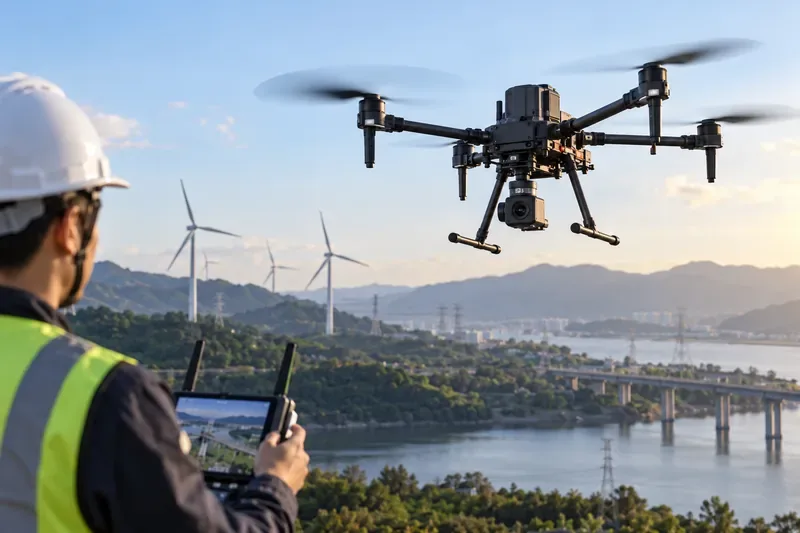
An industrial multirotor carries a sensor payload during infrastructure inspection, where aircraft mass, payload power, wind, route design, and required landing reserve all affect usable endurance.
Why real missions lose endurance so quickly
The first mistake is treating the manufacturer's maximum flight time as an operational promise. Maximum-time tests are usually performed under specified combinations of payload, speed, wind, altitude, temperature, battery state, and end-of-test criteria. Your mission may be heavier, hotter, colder, windier, more stationary, or more power-hungry.
DJI's own Matrice 4 Series accessory test makes the effect visible. The company lists 49 minutes of maximum flight time with no payload in its test conditions. With its speaker and spotlight attached and both devices active, the published maximum flight time falls to 32.1 minutes. The same table separates accessory mass from accessory electrical power, which is exactly how engineers should think about smart payloads. Review the official DJI Matrice 4 flight-time-with-accessories data.
Payload creates two different penalties
Mass penalty: A heavier aircraft must generate more thrust. For a multirotor, that generally means more rotor power, and the penalty becomes especially noticeable in hover, climb, gust rejection, and high-density-altitude conditions.
Electrical penalty: A payload can consume power independently of propulsion. LiDAR, radar, thermal cameras, lighting, edge-compute modules, cellular radios, heaters, pumps, release mechanisms, and gimbals may all draw from the aircraft or a dedicated battery. A 500-gram sensor that draws significant power can be more damaging to endurance than a passive 500-gram payload.
A peer-reviewed endurance study modeled propulsion demand, battery discharge, drag, payload mass, and flight speed together, and validated its prediction against measured multirotor flight time. That is a better engineering model than estimating endurance from battery capacity alone. See the original study, Practical Endurance Estimation for Minimizing Energy Consumption of Multirotor UAVs.
More battery is not a free solution
Adding battery increases stored energy, but the battery itself is payload from the propulsion system's perspective. The larger pack raises takeoff mass, so some of the extra energy is spent carrying the extra battery. Eventually, the added endurance per added watt-hour becomes unattractive, or the aircraft reaches structural, propulsion, thermal, center-of-gravity, or maximum-takeoff-weight limits.
This is why the correct optimization target is not “largest battery that fits.” It is the battery-airframe-payload combination that completes the mission with adequate reserves while keeping motors, electronic speed controllers, connectors, cells, and structure inside their approved operating envelope.
Start with the easiest fix: define the mission before changing hardware
Before replacing motors, buying higher-capacity batteries, or moving to hydrogen, write down what the aircraft must actually do. Separate the mission into takeoff, climb, transit, work, return, approach, and landing. Then record the mass and power state in each segment.
Mission item
What to record
Why it matters
Aircraft mass
Ready-to-fly mass with batteries, mounts, cables, landing gear, and payload
Propulsion demand responds to total mass, not the nominal payload label
Payload power
Average and peak watts for sensors, compute, radios, lighting, heaters, or actuators
Powered payloads reduce the energy left for propulsion
Mission profile
Hover time, cruise time, climb, descent, loiter, repeated accelerations
Different flight states have different power requirements
Air density, cooling, battery behavior, and control effort change with conditions
Required reserve
Manufacturer/operator landing threshold plus contingency margin
Usable mission energy must exclude the energy you cannot safely plan to consume
This simple worksheet often exposes the real bottleneck. A team may discover that a 35-minute nominal mission contains 12 minutes of unnecessary hover, that a payload computer runs continuously even though it only needs to process during the survey leg, or that the aircraft is carrying redundant mounting hardware.
Next, remove grams and watts before adding watt-hours
Reduce payload mass without reducing mission value
Start with mounts, protective housings, duplicated batteries, oversized compute boxes, unused cables, adapters, and redundant sensors. Weight reduction is most valuable when it removes mass that contributes nothing to the required data product.
Do not compromise structural safety to save weight. A lighter bracket that introduces vibration can ruin photogrammetry, LiDAR alignment, thermal imagery, or machine-vision results. The right target is functional mass efficiency: every gram should contribute to flight, sensing, protection, communication, or safety.
Measure payload power instead of guessing
Smart industrial payloads can have a low idle draw and a much higher peak draw. Measure both. If the payload is powered from the aircraft, verify the permitted voltage, current, connector, and interface limits. If it has its own battery, count that battery in total aircraft mass.
Then ask whether every subsystem must stay on for the whole mission. A spotlight, high-performance compute module, modem, heater, or active scanner may only be needed during a portion of the flight. Duty cycling can save energy, provided the payload is designed for it and startup time does not compromise the mission.
Optimize the flight profile before redesigning the aircraft
For many inspection and mapping operations, route design is the cheapest endurance improvement. Avoid repeated climbs, aggressive accelerations, unnecessary station-keeping, and long upwind returns. Place the launch site so that the aircraft does not spend a large fraction of its energy commuting to the work area.
Wind matters twice: it changes groundspeed and it increases the control effort needed to hold position or maintain a path. A mission that appears feasible by distance alone can become marginal when the return leg is into a headwind. Plan energy, not just kilometers.
For large-area missions, ask whether continuous hover capability is actually required. Fixed-wing and lift-plus-cruise aircraft can be much more efficient in forward flight because aerodynamic lift carries the aircraft instead of relying entirely on powered rotors. Wingcopter's current Wingcopter 198 page, for example, lists a 25 kg maximum takeoff weight, 4.7 kg payload, and a maximum range of 94 km; those top-line maxima should not be assumed to occur simultaneously unless the manufacturer explicitly states that they do. See the official Wingcopter 198 specifications.
Make battery operations part of the engineering design
Battery performance is not just a capacity number printed on a label. High current causes voltage sag and heating. Cell aging reduces usable capacity and can increase internal resistance. Temperature changes power availability and charging behavior. Repeated deep discharge or poor storage practices can shorten service life, depending on the chemistry and pack design.
Use the aircraft and battery manufacturer's limits for charging temperature, storage, inspection, retirement criteria, and state-of-charge management. Do not bypass a battery-management system or raise charge voltage to chase more flight time. The FAA notes that lithium-ion batteries can enter thermal runaway when damaged, overheated, exposed to water, overcharged, improperly packed, or affected by manufacturing defects. See the FAA lithium-battery safety guidance.
For fleet operations, log each pack by serial number or asset ID. Track cycles, observed capacity, resting voltage, cell balance if available from the approved system, temperature warnings, abnormal swelling, hard landings, and any manufacturer health metric. A mission planner should know whether today's “100%” pack behaves like a new pack or an aged one.
When software and operations are not enough, improve propulsion efficiency
Propeller diameter, pitch, motor winding, motor speed constant, voltage, electronic speed controller efficiency, rotor disk area, and airframe drag all influence endurance. Components should be selected as a system rather than by choosing the motor with the highest advertised power.
For a custom industrial UAV, test the motor-propeller combination on a thrust stand across the thrust range the real aircraft will use. Record thrust, voltage, current, electrical power, motor temperature, and controller temperature. The goal is not maximum thrust; it is acceptable efficiency and thermal headroom at hover, climb, and contingency power.
High-altitude missions deserve separate validation. Lower air density changes rotor performance and can force higher rotor speeds or power for the same required lift. DJI explicitly states that Matrice 400 payload capacity decreases with altitude, and experimental research on high-altitude multirotors likewise treats air density and propulsion matching as core endurance variables. See the original high-altitude multirotor endurance study.
Choose a different aircraft architecture when the mission demands it
If a battery multirotor cannot meet the mission after reasonable mass, power, route, and propulsion optimization, the answer may be architectural rather than incremental.
Architecture
Best fit
Main tradeoff
Battery multirotor
Close inspection, hover, confined sites, precise positioning
Energy-intensive lift during the entire flight
Fixed-wing or lift-plus-cruise VTOL
Long linear corridors, mapping, logistics, wide-area patrol
Less efficient for prolonged hover; more transition and mission-planning complexity
Tethered multirotor
Persistent observation or inspection around a fixed operating point
Tether limits mobility and introduces cable-management constraints
Fuel-cell/battery hybrid
Long-endurance missions where battery-only mass becomes prohibitive
Hydrogen storage, balance-of-plant, transient power, logistics, certification, and safety complexity
Tethered power is already used in specialized industrial inspection systems. Flyability, for example, offers a tether power configuration for the Elios 3 platform, illustrating how continuous external power can make sense when mobility is secondary to persistence. See the official Flyability product information.
Fuel cells are another path, but they should be treated as a system-engineering project rather than a drop-in battery replacement. A 2026 peer-reviewed study of a proton-exchange-membrane fuel-cell/battery hybrid quadcopter focused specifically on the challenge of supplying highly transient multirotor power while managing fuel-cell constraints and degradation. See the 2026 fuel-cell/battery hybrid UAV study. NASA similarly describes all-electric and multiple hybrid-electric propulsion architectures for electrified aircraft, which is useful context for understanding why there is no single energy system that wins every mission. See NASA's electrified aircraft configurations.
A practical order of operations for solving an endurance shortfall
Measure the real mission. Log takeoff mass, payload watts, environmental conditions, flight segments, battery state, and landing reserve.
Remove unnecessary payload mass. Start with mounts, housings, duplicated electronics, and accessories that do not improve the required output.
Reduce payload energy draw. Duty-cycle high-power devices where the payload design permits it.
Optimize the route. Shorten transit, avoid needless hover and climb, and plan the return leg for wind.
Improve battery discipline. Use healthy packs, correct charging and storage procedures, and fleet-level battery records.
Match propulsion to the mission. Validate propellers, motors, voltage, and thermal headroom at the actual aircraft mass.
Change architecture if necessary. Consider fixed-wing/VTOL, tethered power, or hybrid energy only when the mission requirement justifies the added complexity.
How to verify that the fix actually worked
Do not declare success because one test flight lasted longer. A useful engineering check compares the same mission before and after the change under representative conditions.
Mission completion: Can the aircraft finish the required work and land with the planned reserve still available?
Repeatability: Does the improvement persist across repeated runs rather than one unusually calm flight?
Peak electrical load: Are battery voltage, current, connector load, and payload power stable during climb, acceleration, and gust response?
Thermal margin: Do the battery, motors, controllers, payload electronics, and connectors remain within manufacturer limits?
Control quality: Does the added payload preserve center of gravity, vibration behavior, positioning quality, and actuator headroom?
Data quality: Did weight reduction, vibration isolation changes, or power scheduling degrade the sensor output you actually need?
Environmental margin: Does the mission still work at the expected hot, cold, windy, or high-altitude edge of the approved operating envelope?
For early screening, a few repeated flights can reveal obvious gains or regressions, but a safety-critical or production deployment needs a validation plan appropriate to its regulatory environment, operating risk, fleet size, and manufacturer requirements. Do not treat a small internal test set as certification evidence.
The engineering principle that matters most
Industrial UAV endurance is a system problem. The best result rarely comes from maximizing battery capacity or minimizing payload mass in isolation. It comes from balancing useful payload, total mass, payload power, propulsion efficiency, flight profile, environment, battery health, and reserve requirements around the mission that creates value.
If your aircraft is missing its endurance target, begin with measurements and operational changes because they are the least disruptive. Then reduce nonessential grams and watts. Only after those steps should you redesign propulsion or adopt a new energy architecture. That sequence prevents expensive hardware changes from masking a simpler problem—and it produces an aircraft that is not merely capable of staying airborne longer, but capable of completing the industrial task reliably.