Pop Culture Costume Ideas That Will Dominate Halloween 2026

Plan a recognizable Halloween 2026 look with pop culture costumes inspired by Spider-Man, Supergirl, Toy Story 5, Moana, Mario, and Wednesday.
The SWITCH function in Excel allows you to perform multiple checks on a value and return results based on conditions. Here are the details on how to use the SWITCH function in Excel .
If you have spent too much time creating a nested IF formula ( IFS function ), you will love using the new SWITCH function in Excel . This function saves you time in situations where you need to use the IFS function. Previously, this function was only available in VBA, but SWITCH was recently added to Excel 2016, Excel Online and Mobile, Excel for computers and Android phones. This article will guide you through how to use the SWITCH function in Excel 2016.
SWITCH function syntax
The SWITCH function compares an expression to a list of values and returns the first matching value. If no match is found, it may return a default value.
The structure of the SWITCH function is as follows:
SWITCH(expression, value1, result1, [default or value2, result2],…[default or value3, result3])
It has 4 arguments, one of which is optional:
Since functions are limited to 254 arguments, you can use up to 126 pairs of value and result arguments.
How to use the SWITCH function with other Excel functions
You can also combine the SWITCH function with other Excel functions. For example, you can nest it inside the IF function to increase overall efficiency and create more complex formulas.
Additionally, you can combine SWITCH with the following Excel functions:
Compare the SWITCH function with the IFS function
The SWITCH function, like the IFS function, helps define a series of conditions. However, with the SWITCH function, you can define an expression and a series of values and results, not a number of conditional statements. With the SWITCH function, you do not need to repeat the expressions again and again as in the IFS function.
For example, the IFS function below finds the exact states.

Explanation: Cell A2 contains the string 85-UT. The RIGHT function extracts the rightmost 2 characters from this string (UT). As a result, the IFS function returns the correct state (Utah). If the rightmost 2 characters are not equal to UT, TX, or OH, the IFS function returns a question mark. Instead of TRUE, you can also use 1=1 or something else that is always TRUE.
The SWITCH function below produces identical results but is much more readable.
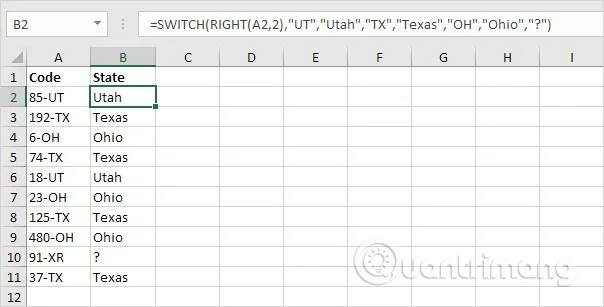
Explanation: if the first argument (RIGHT(A2,2) in this example) equals UT, the SWITCH function returns Uta; if TX returns Texas; if OH returns Ohio. The last argument (the question mark in this example) is always the default value (if there is no match).
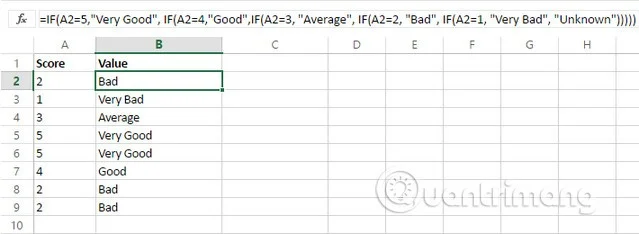
Similarly, you can see the example below with the ranking system, the SWITCH function looks more compact.
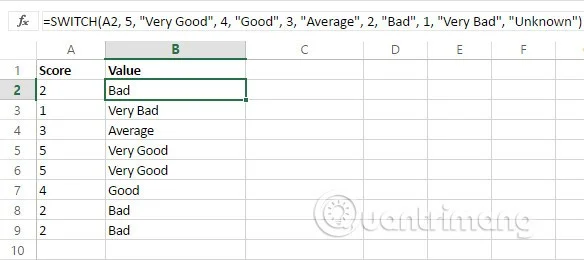
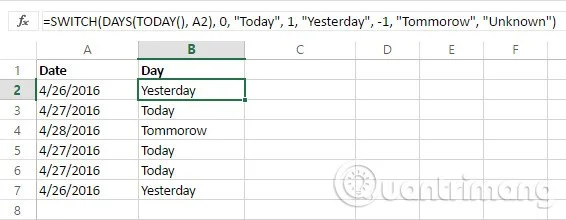
Let's see how the SWITCH function works in combination with other functions. Let's say we have a number of dates and want to quickly see if it's today, yesterday, or tomorrow. To do this, we'll use the TODAY function which returns the serial number of the current date and the DAYS function which returns the number of days between two dates.
You can see the SWITCH function works perfectly for this task.
With the IF function, the conversion requires some nesting and complexity. So you will be more prone to errors.
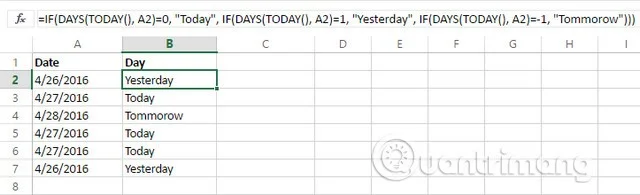
However, it is not always possible to use the SWITCH function in Excel. There are many examples where you cannot use the SWITCH function instead of the IFS function.

Explanation: since the symbols "<=" and="" "="">" are used here in this IFS function, you cannot use the SWITCH function.
The SWITCH function is really a useful function, it saves time and makes less mistakes.
Good luck!
See also:
Plan a recognizable Halloween 2026 look with pop culture costumes inspired by Spider-Man, Supergirl, Toy Story 5, Moana, Mario, and Wednesday.
Sort leftover Halloween candy safely, share or repurpose sealed treats, and choose food use or compost for pumpkins based on their condition.
Compare workplace Halloween costume choices by respect, dress code, mobility, and safety—and learn when a subtle accessory or a policy check is the better option.
Find a couples costume that fits your style, budget, and comfort level, from Addams Family classics to original inside-joke duos.
Need a last-minute high school Halloween costume? Compare 10 easy closet-based ideas by prep time, comfort, school-day practicality, and simple safety checks.
Use a simple 2026 Halloween decorating timeline for indoor décor, outdoor displays, and fresh pumpkins, with practical adjustments for weather and events.
Mix five vivid, approachable Halloween cocktails with measured recipes, simple prep tips, and an alcohol-free option for your party guests.
Find 15 office-friendly Halloween costume ideas for 2026, with practical checks for dress codes, respectful themes, comfort, and workplace safety.
Plan a fun elementary school Halloween party with easy crafts, games, inclusive treats, costume tips, and a sample 75-minute classroom schedule.
Compare realistic side hustles for 2026 by startup cost, fees, flexibility, and income control, with current tax and scam guidance from official sources.