LEFT / RIGHT function: Formulas, usage in Excel

The Left and Right functions are one of the most used functions in word processing groups when working on Excel spreadsheets. Based on the function name, you have probably guessed its use, specifically as follows:

  • LEFT returns the first character or characters in a string, based on the number of characters you specify.
  • RIGHT returns the last character or characters in a string, based on the number of characters you specify.

The LEFT and RIGHT functions always count each character as 1, whether it's a single byte or a double byte, regardless of the default language setting. Character counts include spaces (spaces) and other special characters.

LEFT, RIGHT function formulas in Excel

= LEFT (Text, [num_chars])

= RIGHT (Text, [num_chars])

Explain:

  • Text : is required data. This is the text string containing the characters you want to extract.
  • Num_chars : is optional. This is the number that specifies the number of characters you want to get from the left (LEFT function) or from the right (RIGHT function) to.
    • The number of characters to count must be greater or equal to zero.
    • If this number is not entered, the function will default to 1 character.
    • If the number of characters counted is greater than the length of the text, the function takes the entire text.

How to use LEFT and RIGHT functions?

For example, the original text has the content: Download.com.vn. The corresponding return function will be as follows:

Recipe Results returned
= LEFT ("Download.com.vn"; 8) Download
= RIGHT ("Download.com.vn"; 3) .VN

Applies to specific problems with the Vlookup function

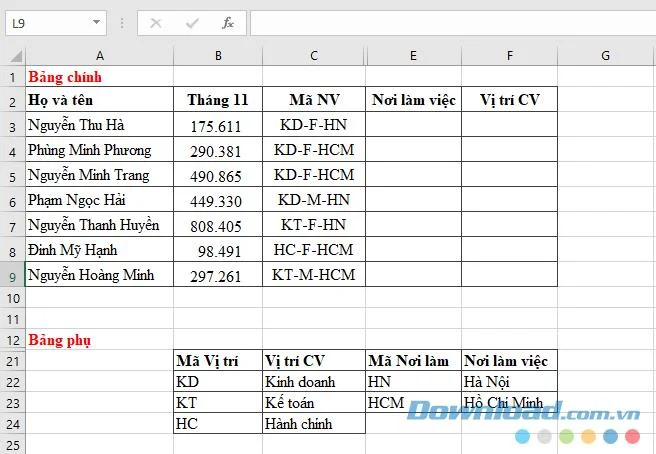
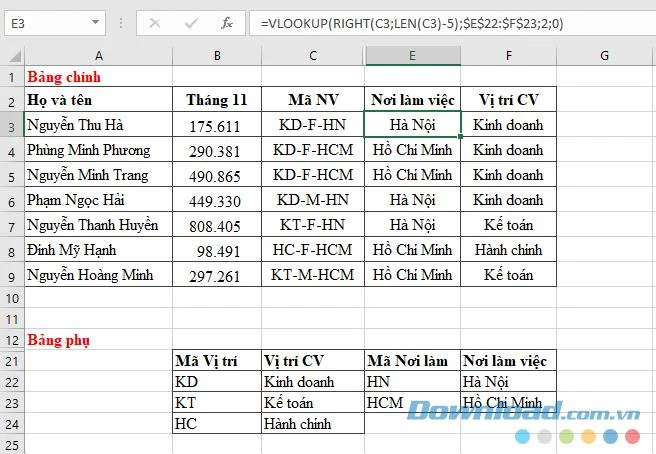
For the main and secondary data tables later, fill in the main data table based on the employee code and data from the 2 secondary tables.
LEFT / RIGHT function: Formulas, usage in Excel

The provisions are as follows : The first 2 characters of the NV Code describe for the job position, the characters at the end describe for the place where employees work. Based on that, we will fill in the formula for calculating each column as follows:

CV position = VLOOKUP ( LEFT (C3; 2) ; $ B $ 22: $ C $ 24; 2; 0)
Workplace = VLOOKUP ( RIGHT (C3; LEN (C3) -5) ; $ E $ 22: $ F $ 23; 2; 0)

In the above formula I have used LEN (Text) as a function to measure the length of a string. Since the Workplace column to look up the column is not 2 or 3 characters long, the length of the string is subtracted from the length of the first characters. To reduce complexity, you can norm for the same type, for example, instead of HN and HCM, you can convert to HAN and HCM, the formula will only be: 

= VLOOKUP ( RIGHT (C3; 3) ; $ E $ 22: $ F $ 23; 2; 0)

And here is the results table after you've filled the formula and copied data down the lines below:

LEFT / RIGHT function: Formulas, usage in Excel

That's it, do you find these 2 functions simple? Actually these are the two simplest functions in the text function group. In addition, through this article you also know one more simple function is the LEN function. Please follow the next articles on Download.com.vn to learn more about using other basic functions of Excel!

Leave a Comment

Side Hustles That Actually Pay in 2026: 7 Realistic Options and the Tradeoffs to Know

Side Hustles That Actually Pay in 2026: 7 Realistic Options and the Tradeoffs to Know

Compare realistic side hustles for 2026 by startup cost, fees, flexibility, and income control, with current tax and scam guidance from official sources.

Remote Work Ergonomics in 2026: Upgrade Your Home Office Without Overbuying

Remote Work Ergonomics in 2026: Upgrade Your Home Office Without Overbuying

Upgrade your home office ergonomics with current OSHA and NIOSH guidance on chair fit, monitor height, laptop setup, lighting, and movement.

Why Emotional Intelligence Matters in Leadership—and How to Build It

Why Emotional Intelligence Matters in Leadership—and How to Build It

Learn why emotional intelligence matters in leadership, where it helps most, how to strengthen it, and how to tell whether your approach is working.

How to Transition to a Tech Career Without a Degree: A Results-First Roadmap for 2026

How to Transition to a Tech Career Without a Degree: A Results-First Roadmap for 2026

A practical roadmap for moving into tech without a degree: choose an accessible role, build job-ready skills, prove them with projects, and use hiring feedback to improve.

Building a Personal Brand on LinkedIn in 2026: What Still Works, What Changed, and What to Ignore

Building a Personal Brand on LinkedIn in 2026: What Still Works, What Changed, and What to Ignore

Build a credible LinkedIn personal brand in 2026 with current profile, content, newsletter, analytics, verification, and visibility guidance from LinkedIn.

Quiet Quitting vs. Quiet Firing in 2026: What’s Really Changing at Work

Quiet Quitting vs. Quiet Firing in 2026: What’s Really Changing at Work

Quiet quitting and quiet firing are catchy labels, not diagnoses. Learn what is verified, what depends on context, and what employees and managers can do next.

The Rise of the Fractional Executive: When Part-Time C-Suite Leadership Makes Sense

The Rise of the Fractional Executive: When Part-Time C-Suite Leadership Makes Sense

Fractional executives offer senior leadership without a full-time hire. Learn when the model works, what to ask, and the risks to manage.

How to Negotiate a Raise During Q4 Performance Reviews: A Practical 2026 Decision Guide

How to Negotiate a Raise During Q4 Performance Reviews: A Practical 2026 Decision Guide

Prepare a stronger Q4 raise request with current wage data, timing options, compensation tradeoffs, and scripts for yes, partial, or no outcomes.

6 High-Income Skills You Can Start Learning Before 2026 Ends

6 High-Income Skills You Can Start Learning Before 2026 Ends

Choose a high-income skill you can realistically start before 2026 ends, with current pay data, learning priorities, and a practical self-check.

Mastering the Hybrid Work Schedule: A Practical Framework That Actually Holds Up

Mastering the Hybrid Work Schedule: A Practical Framework That Actually Holds Up

Build a hybrid work schedule around tasks, team overlap, and measurable outcomes. See sample patterns, warning signs, and when to adjust your plan.