Home
» Today
»
Meta Glasses: What to Know About Meta’s VR and Smart Glasses
Meta Glasses: What to Know About Meta’s VR and Smart Glasses
Meta now uses the word “glasses” for several products that can look related in search results but serve very different purposes. As of September 24, 2026, the company has conventional-looking AI glasses for everyday use, display-equipped smart glasses that put information in your field of view, and newly announced Meta VR Glasses built for immersive entertainment, work, and gaming.
That makes one question especially important before comparing prices or features: do you want eyewear that helps while you stay in the real world, or a device designed to place large virtual screens and immersive media around you?
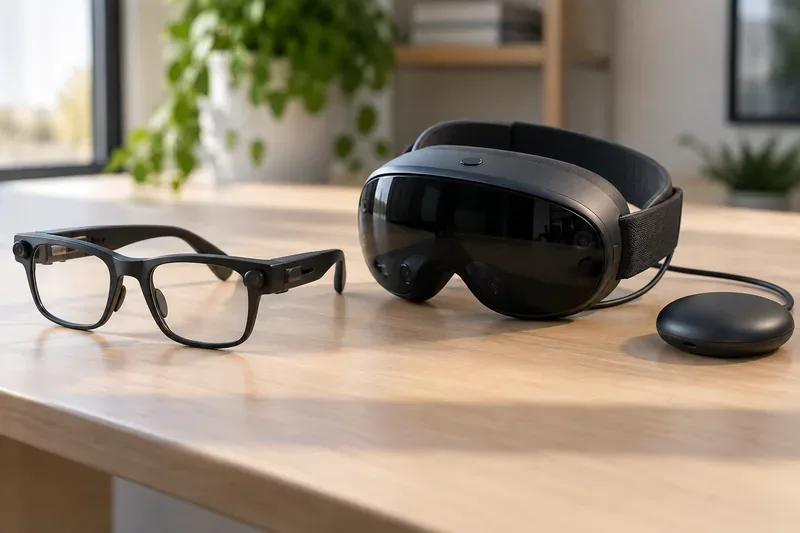
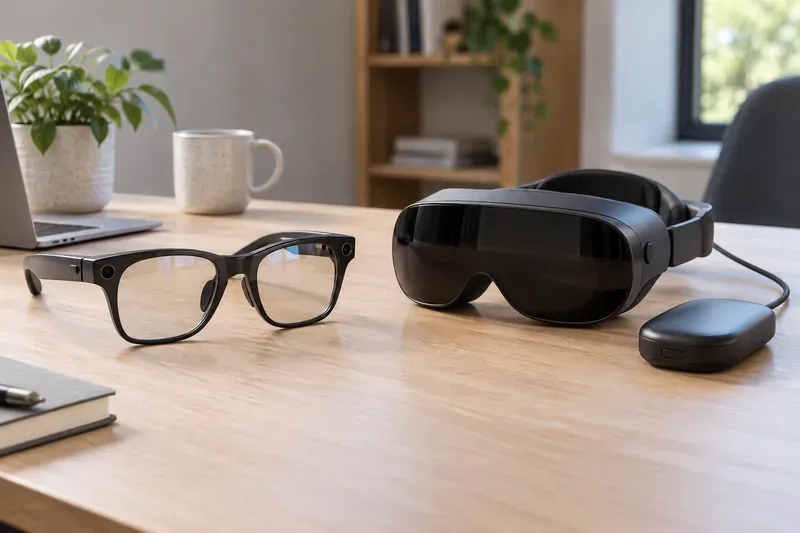
Everyday smart glasses and a larger immersive VR device illustrate the difference between lightweight AI eyewear and hardware built for virtual-reality experiences.
A hypothetical example: choosing “Meta glasses” for a trip
Consider a hypothetical shopper named Jordan. This is only an illustrative example, not a real customer story or product test. Jordan is planning a long flight followed by several days in a new city. The wish list sounds simple: listen to audio without earbuds, ask an AI assistant questions, take hands-free photos, translate conversations, watch a movie privately on the plane, and possibly work with several virtual screens.
At first, Jordan searches for “Meta glasses” and assumes one device should do all of those things. That assumption is where confusion starts. The lighter AI glasses are designed around everyday wear, audio, cameras, voice assistance, and—in some models—a small display. Meta VR Glasses are a different category: they are intended to create an immersive viewing and computing environment while still using passthrough to preserve awareness of the physical world.
The practical lesson from Jordan’s example is that feature lists make more sense after you first separate Meta’s glasses into categories.
Meta’s glasses lineup, simplified
Category
What it is designed for
What to know
Meta VR Glasses
Immersive movies, sports, virtual workspaces, gaming, and spatial calling
Announced September 23, 2026; Meta says U.S. sales are planned for spring 2027 at $1,299.99
Ray-Ban Meta and Meta Glasses
Everyday AI assistance, open-ear audio, calls, photography, video, and hands-free interaction
Look much closer to normal eyewear and are intended for daily use
Ray-Ban Meta Audio
Audio, calls, and AI without a camera
Announced in September 2026 as Meta’s first audio-only glasses; starts at $349
Meta Ray-Ban Display
Everyday smart glasses with a visual display
Can show navigation, notifications, translations, and other information in the wearer’s view
Oakley Meta
Performance-oriented AI glasses
Targets active and sport-focused use cases while retaining Meta AI features
Meta’s own current overview is the best place to see which models are actually offered in your market: Meta technologies overview. Availability, frame choices, prescriptions, and software features can vary by country and model.
What are Meta VR Glasses?
Meta VR Glasses were announced at Meta Connect on September 23, 2026. They are not simply a thinner version of Ray-Ban Meta. Meta describes them as a new virtual-reality device built around a glasses-style form factor with no head strap. The company says the portion worn on the face weighs about 100 grams.
The design uses a two-part system. Sensors and displays sit in the glasses, while a separate puck connected by an optical tether handles compute, battery, and storage. According to Meta, this split is what allows the worn portion to be much lighter than a conventional standalone VR headset.
Meta says the device uses a 5K “Infinite Display” based on micro-OLED panels, with 37 pixels per degree, pancake optics, Dolby Vision, and Dolby Atmos audio in the frames. Interaction is designed around voice, eye input, and natural hand gestures rather than dedicated controllers. Meta also says the external puck uses Qualcomm’s Snapdragon Reality Elite processor and provides up to three hours of continuous high-resolution media playback, with 45W charging support.
Those details are manufacturer specifications, not independent test results. The product is not scheduled to go on sale until spring 2027, so buyers should expect independent reviews, app-compatibility findings, comfort assessments, and battery tests to arrive closer to launch. See Meta’s original announcement: Introducing Meta VR Glasses.
What Meta VR Glasses are meant to do
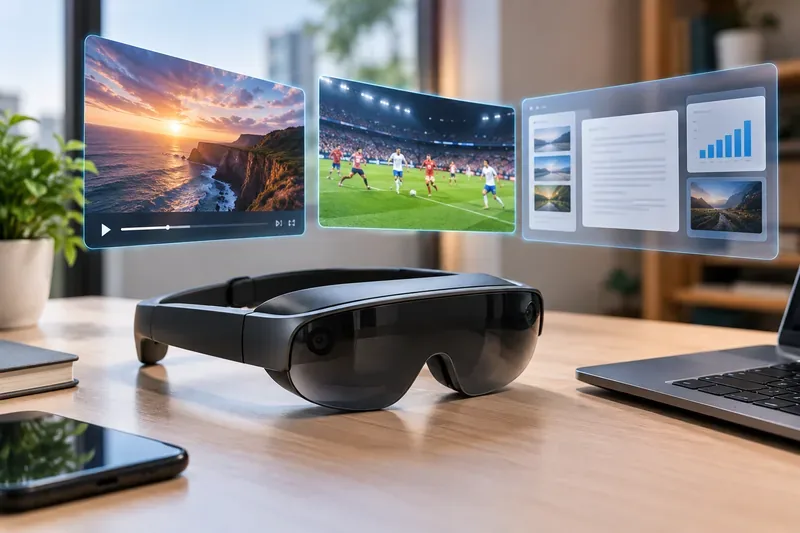
Meta is positioning the device around four broad uses: immersive video, live sports, private multi-screen work, and gaming. The company says it is the first IMAX Enhanced-certified VR device and is working with streaming and media partners for 3D and immersive content. Meta also says users will be able to create multiple private virtual screens and turn a flat surface into a keyboard and touchpad.
For Jordan, the hypothetical traveler, that means Meta VR Glasses are the relevant product when the goal is a private cinema or a virtual workstation during a flight. They are not the obvious choice for casually walking around a city all day.
How Meta’s everyday smart glasses differ
The everyday smart-glasses family is built around staying engaged with the physical world. These products use familiar eyewear shapes and typically emphasize open-ear speakers, microphones, cameras on camera-equipped models, voice interaction, and Meta AI. Some models support prescription lenses.
Meta’s September 2026 updates expanded that range substantially. The company announced Ray-Ban Meta Audio, new Ray-Ban Meta (Gen 3) models, additional Meta Glasses styles, and broader integration with its Muse personal AI agent. Meta says Ray-Ban Meta (Gen 3) starts at $449, includes a 12-megapixel camera, supports 3K Ultra HD video, and offers up to nine hours of battery life. Ray-Ban Meta Audio starts at $349 and is intentionally camera-free, focusing on audio, calls, and AI interaction. The original details are in Meta’s September 2026 AI-glasses announcement.
For Jordan, these products fit the parts of the trip involving music, calls, quick AI questions, translation, or hands-free capture. The exact model matters because camera capability, battery life, frame style, prescription support, and display availability are not identical across the lineup.
What is Meta Ray-Ban Display?
Meta Ray-Ban Display sits between conventional AI glasses and immersive VR. It is still designed as wearable eyewear for everyday surroundings, but it adds a visual display. Meta says current and announced capabilities include turn-by-turn navigation, transit information, visual prompts, calendar information, notifications, translation, and app experiences.
The device also works with Meta Neural Band, a wrist-worn surface-electromyography input system that detects subtle hand and finger gestures. That gives users another way to interact without relying only on voice or touching the glasses.
At Connect 2026, Meta announced expanded navigation, notification features, an Explore app for glasses experiences, and broader international availability. Feature rollouts can be staged by country, language, and software version, so it is important to check current support before buying for one specific capability. Meta’s update is here: New features for Meta Ray-Ban Display.
VR glasses, AR glasses, and AI glasses are not interchangeable terms
Search results often mix “VR glasses,” “AR glasses,” and “smart glasses,” but they describe different levels of visual computing. VR is primarily about presenting a virtual environment or large virtual content around you. AR generally means placing digital content in relation to the physical world. AI glasses may have no display at all; they can still use microphones, speakers, cameras, and cloud or on-device AI to answer questions and help with tasks.
Meta itself demonstrates this distinction. Ray-Ban Meta Audio can be useful without a camera or visual display. Camera-equipped Ray-Ban Meta models can understand aspects of what the wearer sees and provide AI assistance. Meta Ray-Ban Display adds visual information. Meta VR Glasses go much further toward immersive spatial computing.
What about Meta Quest?
Meta Quest remains important because many people searching for “Meta VR glasses” may actually be looking for the company’s currently available VR headsets. Meta Quest 3 and Quest 3S are established headset products, while Meta VR Glasses are a newly announced 2027 device with a different physical design.
If Jordan needed immersive VR immediately rather than waiting for spring 2027, the current Quest family would be the relevant Meta product line to compare. Meta’s official store continues to list Quest devices alongside its glasses products.
Privacy and social context matter with camera-equipped glasses
Camera glasses raise a practical issue that does not appear in the same way with ordinary headphones: people around the wearer may not always know what the glasses can record. Meta says its camera-equipped Ray-Ban Meta glasses include an external LED intended to signal when photos or video are being captured.
That indicator does not remove the need for normal judgment. Rules for recording can differ by location, workplace, venue, school, or private property. A sensible approach is to treat camera glasses as a visible recording device: check local requirements, respect venue policies, and ask before recording people in situations where consent is expected.
Connectivity, phone support, and subscriptions are easy to overlook
Smart-glasses features can depend on a paired phone, the Meta AI app, an internet connection, account setup, supported apps, and regional availability. Translation languages and assistant features may also change over time. Some immersive media services on Meta VR Glasses will require separate subscriptions from their providers.
This is another place where Jordan’s hypothetical checklist helps. Instead of asking only “Can these glasses translate?” Jordan should ask: “Does this model support the languages I need, in the country where I will use it, with the phone and account I already have?” For media, the equivalent question is whether the content service, title, region, and subscription are supported.
How to choose among Meta glasses
Start with the activity you expect to do most often. If you want regular-looking eyewear for calls, music, AI assistance, photography, or hands-free video, look at Meta’s AI-glasses families. If you want visual information while remaining in the real world, compare display-equipped models. If your priority is a private cinema, virtual desktop, spatial games, or deeply immersive media, Meta VR Glasses are the more relevant category—but they are a future product as of September 24, 2026.
Then compare practical constraints: price, weight, battery life, camera preference, prescription compatibility, frame fit, country availability, supported languages, and dependence on phone or network access. Those factors often matter more in daily use than the longest feature list.
Bottom line
“Meta glasses” no longer refers to one type of device. Meta’s current strategy spans lightweight AI eyewear, camera-free audio glasses, display-enabled smart glasses, performance-focused models, established Quest headsets, and the newly announced Meta VR Glasses coming in spring 2027.
The easiest way to avoid buying the wrong category is to define the experience first. In Jordan’s hypothetical case, everyday city use points toward AI glasses, while the private cinema and multi-screen workspace point toward VR. Once that distinction is clear, model-by-model comparisons become much more useful—and much less confusing.