Home
» Today
»
VR Glasses Explained: What Meta AI Glasses and Meta VR Glasses Can Actually Do
VR Glasses Explained: What Meta AI Glasses and Meta VR Glasses Can Actually Do
Searching for “VR glasses” has become confusing because several very different products now look increasingly similar. Some Meta glasses are designed to be worn like normal eyewear while you stay focused on the real world. Others add a small display for quick visual information. The newly announced Meta VR Glasses are meant for full virtual reality, movies, work, gaming, and spatial computing. Meanwhile, Meta Quest 3 and Quest 3S remain the company’s current-generation VR headsets.
The easiest way to avoid buying the wrong category is to start with one question: do you want an everyday assistant that stays out of the way, or do you want an immersive screen that can replace your monitor, TV, or game display? Once that is clear, the Meta lineup makes much more sense.
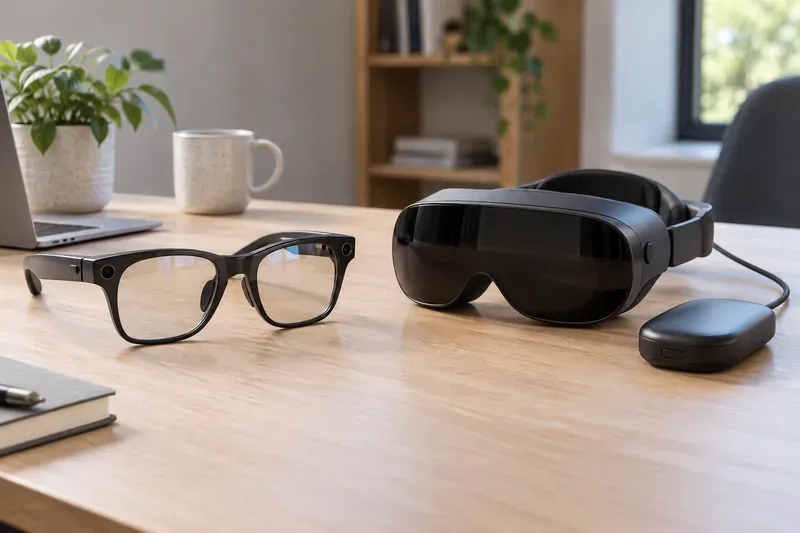
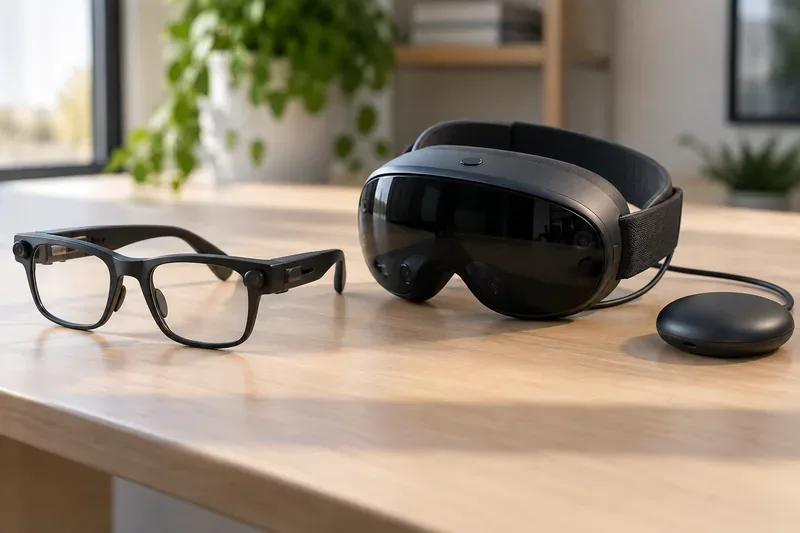
Everyday-style smart glasses sit beside a compact VR-style setup with an external compute module, illustrating why the categories can look related even though they are built for different jobs.
First, fix the biggest misunderstanding: Meta AI glasses are not the same thing as Meta VR Glasses
Meta’s AI glasses are primarily designed for hands-free help while you continue looking at the world normally. Depending on the model, they can play audio, take calls, respond to Meta AI, capture photos or video, translate conversations, and in the Display model show information in your field of view. They do not all create an immersive virtual world.
The product called Meta VR Glasses, announced at Meta Connect on September 23, 2026, is a separate device. Meta says it will use micro-OLED displays, eye and hand input, full-color passthrough, spatial audio, and an external compute-and-battery puck to deliver VR in a glasses-like form factor. It is scheduled to go on sale in spring 2027, so its launch features should be treated as announced plans rather than capabilities consumers can verify in a shipping product today. See Meta’s official Meta VR Glasses announcement.
What Meta AI glasses can do today
Ray-Ban Meta (Gen 3): camera, audio, voice AI, and hands-free capture
Ray-Ban Meta (Gen 3), announced on September 23, 2026, is the clearest example of camera-based AI glasses. Meta lists a 12-megapixel camera, 3K Ultra HD video recording, a six-microphone array, open-ear audio, a customizable action button for Meta AI, and up to nine hours of battery life. The glasses also include a capture LED intended to make people nearby aware when photos or video are being recorded.
In practical terms, this category is useful when pulling out a phone would interrupt what you are doing. You can capture a point-of-view moment, take a call, listen to audio, ask an AI question, or request information while walking. Meta also says its AI glasses can provide information such as sports scores, restaurant suggestions, and live-conversation translation. The latest lineup and specifications are described in Meta’s Connect 2026 AI glasses announcement.
Ray-Ban Meta Audio: AI and audio without a camera
Meta also announced Ray-Ban Meta Audio, a camera-free option focused on open-ear sound and hands-free AI. Meta says it weighs 43 grams and offers up to 12 hours of use on one charge, with additional charging capacity in the case. This model is aimed at people who want calls, music, podcasts, and voice access to an AI assistant without the camera hardware of the standard Ray-Ban Meta line.
That difference matters if your main goal is listening and asking questions rather than capturing what you see. It can also reduce one source of social friction in places where people may be uncomfortable around wearable cameras.
Meta Ray-Ban Display: glanceable visuals without full VR
Meta Ray-Ban Display sits between screenless AI glasses and immersive VR. It includes an in-lens display for short visual interactions rather than a display that replaces your whole field of view. Meta says the glasses can show messages, photo previews, translations, Meta AI responses, navigation, and other glanceable information. The product is paired with Meta Neural Band, an EMG wristband that turns subtle muscle activity into control commands.
Meta expanded the Display product on September 23, 2026. The company says cycling directions and real-time public-transit departures are rolling out in the United States and Canada later in September. It also announced richer calendar controls, an Explore app for glasses experiences, mirrored phone notifications that are still “coming soon,” and a WhatsApp hologram feature planned for early access in the United States later in the fall. Because several of these items are staged rollouts rather than universally available features on publication day, check Meta’s current Meta Ray-Ban Display update before relying on a specific feature.
What the new Meta VR Glasses are supposed to do
Meta is positioning its upcoming VR Glasses as a much more immersive device. The company says the glasses will weigh about 100 grams and split the hardware into two parts: the eyewear contains the displays and sensors, while a puck connected by an optical tether handles compute, battery, and storage. Meta says this approach makes the eyewear itself about five times lighter than Quest 3.
The announced display system is a 5K “Infinite Display” built on micro-OLED panels at 37 pixels per degree, with Dolby Vision support and Dolby Atmos spatial audio in the frames. Meta says users will be able to control the interface with voice, eye input, and natural hand gestures instead of needing controllers for basic operation. The external puck is rated by Meta for up to three hours of continuous high-resolution media playback and supports 45W fast charging.
Movies and immersive sports
Entertainment is one of the headline uses. Meta says the device is IMAX Enhanced certified and is being developed for 3D movies, immersive viewing environments, and live sports. The company says it plans more than 100 immersive live U.S. sports events per year after launch through partners including ESPN, MLB, NBC Sports, TNT Sports, and UFC. Those are launch plans announced by Meta; catalog size, regional rights, subscriptions, and event availability can still vary.
A private multi-screen workspace
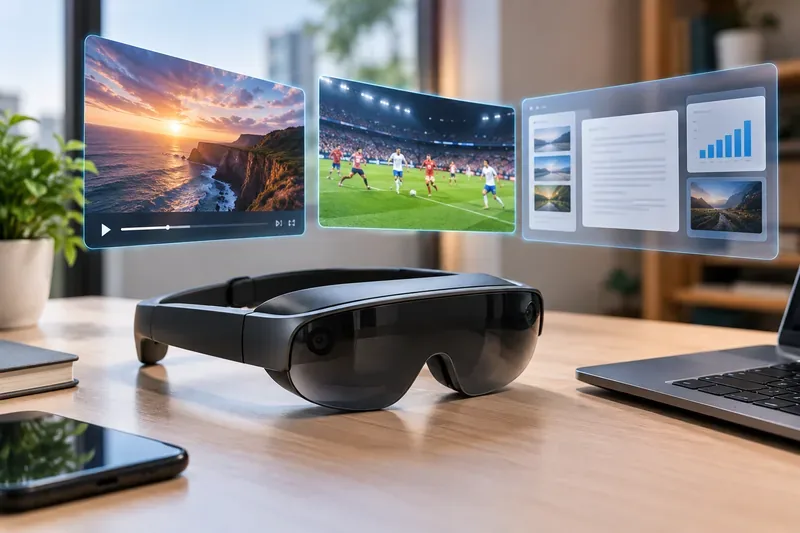
The VR Glasses are also designed to act as a portable workspace. Meta says you will be able to place one or more large virtual screens in front of you while full-color passthrough keeps your desk, phone, and surroundings visible. The company also says a flat surface can be used as a virtual keyboard and touchpad. That is a much more ambitious use than the small, glanceable display on Meta Ray-Ban Display.
Gaming and spatial calls
Meta says more than 75 games at launch will support hand-only control, with additional games available through Xbox Cloud Gaming. The company has also announced hologram calling that can place a photorealistic representation of another person in the virtual space and can present your own representation to people joining from a phone or computer. As with the rest of the product, these capabilities should be reassessed once retail hardware and launch software are available.
Where Quest 3 and Quest 3S fit right now
If you want Meta VR today rather than in 2027, the relevant products are still Quest 3 and Quest 3S. Meta’s developer documentation identifies those two as its current-generation headsets. Both are standalone VR and mixed-reality devices that support full-color passthrough and controller-free hand tracking, although Quest 3 has a higher-resolution display and a depth sensor that Quest 3S does not. Meta’s current Horizon OS hardware guide describes Quest 3 and Quest 3S as the present-generation platform.
That leads to a simple rule: if you need immersive VR now, look at Quest. If you mainly want hands-free assistance in normal eyewear, look at Meta AI glasses. If you specifically want Meta’s lighter glasses-shaped VR system, you are waiting for the spring 2027 Meta VR Glasses launch.
Quick comparison: which category matches your goal?
Product category
Best fit
What you see
Status on Sept. 24, 2026
Ray-Ban Meta (Gen 3)
Hands-free AI, calls, photos, video, audio
Normal view; no immersive screen
Available now
Ray-Ban Meta Audio
Calls, music, podcasts, voice AI without a camera
Normal view; no display
Preorder; shipping Oct. 13, 2026
Meta Ray-Ban Display
AI plus short visual prompts, navigation, captions, notifications
Small in-lens display for glanceable information
Available, with some 2026 features still rolling out
Quest 3 / Quest 3S
VR and mixed reality now
Immersive headset display with passthrough
Current-generation Quest headsets
Meta VR Glasses
Immersive cinema, workspace, gaming, spatial computing in a lighter form
Full VR with passthrough
Announced for spring 2027
How to choose without overcomplicating it
1. Start with the least immersive solution
If your problem is simply that you want quicker access to calls, audio, photos, translation, or an AI assistant, ordinary AI glasses are the simplest match. They preserve your normal view and are meant to be worn during everyday activities.
2. Add a display only if seeing information matters
If audio answers are not enough and you want directions, captions, message previews, or visual AI responses in front of you, Meta Ray-Ban Display is the relevant step up. It still does not turn your surroundings into a full virtual environment.
3. Move to Quest when immersion is the actual requirement
For games, spatial apps, virtual screens, exercise experiences, or mixed reality available today, a Quest headset is the practical Meta category. Calling camera-based smart glasses “VR glasses” can create the wrong expectation because they are not designed to surround your vision with virtual content.
4. Wait for Meta VR Glasses only if their specific form factor solves a real problem
The upcoming Meta VR Glasses are most interesting if headset weight, long-session comfort, portable multi-screen work, or a glasses-like VR form is the deciding factor. The tradeoff is that you are considering a product that is not scheduled to ship until spring 2027 and uses a tethered compute puck. Meta announced a U.S. price of $1,299.99.
Important limits before you buy
Feature availability changes by region and language. Translation, navigation, AI services, linked apps, and staged software updates do not necessarily appear everywhere at the same time. Meta’s AI glasses translation guide notes that model and country availability differ.
Future features are not the same as shipping features. Meta VR Glasses are a 2027 product, and several Display updates announced in September 2026 are still rolling out or labeled as coming soon.
Wearable cameras require judgment. The Ray-Ban Meta (Gen 3) capture LED is designed to signal recording, but you still need to respect local rules and the expectations of people around you.
Battery claims describe specific usage conditions. Meta’s stated numbers for AI glasses and the VR Glasses puck are not guarantees for every workload, network condition, recording session, or app.
Immersive and everyday eyewear solve different problems. A lighter frame does not automatically make an AI-glasses product suitable for VR, and a VR device is not automatically convenient for all-day ordinary eyewear use.
Self-check: did you end up in the right category?
Before spending money, test your choice against these five questions. If your answers no longer match the product category, change direction before buying.
Do I need to stay visually present in the real world most of the time? If yes, start with AI glasses.
Do I need information displayed in front of my eye, not just spoken to me? If yes, consider a display-equipped AI-glasses model.
Do I want virtual environments, large floating screens, or immersive games? If yes, I need a VR or mixed-reality device rather than standard smart glasses.
Do I need the product in 2026? If yes, the announced Meta VR Glasses are not yet the answer.
Have I checked the exact feature, country availability, price, and rollout status on Meta’s official page on the day I buy? If no, verify those details first.
For most shoppers, the confusion disappears once “glasses” is separated from “VR.” Meta AI glasses are designed to add intelligence, audio, capture, and sometimes glanceable visuals to ordinary life. Quest is Meta’s immersive option today. Meta VR Glasses are the company’s attempt to bring that immersion into a much lighter glasses-style device in 2027.