Home
» Technology
»
Scaling CCUS: Can Carbon Capture Really Reverse Global Emissions?
Scaling CCUS: Can Carbon Capture Really Reverse Global Emissions?
Carbon capture, utilization, and storage is entering a more consequential phase. In March 2026, the International Energy Agency (IEA) reported that more than 30 CCUS projects had reached final investment decisions in the previous two years and that annual investment had risen more than fifteenfold since 2020, to more than $5 billion in 2025. The newest IEA project update also found that capture capacity already operating or under construction was more than 10% higher than in the prior annual update. At the same time, the broader climate picture moved in the wrong direction: the IEA's Global Energy Review 2026 estimated that global energy-related CO2 emissions rose about 0.4% in 2025 to a record of nearly 38.4 billion metric tons.
That contrast is the central issue for CCUS today. The technology is advancing, financing structures are becoming more mature, and shared transport-and-storage networks are beginning to operate. Yet the global emissions system is vastly larger than the carbon currently being captured. The practical question is therefore not whether CCUS “works” in a laboratory sense. It is whether it can scale fast enough, in the right sectors, with verifiable storage and acceptable lifecycle emissions, to make a meaningful contribution to climate stabilization.
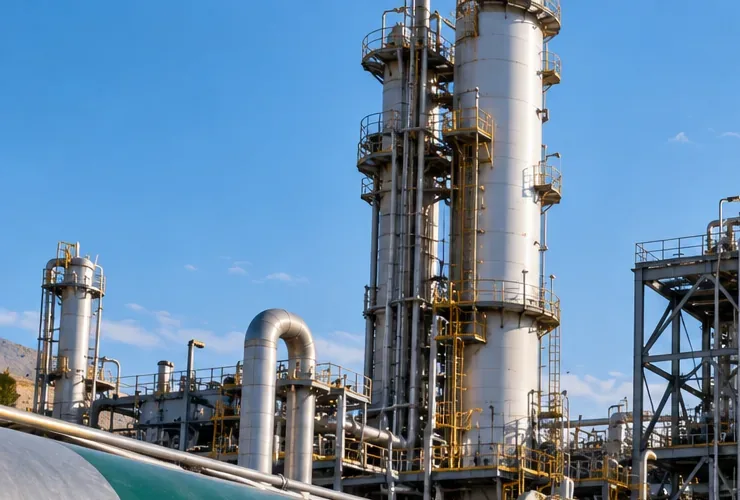
Industrial processing towers and interconnected pipelines illustrate the physical scale of capture equipment that must ultimately be linked to CO2 transport and permanent storage infrastructure.
First, What Does “Reverse Global Emissions” Actually Mean?
The phrase can hide an important distinction. Conventional carbon capture at a fossil-fuel or industrial source can prevent some CO2 from reaching the atmosphere. That is an emissions-reduction technology. It does not, by itself, remove CO2 that is already in the atmosphere.
The Intergovernmental Panel on Climate Change (IPCC) makes this distinction explicit. Its AR6 assessment of carbon dioxide removal states that CCS or carbon utilization applied to fossil CO2 is not carbon dioxide removal, because the carbon did not come from the atmosphere. By contrast, direct air carbon capture and storage (DACCS) and bioenergy with carbon capture and storage (BECCS) can count as carbon dioxide removal when atmospheric or biogenic carbon is captured and then stored durably.
So there are really three different climate outcomes:
Avoided emissions: a factory or power plant emits less CO2 because a portion is captured and permanently stored.
Net-zero balance: residual emissions that remain after deep reductions are counterbalanced by durable carbon dioxide removal.
Net-negative emissions: durable removals exceed remaining emissions, causing the total human-caused CO2 flow to the atmosphere to become negative. Sustained net-negative emissions can reduce atmospheric CO2 concentrations over time.
CCUS can contribute to all three outcomes, but only some forms of it can create the third. That is why saying “carbon capture can reverse emissions” without specifying the carbon source and storage permanence is misleading.
The 2026 Update: Real Momentum, but Not Yet a Global-Scale Solution
The latest verified development is encouraging but mixed. The IEA's March 2026 report, Financing CCUS at Scale, describes a larger and more geographically diverse investment wave than in previous years. It reports more than 70 large-scale capture facilities in operation and more than 9,000 kilometers of CO2 pipelines. Projects already under construction could nearly double operational capture capacity by 2030.
There are also signs that infrastructure is becoming less theoretical. The IEA's March 27, 2026 project update noted that the world's first dedicated CO2 storage hub began operating in Norway in 2025, while major projects were commissioned in China and North America and construction started in eight countries.
But those developments do not erase the deployment gap. The same IEA financing report says roughly 90% of CCUS projects announced for 2035 had not yet reached a final investment decision. Some planned projects have been canceled or withdrawn when financing, transport availability, storage access, or long-term revenue proved too uncertain. In other words, announced capacity is not the same as operating capacity.
Where CCUS Has the Strongest Climate Case
Cement and other process-emissions industries
Cement is one of the clearest applications because a large share of its CO2 is released by the chemistry of converting limestone into clinker, not simply by burning fuel. Switching the kiln to clean electricity or low-carbon fuel therefore cannot eliminate all process emissions. The IPCC's Working Group III Summary for Policymakers identifies CCS as an important mitigation option for large industrial sources where suitable geological storage is available.
That does not make every cement CCS project automatically beneficial. The result still depends on the capture system's actual performance, the energy required to run it, upstream emissions from that energy, transport losses, and secure long-term storage. But the underlying need is easier to justify than in applications where mature zero-carbon alternatives already exist.
Hydrogen, chemicals, steel, and selected power systems
CCUS can also reduce emissions in hydrogen production, chemicals, some steelmaking routes, refining, and dispatchable power. The quality of the climate case varies by location. A gas power plant with CCS, for example, should be compared with feasible alternatives such as renewables, storage, transmission, demand flexibility, nuclear power, or combinations of those resources. The relevant metric is not simply “percent captured at the stack,” but lifecycle emissions per unit of useful output.
This distinction matters because capture equipment consumes energy. A plant can report a high capture rate while still having meaningful residual emissions or additional upstream emissions. Good project evaluation therefore asks how much CO2 is avoided across the whole system, not just how much is separated inside the capture unit.
DACCS and BECCS for genuine carbon removal
If the goal is to move beyond net zero toward net-negative emissions, point-source fossil CCS is insufficient. The removal side of the portfolio must capture carbon that came from the atmosphere and store it durably. DACCS does this directly. BECCS can do it indirectly when biomass has absorbed atmospheric CO2 and the resulting carbon is captured during conversion or combustion.
The IPCC concludes that carbon dioxide removal is needed to counterbalance hard-to-abate residual emissions in pathways that reach net zero, while also warning that removal cannot substitute for immediate and deep emissions reductions. This is a crucial guardrail. The more gross emissions are reduced, the smaller and more manageable the removal burden becomes.
Why Scaling CCUS Is Harder Than Installing Capture Equipment
The system is a chain, and every link must arrive on time
A full CCUS project needs capture equipment, compression, transport, an injection site, subsurface characterization, monitoring, permits, commercial contracts, and long-term liability arrangements. A capture plant can be technically ready and still sit idle if a pipeline or storage permit is delayed. A storage operator can face the opposite problem: expensive injection capacity with too few committed customers.
This “cross-chain” risk is one reason the latest IEA financing work emphasizes hubs and shared infrastructure. A common pipeline and storage network can serve multiple emitters, spread fixed costs, and make smaller industrial facilities more viable. It can also create a coordination challenge: contracts must specify who pays when one part of the network is unavailable.
Storage must be characterized, monitored, and governed
Deep geologic storage is not simply a matter of pumping CO2 underground. Site selection and regulation must address injectivity, pressure, old wells, faults, groundwater protection, monitoring, closure, and financial responsibility. In the United States, for example, the Environmental Protection Agency's Class VI program for geologic sequestration wells requires site characterization, plume and pressure modeling, well-integrity controls, ongoing monitoring, post-injection care, emergency planning, and financial assurance.
The broader lesson applies internationally: theoretical storage capacity is not the same as permitted, characterized, financeable storage. Scaling CCUS requires converting geological potential into specific injection sites with verified capacity and long-term stewardship.
CO2 utilization is not automatically permanent storage
The “U” in CCUS covers many uses of captured carbon. Some products, such as certain mineralized building materials, may store carbon for long periods. Other uses can return the CO2 to the atmosphere relatively quickly. Synthetic fuels are an obvious example: their carbon is generally released when the fuel is burned.
Utilization can still be useful if a rigorous lifecycle analysis shows that it displaces a more carbon-intensive product or process. But using captured CO2 is not equivalent to permanent sequestration, and it should not be counted as durable removal unless the carbon stays stored on a climate-relevant timescale.
How to Judge Whether a CCUS Project Is Actually Delivering
Question
Why it matters
What strong evidence looks like
What is the CO2 source?
Determines whether the project avoids new emissions or can qualify as carbon removal.
Clear accounting that distinguishes fossil, biogenic, and atmospheric CO2.
How much CO2 is avoided on a lifecycle basis?
Stack capture rate alone can overstate climate benefit.
Energy use, upstream emissions, transport, residual emissions, and storage are all included.
Where does the carbon go?
Utilization and storage have very different durability.
Verified geologic storage or a product with demonstrably durable carbon retention.
Is storage capacity actually permitted and available?
Announced storage resources do not guarantee operational injection capacity.
Characterized formations, permits, injection wells, monitoring plans, and contracted access.
Is performance measured after startup?
Design specifications are not the same as real-world operation.
Transparent operating data covering capture, downtime, energy penalty, transport, injection, and leakage monitoring.
Would a cleaner alternative be cheaper or faster?
CCUS should compete with other ways to eliminate the same emissions.
A sector-specific comparison using cost, timing, reliability, land, infrastructure, and lifecycle emissions.
What Would Successful Scale-Up Look Like by 2030?
The most useful indicator is not the number of announcements. It is the conversion of projects into operating systems that capture, transport, inject, and verify CO2 year after year. Several signals would show that the sector is moving from demonstration toward durable scale:
More announced projects reaching final investment decision rather than being repeatedly delayed.
Capture capacity growing in cement, steel, chemicals, and other hard-to-abate sectors, not only in relatively easy, high-purity CO2 streams.
Shared transport and storage hubs filling with multiple customers instead of remaining underused.
Storage permitting and monitoring systems producing credible, public evidence of containment and pressure management.
Lower capital and operating costs without sacrificing capture performance or environmental safeguards.
Clear separation in climate accounting between avoided fossil emissions and true atmospheric carbon removal.
Not on its own, and conventional point-source CCUS does not “reverse” emissions in the strict sense. Its primary role is to stop part of an emissions stream from entering the atmosphere, especially where alternatives are limited. That can be highly valuable for sectors such as cement and selected heavy industries.
To make global annual CO2 emissions net negative, the world would need durable carbon dioxide removal at a scale greater than the residual emissions left after aggressive direct reductions. DACCS, BECCS, and other removal methods can contribute to that task, but their sustainable scale, cost, energy needs, land requirements, and infrastructure remain major constraints.
The most defensible interpretation of the 2026 evidence is therefore neither “CCUS will save the climate” nor “CCUS is irrelevant.” Investment and project execution are clearly improving, and the technology can address emissions that are otherwise difficult to eliminate. But the current global emissions total remains enormous, most announced future CCUS projects are not yet financed to construction, and carbon removal cannot safely be treated as a license to postpone reductions elsewhere.
CCUS is best viewed as a specialized part of a broader decarbonization system: reduce emissions wherever practical, capture difficult industrial emissions where the full lifecycle case is strong, build regulated transport and storage infrastructure, and reserve durable removal for residual emissions and eventual net-negative goals. If those pieces scale together, CCUS can materially improve the odds of reaching net zero. If they do not, headline capture capacity alone will not reverse the global carbon trend.